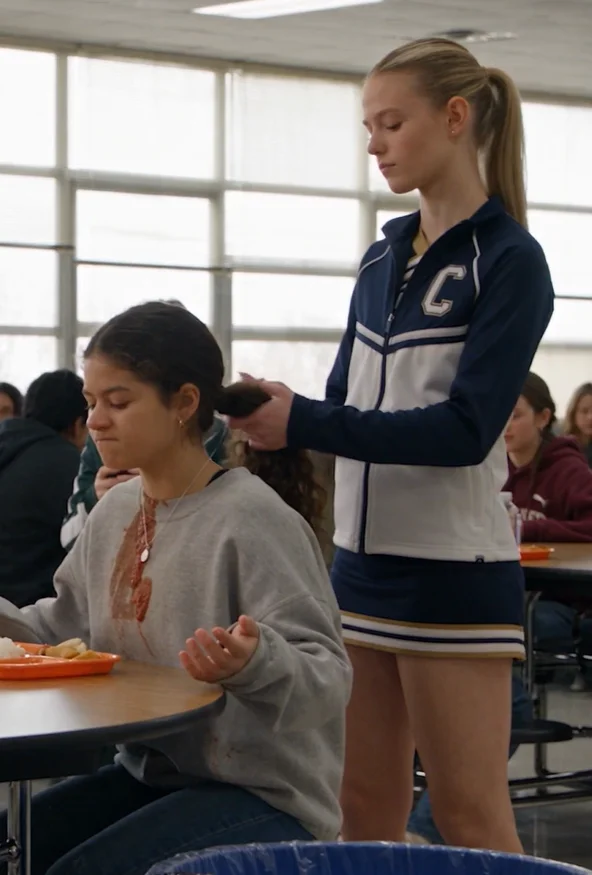
I swallowed. “It won’t matter. Her dad’s on the board.”
He leaned back in his chair. “Maybe. Maybe not. But if you hand people vagueness, they can bend it. If you hand them facts, dates, witnesses, and your own self-control, you make bending harder.”
I thought of Peyton’s fingers catching only air and of the weird shock on her face when I didn’t collapse.
“What if none of them care?” I asked.
“Then you learn exactly who they are,” he said. “And you keep standing anyway.”
Practice that night was brutal in the best way. Sprints, sprawls, hand fighting, pummeling. Every time my anger tried to rise into my throat, the drills pushed it down into my legs and lungs where it could become something useful. By the end my muscles shook and my mind felt almost clear.
When most of the other wrestlers headed for the locker room, Coach Reed had me stay on the edge of the mat and run one more sequence with him. He circled lightly and said, “Again. Show me exactly what you did.”
I demonstrated the movement in pieces—bench at my calves, weight dropping, left foot planting, hips turning, right shoulder opening. He watched my feet more than my hands.
“Good,” he said when I finished. “You didn’t run. You didn’t freeze. You made space.”
“It didn’t feel good.”
“It wasn’t supposed to. Self-control is not a magic trick. It’s usually uncomfortable and occasionally lonely.”
I wrapped and unwrapped the athletic tape around my wrist. “People keep acting like if I had just ignored it better, maybe it would have stopped.”
Coach Reed’s expression hardened. “Predators like rehearsal. Every unchallenged act teaches them the room is theirs. That does not make the target responsible. It means adults should have intervened sooner.”
He wasn’t a school administrator. He didn’t talk in official language. Sometimes that made his words land harder.
“Then why does it feel like I’m the one who has to prove everything?” I asked.
“Because truth often arrives carrying a burden the lie never had to lift.” He pointed at my legal-pad statement. “That’s why you document. Not because it’s fair. Because it’s necessary.”
I nodded, even though my chest hurt with the unfairness of it.
At home, Grandma Dee read Brooks’s voicemail on our old phone before I could explain. She listened to me in the kitchen with both hands wrapped around a mug of tea gone cold.
“They called it a disagreement?” she asked finally.
I nodded.
She took off her reading glasses and set them on the table. “Tomorrow morning, I’m asking for a meeting with the counselor.”
I looked at her lined face, at the stubborn set of her jaw that I had inherited. “It won’t do anything.”
“Maybe not the first time,” she said. “But I didn’t raise you to hand over truth because somebody richer sounds more official.”
I went to my room and opened the bottom drawer of my dresser. Under my socks sat a marble notebook with a blue cover. Fifty-seven lunches had not all gone exactly the same way, but most of them had rhymed. I had started writing them down on day twelve, after chocolate milk soaked my backpack and Mr. Henderson told me maybe I should stop reacting so visibly.
At first the notebook had been mostly practical. Date. Food. Who was there. I think some part of me believed that if I got the facts down, the next adult I showed would say, of course this is a pattern, of course we’ll stop it. When that didn’t happen, the notebook became something else: a place where the day couldn’t be softened after the fact. On a page from late September I had written, moved tables today. they followed. On one from October: thought if I laughed maybe they’d quit. they laughed harder. Some entries were so brief they looked almost silly until you understood what I was preserving against.
Each page had a date. A table. A description. Sometimes a witness. Sometimes just a stain and the feeling of everybody watching.
I carried the notebook back to the kitchen and set it in front of Grandma Dee.
Her hand covered her mouth as she flipped through it. “Baby.”
“I didn’t think anybody would care.”
She lifted her eyes to mine. “I care. And tomorrow somebody else is going to, too.”
I wanted to believe her. I really did. But when I lay in bed that night, the sentence from the office kept replaying in my head: from both sides. It sounded neat enough to fit on a form. It sounded tidy enough to erase me.
I slept with my repaired-not-yet-repaired locket under my pillow, and the next morning I walked into school knowing the hardest part of lunch was over.
The harder part was that now the adults had started writing the story.
The first rumor I heard Wednesday morning was that I had nearly punched Peyton in the cafeteria.
The second was worse: that Peyton had only touched me because I went crazy when somebody joked about my dead mother.
Rumors move differently in middle school than they do anywhere else. Adults talk about lies spreading like wildfire, but wildfire at least obeys wind and terrain. Rumors move like ants under floorboards—silent until they show up everywhere at once.
By first period English, three kids had already looked at me with that mixture of fascination and caution people use when they want drama close enough to enjoy but not close enough to stain them. One girl from homeroom whom I barely knew actually asked, “Did you really almost slam Peyton?” like it was a compliment.
“No,” I said.
She seemed disappointed.
Grandma Dee had emailed the school before seven asking for a meeting with the guidance counselor. We didn’t get Vice Principal Brooks again. Instead we were given Ms. Carla Diaz during my study hall, which felt like a miracle so small I didn’t trust it at first.





