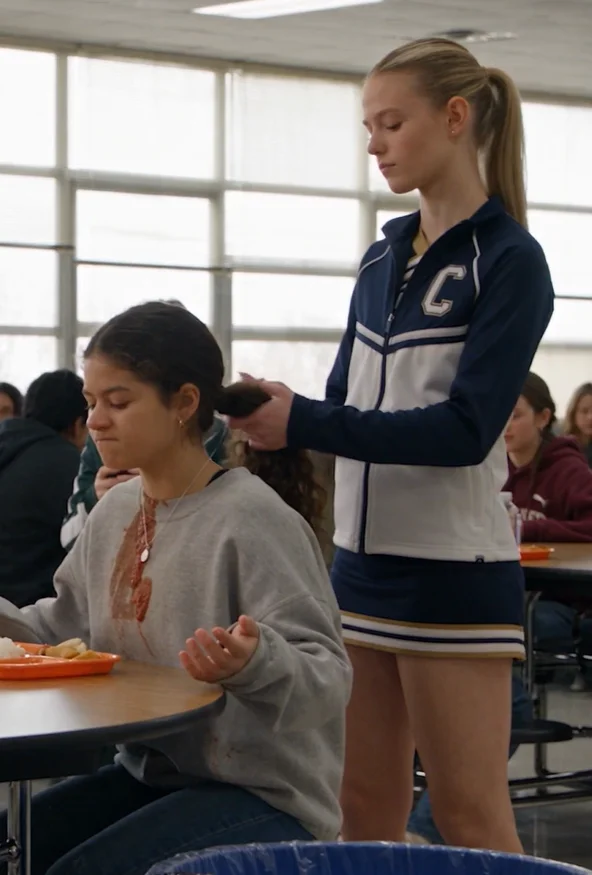
I walked away without looking back, my pulse hammering. By the time I reached the parking lot doors, my hands were shaking so badly I had to stop and press them flat against the cool glass. Ms. Diaz found me there two minutes later on her way to an after-school meeting. She took one look at my face and said, “Did she approach you?”
I nodded.
Ms. Diaz’s mouth tightened. “Tell me exactly what was said.”
I did. Every word. She wrote it down on the spot. Another little lesson in how institutions work: the moments that feel most private are often the ones that need the clearest record.
“You did the right thing by walking away,” she said when I finished.
“I keep doing the right thing,” I said, surprising myself with the bitterness in my voice.
“I know,” she answered quietly. “And that should have cost you less.”
That was maybe the kindest sentence any adult at school had spoken to me all semester.
That encounter didn’t make me feel sorry for her. It did something more useful. It made her smaller. Not harmless. Not innocent. Just smaller than the monster my fear had sometimes made of her.
The final review meeting was scheduled for Friday morning.
That night I set out my clothes twice and changed my mind twice more. It felt ridiculous, but clothing is one of the few things you can still control when a room full of adults is about to judge a week of your life. I finally chose the clean hoodie and jeans because they felt most like me. Not polished. Not pitiful. Just mine. Then I slipped my notebook into my backpack, though Ms. Diaz already had copies. Carrying it made me feel less empty-handed.
Grandma Dee knocked softly on my door after ten. She sat on the edge of my bed and, for a while, neither of us said anything. Then she told me a story I had heard only pieces of before—about my mother at thirteen, standing up to a choir director who kept sticking the shy girls in the back row because they were less trouble there. “Your mama went home furious, typed a whole letter on a borrowed typewriter, and made me drive her back to the church to hand it in,” Grandma Dee said. “She cried the whole car ride. Then she walked in anyway.”
I smiled into my pillow. “Did it work?”
“Eventually. Which is another way of saying after too much effort. Runs in the family.”
When she left, I slept better than I had in days. Not because I expected mercy. Because I remembered I came from women who kept showing up in rooms that hoped they wouldn’t.
This time, I knew the truth would be in the room.
I just needed to see what the adults would do with it.
Friday began with frost silvering the grass outside the school and my stomach tied in four separate knots.
I barely touched breakfast. Grandma Dee made toast anyway and stood at the stove watching me like she could will steadiness into my body by proximity alone. Before we left, she reached out and smoothed a wrinkle from my sleeve the way she used to when I was little and heading into a spelling bee. “No matter what happens in that room,” she said, “you are not the child who should be ashamed today.”
I carried the jeweler’s estimate in a manila envelope. The locket itself sat warm in my jeans pocket. We had left it overnight for cleaning and repair, and the jeweler had called first thing in the morning to say she could finish the clasp by the end of the day if we wanted to pick it up after school. That timing felt like an omen, though I did not say so out loud.
Grandma Dee and I arrived five minutes early for the final review. Principal Morgan’s conference room was set more formally this time, with folders at each chair and a copy of the student conduct code stacked near the tissues. Ms. Diaz was present again. So was Vice Principal Brooks, looking even stiffer than before.
Peyton was there with her father.
Russell Vance wore a navy suit and the expression of a man who had spent his life entering rooms expecting them to tilt in his favor. He was broad-shouldered, silver at the temples, and careful with his voice in the way adults are when they want to sound reasonable while applying pressure. Peyton sat beside him in a cream sweater, her blond ponytail tight, her mouth set like a bruise.
Brooke and Tessa were not present. Nora was not present. Their statements, I assumed, had already been folded into the stack of paperwork on Morgan’s table.
Morgan opened the meeting without preamble. “Thank you for attending. This conference concerns the harassment review arising from the November fourteenth cafeteria incident and the prior pattern allegations. We have completed witness interviews, reviewed available video, and examined the initial administrative summary.”
Russell Vance smiled thinly. “And we’re hopeful the school will be fair to all students involved.”
Something in the phrase all students involved tried to pull the room backward into false balance. Morgan did not let it.
“That is the intent,” she said. “Fairness requires accuracy.”
She turned first to me. “Maya, you may submit any final information.”
I placed the estimate on the table. My fingers wanted to shake. I made them stay still.
“This is the repair estimate for my mother’s locket and chain,” I said. “And I want to repeat that I never touched Peyton during the incident. I asked for help and gave the school the notebook because Friday wasn’t a single bad lunch. It was fifty-seven.”
Morgan accepted the estimate and nodded. “Thank you.”
Russell Vance leaned back in his chair. “With respect, we continue to dispute the dramatic inflation of that number.”
I looked at him. “You think I counted wrong?”





