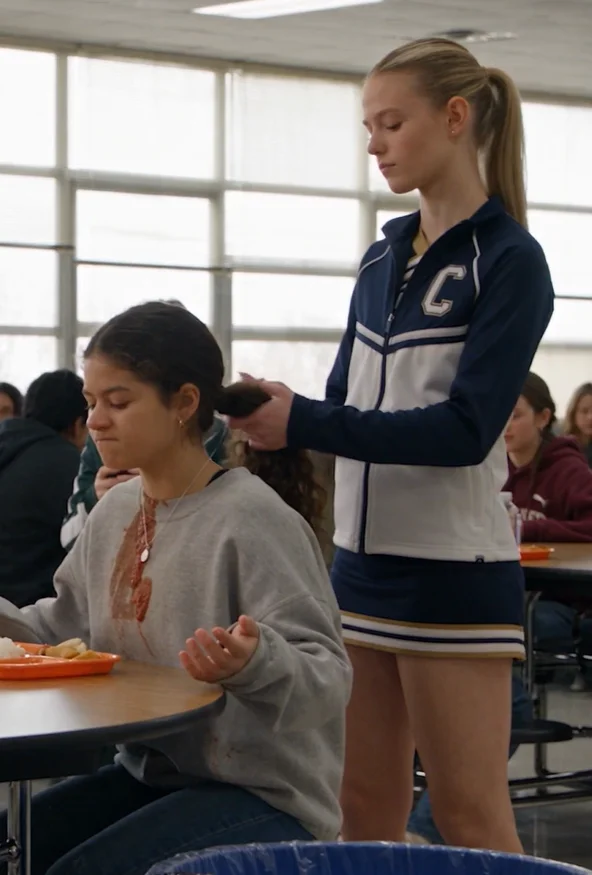
Yes, I thought. I wished to add a thousand things. Instead I said, “I did exactly what adults always say to do. I did not hit her. I did not threaten her. I asked for help. If I lose practice over that, then the rule is really don’t get bullied where anyone important can be inconvenienced.”
The room went still.
Ms. Diaz looked up sharply. Grandma Dee’s hand found my knee under the table.
Principal Morgan let the silence sit. “Understood,” she said finally.
She dismissed us for ten minutes while she consulted privately with Ms. Diaz and Brooks. Grandma Dee and I waited in the hallway outside the conference room. Students moved past toward first period, blissfully unaware that my entire week felt balanced on a door with frosted glass.
“You did good,” Grandma Dee whispered.
“I feel like I’m going to throw up.”
“That can also happen while you’re doing good.”
When they called us back in, Morgan’s expression had shifted from cautious to resolved.
“I am rescinding the provisional practice restriction effective immediately,” she said. “You are cleared for all normal school activities.”
Relief hit so fast it almost made me dizzy.
“Further,” she continued, “the incident record will be amended to reflect that Peyton Vance initiated the physical contact and the property damage to your necklace. The prior characterization of mutual escalation is being withdrawn.”
Grandma Dee closed her eyes for a second. I gripped the edge of my chair.
But Morgan wasn’t finished.
“Because the review is still formally open as to repeated conduct and appropriate consequences, I am not discussing all outcomes at this moment. However, immediate separation measures are being implemented. You will have monitored seating options, and Peyton is not to approach you at lunch, in the hallway, or before activities. Staff have been notified.”
Not full justice. Not yet. But the lie at the center of the week had been cut open.
After the meeting, Ms. Diaz walked us out and said quietly, “There will be a separate family conference this afternoon. Your notebook mattered. So did your consistency.”
I thought of all the times adults had treated consistency as a personality trait instead of a survival tool.
In wrestling practice that afternoon, I moved like somebody had taken ten pounds off my shoulders. Coach Reed watched me finish a live round and gave only a small nod, which from him was practically a parade.
Afterward he said, “Paper corrected?”
“Practice restriction’s gone. Incident report’s being amended.”
“Good.”
“That’s it? Good?”
He raised an eyebrow. “Would you prefer I cartwheel?”
I laughed for the first time in what felt like weeks.
Then his expression softened. “I am proud of you, Maya. Not because you suffered well. Because you told the truth precisely under pressure.”
That distinction lodged deep.
The family conference with the Vances happened without me, but not without effect. By Wednesday morning, everyone at school knew something significant had gone down. Peyton was absent. Brooke looked panicked. Nora sat at a table near the library with two girls from band instead of the cheer crew.
Ms. Diaz called me in after lunch.
“Your grandmother can join by phone if you’d like,” she said.
I nodded.
Once Grandma Dee was on speaker, Ms. Diaz explained the next steps. Principal Morgan had recommended a defined suspension for Peyton based on the video, witness statements, and repeated harassment pattern. The district would also review staff response failures, including the accuracy of initial incident documentation.
My head lifted. “Staff response failures?”
“Yes.” Ms. Diaz met my eyes. “That includes duty-of-care expectations.”
Which meant Henderson. Brooks. Maybe others.
The second part nearly made me stop breathing.
“Additionally,” she said, “the school intends to request restitution for the locket repair through the family conference process, provided you submit the estimate.”
I thought of the jeweler’s careful fingers, the strengthened clasp, my mother’s photo protected inside the tiny silver oval. “We have one.”
“Bring it tomorrow.”
When I got home, I almost allowed myself to think the ending had arrived.
It hadn’t.
Because Thursday afternoon, right as I was leaving algebra, Peyton stepped out from an empty classroom and blocked my path.
She wasn’t supposed to. Separation measures were already in effect.
For one startled second I looked up and down the hall for an adult, but the last bell had just rung and the corridor was noisy in that directionless way schools get at day’s end.
Peyton’s eyes were red-rimmed, whether from anger or crying I couldn’t tell. “You happy now?” she asked.
I tightened my grip on my backpack straps. “Move.”
“My dad says you made this bigger than it had to be.”
“He should tell you not to throw dead people’s jewelry in trash.”
Her face twisted. “You think you won? You think one video makes you some hero?”
“I don’t want to be a hero.” I kept my voice even. “I wanted you to stop.”
For a second she just stared at me. Then she said something I didn’t expect.
“I said that stuff because you never reacted.”
The hallway noise seemed to dim around us. “What?”
“You always sat there like you were above everything.” Her voice sharpened. “Like none of us mattered.”
I looked at her and understood something ugly and ordinary at once: she had built a whole story in her head where my silence was an insult to her. Not pain. Not grief. Not trying to survive. Just disrespect.
“I wasn’t above you,” I said. “I was trying to get through lunch.”
Her mouth trembled once, quickly enough that I almost imagined it. Then she moved aside and said, “Whatever.”





