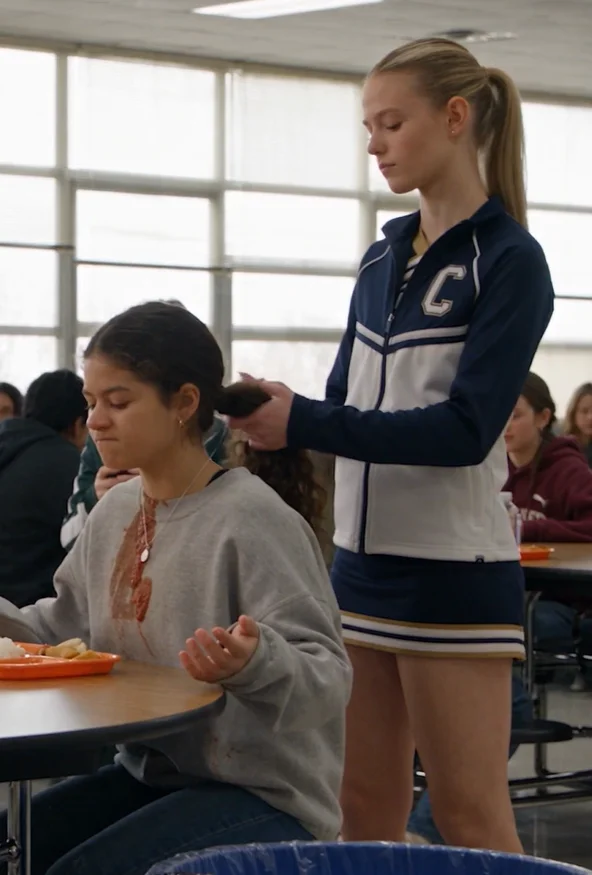
I didn’t sit in my corner spot that day. Ms. Diaz had arranged for me to eat in the guidance office if I wanted, but I refused. Not because I was brave exactly. Because I was tired of disappearing from rooms where other people behaved badly.
So I carried my tray into the cafeteria with Eli walking beside me and sat two tables closer to the center under Mr. Finch’s line of sight. My repaired chain was not back from the jeweler—because there was no jeweler yet—but the locket sat in the pocket of my hoodie. I touched it every few seconds without meaning to.
“You don’t have to talk the whole time,” Eli said as he sat across from me. “I know I’m not exactly calming.”
That almost made me smile. “You’re doing fine.”
He peeled back the lid on his applesauce. “Just so you know, I would have said something sooner if I’d known it was this bad.”
I looked at him. Most people apologize because they want relief. Eli sounded like he wanted accuracy. “You did say something on Friday.”
“Yeah, but that was after everybody had a front-row seat.” He shrugged unhappily. “There were other times. I laughed once, I think. Not because it was funny. Because everyone else was. I keep thinking about that.”
I hadn’t expected a confession at lunch. “Middle school would be shorter if people stopped pretending laughter is neutral.”
“Can I put that on a T-shirt?”
“Only if I get royalties.”
The exchange loosened something in my chest. Not much. But enough.
Peyton entered five minutes later with her usual orbit. She slowed when she saw me at the new table. Her eyes moved from me to Eli to Mr. Finch behind the serving line. She smiled, but it looked practiced.
“Aw,” she said as she passed. “You brought protection.”
Eli almost stood up. I shook my head before he could.
My heart thudded through the whole lunch, but Peyton didn’t spill anything. She didn’t need to. By fourth period, somebody had posted a twelve-second crop from Nora’s video to a private class group chat, and by the time a friend of a friend showed it to Eli on his phone in the hallway, the version spreading around school began halfway through the scene.
In the crop, all you saw was me rising from the bench fast, Peyton pitching sideways, and a lot of kids making noise. No chain snap. No locket falling into slop. No shove. No hands open at my sides.
The clip ended before Peyton lunged again.
“That’s filthy,” Eli said.
“Can you send it to me?” I asked.
He looked guilty. “It disappears after an hour in the chat.”
We watched it twice. The first time, I felt the room tilt. The second time, I forced myself to study it like Coach Reed would study film at practice. What did it show? What did it leave out? How easy would it be for an adult already leaning toward mutual disagreement to call that proof?
Too easy.
Nora passed me in the corridor before science. She slowed without quite stopping.
“I didn’t post that,” she said.
I turned. “But it’s your video.”
Her cheeks went red. “I know. Brooke took my phone for like two minutes on the bus yesterday. I didn’t think…” She trailed off. “I didn’t think she’d send it anywhere.”
I had a dozen answers for that, none of them useful. So I asked the only one that mattered. “Do you still have the full version?”
Nora’s mouth tightened. “Yeah.”
“Will you give it to Ms. Diaz?”
She looked over her shoulder as if Peyton might materialize from the lockers. “I don’t know.”
“You were filming when she threw my mom’s locket into a slop barrel.” I kept my voice low, but I didn’t soften it. “You heard what she said.”
“I know what I heard.”
“Then why are you protecting her?”
Nora flinched like I had touched a bruise. “Because nobody at this school likes becoming the next story.”
That answer stayed with me the rest of the day because it was honest in a way most people weren’t brave enough to be. Peyton got away with things partly because she was mean, partly because her father had power, and mostly because everybody understood the basic economy of our school: if she could do it to me in public for fifty-seven days, she could do smaller versions to anybody who crossed her.
In art class, I stared at a half-finished still-life sketch of a ceramic pitcher and three pears while Mrs. Levin talked about shading. The pitcher sat under a lamp so bright every contour looked obvious. I kept thinking that people imagine truth works the same way. Put enough light on it and everyone sees the same shape. But human beings aren’t bowls or fruit. They decide what part of a scene serves them and call the rest blurry. By the time the bell rang, I had shaded the pears dark enough to look bruised.
After wrestling practice, Coach Reed drove me and two other girls from the club to the local diner for fries because one of them had won a weekend tournament. When the others got dropped off, I told him about the cropped video.
He nodded grimly. “Context is what cowards cut first.”
I smiled despite myself. “Do retired Army sergeants talk like fortune cookies on purpose?”
“Only when the child in the passenger seat is trying not to throw a fit.”
“I’m not trying not to throw a fit.”
“You are. You’re doing a fine job.”
I looked out the window at the wet streets sliding past under November streetlights. “What if Nora never hands it over?”
“Then you keep building with what you have.”
“What if what I have isn’t enough?”





