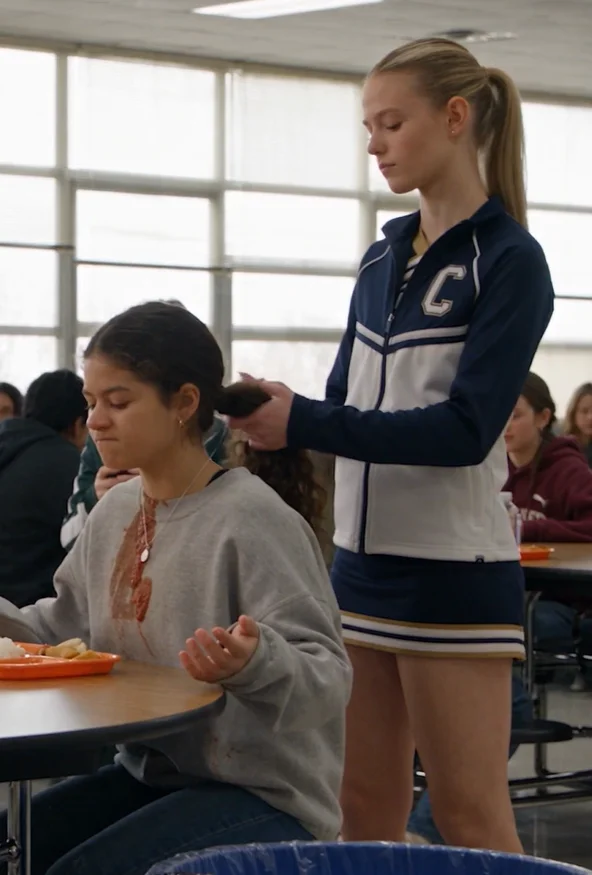
I turned toward the nearest adult who wasn’t pretending not to exist. Luis Finch, one of the cafeteria workers, had emerged from behind the dish return. He was a short man in a hairnet and gloves, maybe in his forties, with a face that always looked worried even on normal days.
“Mr. Finch,” I said, still loud enough for the people around us to hear. “My necklace is in there. Can you help me get it out?”
He looked at Peyton, then at Vice Principal Brooks, then back to me. For a second I saw the old pattern in him—the part where adults checked which child had power before deciding what kind of courage they could afford.
Then something on my face or maybe something in the room changed his mind.
“Yes,” he said. “Yes, I can.”
He went for the long rubber gloves kept under the return station.
Peyton scoffed. “You’re really making a big deal over junk.”
That did it. Not for me. For the room.
There was a wave of sound from the students who had been watching. Not loud, not organized, but different from before. Disturbed. Uncomfortable. A murmur sliding through table after table. I saw Brooke lower her phone. Tessa’s smile was gone. Even Nora’s camera drifted down an inch.
Vice Principal Brooks finally walked toward us in careful, professional steps, as if she had only just become aware that anything unusual was happening.
“What seems to be the problem here?” she asked.
I stared at her. She had been twenty feet away when Peyton snapped my chain. She had looked directly at us when the locket hit the barrel. I knew because I had looked for help and found her eyes on mine for half a second before she turned to the mustard pump.
“She took my necklace and threw it into the slop,” I said.
Brooks glanced at Peyton first. Of course she did.
Peyton crossed her arms. “She’s being dramatic. We were messing around.”
“Were you messing around when you poured food on her?” Eli Torres called from the next table over.
Every head turned toward him.
Eli was one of the few kids who ever sat near my corner table on purpose. He wasn’t exactly my friend then, but he was a decent seventh grader with braces, dark curls that always stuck up in the back, and a habit of blurting out the truth before social survival had a chance to stop him.
Peyton’s eyes narrowed. “Mind your business, Eli.”
“He is minding it,” I said, before I could think better of it. “He’s sitting in it.”
A few kids made startled little sounds that might have been laughs. Peyton flushed.
Mr. Finch pulled the slop barrel closer, grimacing as he reached into it with the long gloves. Noodles clung to the plastic. The whole cafeteria had gone nearly silent now, but not the kind promised by the headline in someone’s dramatic version of my life. It was the silence that comes when a crowd realizes something has gone farther than entertainment and they don’t know whether they’re ashamed or relieved to have noticed.
Brooks drew in a breath. “All right. Everyone lower your voices. Peyton, Maya, come with me to the office once the necklace is retrieved.”
Nora had lowered her phone completely. Her eyes flicked to Brooks, then to Peyton. She looked suddenly younger than she had a minute earlier. Not mean, exactly. More like somebody realizing that the joke she had agreed to film did not feel like a joke anymore.
Mr. Finch found the locket on his second pass. He lifted it carefully between two gloved fingers. Spaghetti sauce dripped from the silver oval and the broken chain. The sight of it made my throat tighten for the first time all day.
“Thank you,” I said.
“Come rinse it,” he told me quietly. “In the kitchen sink.”
Brooks opened her mouth, maybe to say no, maybe to retake control of the scene, but then she noticed the phones still raised around us and simply nodded. “Quickly.”
I followed Mr. Finch behind the serving line to the industrial sink. He ran cool water over the locket while I stood beside him trying not to cry, because crying would have felt less like grief and more like surrender.
“You all right, kid?” he asked.
“No,” I said.
He nodded like that made sense. “I saw enough.”
The words warmed me and angered me at the same time. Enough to know what had happened. Not enough to stop it before my mother’s locket landed in trash.
He handed me a square of paper towel. I cleaned the locket as carefully as I could. The hinge still worked. The little photo inside, protected by the tight seal, was damp only at the edges. The chain hung useless, clasp broken clean through.
When I walked back out, Peyton was waiting by Brooks with her arms folded and one sneaker tapping the floor. Tessa and Brooke had retreated to their own table. Nora stood a little apart from Peyton now, phone down by her side.
Brooks led us to the office in a thin line, Peyton beside her, me two paces behind. Kids leaned out of the cafeteria door to watch us go. The hallway smelled like floor wax and pencil shavings and the cold damp of Ohio in November. My sweatshirt stuck to my chest. Marinara had dried tacky at the sleeves.
In the assistant office beside Brooks’s desk, Peyton dropped into a chair as if she owned the room. I stayed standing until Brooks told me to sit. On the wall behind her hung a framed poster about school values: RESPECT, SAFETY, COMMUNITY. The corners were peeling.
Brooks folded her hands. “I understand there was an altercation at lunch.”
The word hit me like another shove.
“An altercation?” I repeated.
Peyton gave a theatrical sigh. “She got up in my face, too.”
“No, I didn’t.”





