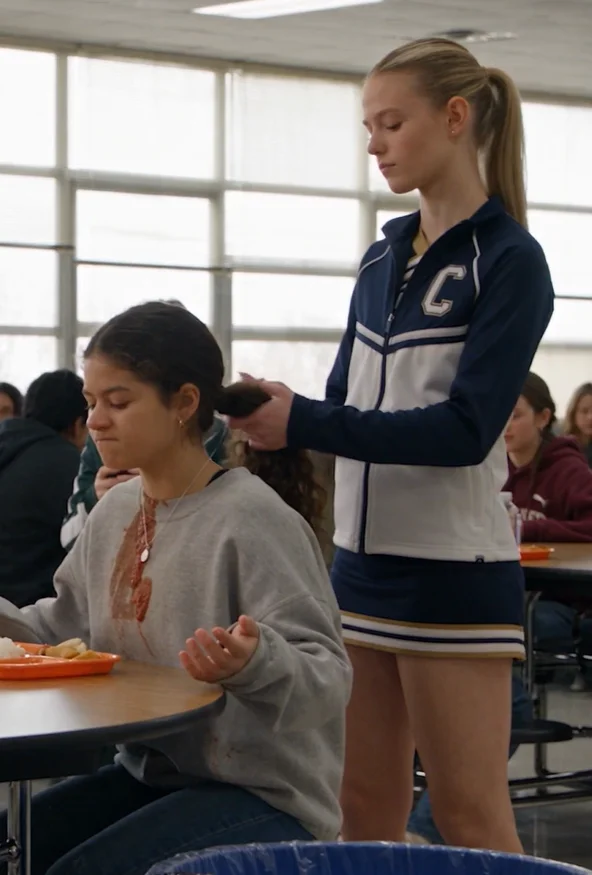
I looked up at him. His face was blotchy around the cheeks. He did not look like a villain then. He looked like a man discovering too late that cowardice also leaves a paper trail.
“Yes, you should have,” I said.
He nodded once and moved on. It wasn’t a full conversation. It wasn’t forgiveness. But it was the first direct apology I had received from an adult who had stood in the room and done nothing.
Eli caught up with me after third period. “Well?”
I held up my thumb.
His entire face lit. “Seriously?”
“Seriously.”
He actually fist-pumped in the middle of the hall and earned a glare from the assistant band director. “I knew it.”
“No, you didn’t,” I said.
He grinned. “Okay, I hoped it.” Then he got serious. “You okay?”
I considered the question honestly. “I think I’m starting to be.”
At lunch, a staff member was already positioned near the tables by the emergency exit. Not Brooks. A rotating dean I barely knew, but present and looking at students instead of condiment pumps. Peyton’s entire group was absent. Nora sat across from me without asking, setting her tray down like someone approaching a skittish animal.
“Can I?” she asked belatedly.
“You already did.”
She gave a nervous laugh. “Right.”
For a minute we ate in silence.
Then she said, “My mom grounded me for a week after I told her.”
“That sounds fair.”
“It probably is.” She pushed peas around with her fork. “I’m sorry.”
I set my spoon down. There were versions of forgiveness adults liked because they made rooms comfortable fast. This wasn’t one of them.
“Thank you for sending the video,” I said. “That mattered.”
Her shoulders dropped a little.
“I’m still mad you filmed it,” I added.
She nodded immediately. “You should be.”
That honesty made something possible between us that might one day become friendship, or at least decency.
After school, Grandma Dee and I picked up the locket from the jeweler on Cedar Street. The clasp had been strengthened, the chain cleaned, the silver polished back to a soft shine. The woman handed it to me in a small velvet pouch.
“Try it,” she said.
My fingers shook as I lifted the chain around my neck and clicked the clasp into place. The oval rested against my collarbone where it belonged. Not exactly the same as before—one link near the clasp was newly soldered, one edge held a faint mark that polish couldn’t erase—but whole in the way repaired things sometimes are.
“It’s beautiful,” Grandma Dee said.
I touched the locket and thought of my mother’s hand pressing it into mine, of slop and paper towels and legal pads and all the boring machinery of proving something that had always been real.
That night, Coach Reed made me do extra sprawls because he claimed justice had made me lazy.
“Justice gave me one decent day,” I shot back, dropping to the mat. “It did not improve my love of sprawls.”
The other girls laughed. Coach almost smiled.
When practice ended, he stopped me at the door. “You understand what you actually won here?”
“A week without Peyton?”
“A chance to stop calling endurance the same thing as peace.”
I frowned. “That was worse than the fortune cookie thing.”
“Maybe,” he admitted. “Still true.”
At home, I opened my blue notebook one last time.
For weeks it had been a record of things done to me. Dates. Spills. Witnesses. Silences.
On the next blank page, I wrote:
Day 58. Peyton did not come to lunch. I sat where I wanted. My necklace is back where it belongs.
Then, after a second, I added:
People saw the truth and wrote it down correctly.
That line mattered more than I expected. I tore the page out neatly, made a photocopy for myself, and slipped the original into the back pocket of the notebook. Someday, I thought, I might stop needing records. But I would never again confuse silence with safety.
The following Monday, Peyton returned to school. We did not speak. She ate at the far side of the cafeteria under staff supervision, her old orbit fractured. Brooke stayed close to her. Tessa did not. Nora waved at me from the milk cooler and came to sit with Eli and me without asking permission from anybody.
I watched Peyton only once that lunch. She was laughing at something Brooke said, but the laugh looked effortful, too sharp around the edges. For months I had thought the center of her power was confidence. Now I understood that a lot of it had simply been the school’s willingness to let her perform cruelty without interruption. Once interruption entered the room, the performance changed.
Nothing transformed into a movie ending. I still had moments when a laugh across the cafeteria made my shoulders tense. I still checked the hallway before turning corners. Grief for my mother did not become easier because a school finally told the truth about a locket.
That Thursday, our wrestling club traveled to a small meet at a middle school across town. It wasn’t some huge championship—just a weeknight set of matches in a loud gym that smelled like disinfectant and popcorn—but it felt important anyway because it was the first place I had gone since the review where my body was supposed to do something besides endure. Coach Reed taped my ankle, checked my headgear, and asked if I was focused enough to compete.
“I think so,” I said.
“Think is not the same as know.”
I took a breath and corrected myself. “I know so.”
He nodded. “Better.”





