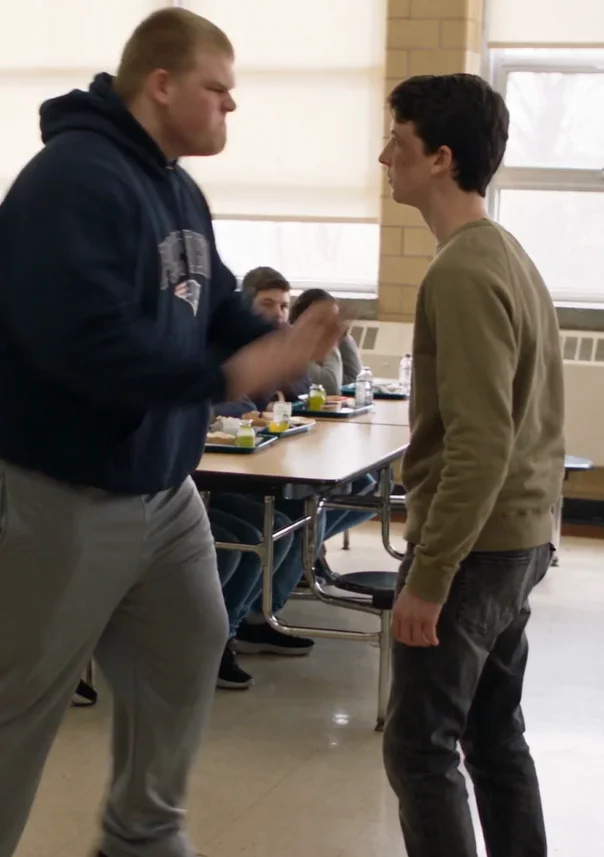
The cafeteria always sounded louder in October than it had any right to.
Maybe it was the weather. South Harbor High sat close enough to the harbor that cold air slid in under jacket collars before most of the city had admitted summer was over, and by the second week of the month everybody wanted to be inside at once. The lunchroom’s windows fogged at the corners. Trays slapped onto tabletops. Chairs screeched. Three hundred conversations stacked over one another until the whole room felt like one long, restless machine.
Eli Carter usually liked that part.
Noise gave him cover.
At sixteen, he had gotten good at disappearing into busy places. He was the quiet junior teachers described as “steady” when they meant they had to think a little to remember him. He took notes in all his classes. He volunteered in ways that let him stay useful without becoming noticeable. He had a narrow face, dark hair he forgot to get cut until it brushed the tops of his ears, and a posture that seemed made for shrinking around other people’s tempers.
There was one place in the cafeteria where he let himself relax anyway.
The radiator-side table was old, chipped at the edges, and close enough to the windows that the winter light always landed there first. In warmer months nobody cared much about that corner. Once the temperature dropped, the radiator clicked and thumped and breathed heat into the metal-backed chairs beside it, and suddenly the table mattered.
Eli had learned that last year.
He sat there now with a turkey sandwich still wrapped in foil, a spiral notebook open to a page full of calculus corrections, and the thick black smart-pen his mother had found used online over the summer when she realized his old one had finally quit working. The pen’s red light blinked in slow, quiet intervals. Eli used it when he studied because it could store audio notes while he wrote. Sometimes he recorded himself working out practice problems and explaining them back to himself later. Sometimes he forgot to turn it off. That day he had tapped it on when he started reviewing formulas in homeroom and hadn’t ended the session yet.
He looked down at a scratch in the imitation wood tabletop, tore the sandwich in half, and took the first bite just as the room changed around him.
It happened the same way storms happened over the harbor: no warning if you weren’t looking for signs, and then the pressure changed all at once.
A shadow fell across the table. Several voices behind it cut off. Eli knew whose weight made the floor sound that way before he ever lifted his eyes.
Marcus Doyle planted both hands on the edge of the Formica and leaned over it.
Marcus was seventeen and built like he had skipped the ordinary proportions most boys had to grow through on their way to size. He played defensive lineman for South Harbor’s varsity team, carried two hundred and forty pounds like he expected rooms to widen for him, and had the kind of confidence that came less from actual achievement than from being treated for years as though wanting something strongly enough entitled him to it. A navy team hoodie stretched over his shoulders. His sandy buzz cut made his face look broader. Two of his friends hovered several feet behind him in the aisle, already smiling in the way people did when they thought entertainment had arrived.
“Get up and move somewhere else,” Marcus said.
Eli kept chewing.
He did hear him. The whole table heard him. Half the room probably heard him. But answering Marcus in front of an audience would turn the moment into a negotiation, and Eli knew from months of watching the senior drift through school like a man forever testing unlocked doors that Marcus loved negotiations he could win by being louder.
So Eli swallowed and took another bite.
Marcus’s fingers tightened on the tabletop. “You deaf?”
Eli still didn’t look up.
The first time Marcus had claimed the radiator table had been the previous winter. Not claimed, exactly. Occupied. He and whichever teammates or friends were orbiting him had started taking it because it was warm, and after a week people simply referred to it as Marcus’s spot, as if repetition could create ownership out of cafeteria furniture. Eli had ignored that too. He sat there when he got there first. Sometimes Marcus ate somewhere else. Sometimes he was late to lunch because of a meeting with a coach. Sometimes nothing happened. The problem with letting those moments pass quietly was that it encouraged people like Marcus to treat restraint as surrender.
A thick vein pulsed in Marcus’s neck. Without warning he jerked the table hard toward himself.
The tray jumped. Eli’s milk carton toppled onto its side and spilled in a cold white sheet across the tabletop. It ran straight toward the spiral notebook, soaking the lower corners of three pages before Eli could catch the carton. The foil-wrapped half of the sandwich slumped into the puddle.
A few students at the next table went silent.
Marcus bent lower, and the sour, chemical smell of some canned energy drink hung on his breath.
“Quit acting like you can’t hear me.”
Eli set the carton upright. Milk kept spreading under the notebook. He could feel eyes turning in from every side. He hated that feeling more than he hated the ruined lunch, because it reminded him how quickly a room could decide a person was public property.
He still said nothing.
What happened next came quickly enough that later, when adults tried to flatten the whole thing into a “fight,” Eli kept wanting to stop them and explain how many choices it contained.





