“We are close,” she said. “Before I issue the written determination, I want Eli to hear one thing directly and I want everyone in this process aligned about the facts.”
Eli’s shoulders stiffened. “Hear what?”
“A clarification.”
A knock sounded. Bennett opened the door to Marcus, Marcus’s mother, and Coach Ellis.
If the week had been difficult for Eli, it had not been gentle with Marcus either. The bruising at his mouth had gone yellow at the edges. His shin still made him walk a little unevenly. More noticeable than either injury was the absence of swagger. He avoided looking at Eli for the first three seconds after entering, which by itself felt historic.
Marcus’s mother, Colleen Doyle, looked tired in the way of people who had rearranged work schedules and private pride too many times in too few days. She wore hospital scrubs under a winter coat and held a folder against her chest as if paperwork might keep her temper from spilling out prematurely.
Coach Ellis sat near the wall again.
No one offered small talk.
Bennett folded her hands. “I spoke with all of you yesterday because I needed accuracy before consequence. During that meeting, Marcus acknowledged that his prior written and verbal accounts had not fully described the initial physical contact.”
She turned to him. “Marcus, say that in your own words.”
The room stayed silent long enough that Eli could hear a student locker slam somewhere out in the hallway.
Marcus stared at the tabletop. “I slapped him,” he said at last. The sentence sounded dragged out of him by chain. “And I shoved him.”
Eli felt Dana’s hand settle lightly against his forearm under the table.
Bennett said, “Why did you deny it first?”
Marcus’s jaw flexed. “Because I thought if everybody focused on the chair, it wouldn’t matter.”
There it was. Ugly and almost embarrassingly simple.
Not a misunderstanding. Not a story difference born of angle or panic. Calculation.
Colleen Doyle closed her eyes for a second, then opened them and said to the room more than to her son, “I told him in the car that if I found out I was losing sleep over a lie, he was going to regret more than football.”
Coach Ellis kept his face composed, but Eli could see approval flicker there—not at the threat, but at the plainness.
Bennett continued. “Why did you approach Eli at all?”
Marcus lifted one shoulder. “I wanted the table.”
“The table was occupied.”
He said nothing.
“And after Eli refused to move?”
“I got mad.”
This, too, was revealing in its emptiness. Not some deep grievance. Not provocation. Anger at not getting immediate compliance.
Bennett turned slightly so Eli remained part of the same factual field. “Eli, hearing this changes nothing you need to say unless something is inaccurate. Is anything inaccurate?”
“No,” Eli said. His voice sounded steadier than he felt.
“What remains under review,” Bennett said, “is not whether Marcus initiated physical aggression. He did. What remains under review is whether Eli’s response was proportionate under the circumstances.”
The sentence irritated him again, but less than before. A fair process, he was learning, could still sound frustrating because fairness liked precision more than vindication.
Bennett opened the folder at last.
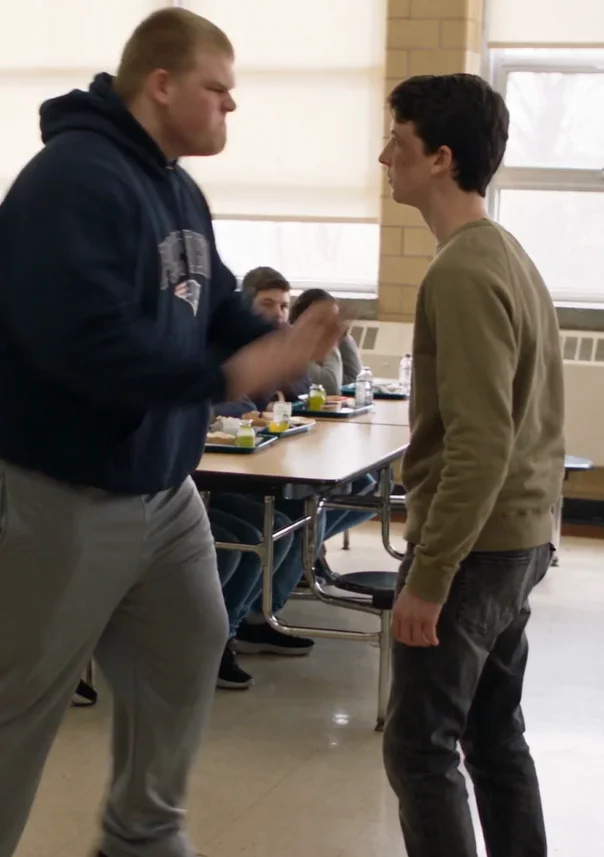
She read from her notes instead of announcing a final decision. “Eli remained seated during the verbal demand. Marcus jerked the table, causing food and milk to spill over Eli’s materials. Marcus then slapped Eli. Eli stood. Marcus shoved Eli, who took hold of a chair already immediately adjacent to him. Marcus then advanced rapidly while declaring intent to take the chair. Eli pivoted away and moved the chair into the path of Marcus’s forward motion. Marcus struck the chair with his shin and fell. Eli did not strike Marcus after the fall.”
She looked up. “That is the factual sequence this school finds more likely than not.”
Dana exhaled slowly.
Eli did not realize until that instant how badly he had needed those words said in that room, in that order, by a person with institutional authority.
Bennett went on. “Because a chair is an inherently hazardous object in a school environment, I had to consider whether Eli’s use of it should draw a separate consequence despite the context.”
Marcus’s mother looked startled, as if this possibility had not occurred to her.
Eli’s pulse sped again.
Bennett met his eyes directly. “I have concluded that it should not, for two reasons. First, the action was brief, low, and directly responsive to an immediate charge by a significantly larger student who had already slapped and shoved him. Second, there is no evidence Eli escalated after the threat ended. Accordingly, Eli will not be disciplined for the incident.”
It was a simple sentence. It split the week in half.
Dana’s hand tightened once on his arm and then let go.
Across the table, Marcus finally looked at Eli. The expression wasn’t warm. It also wasn’t the pure hostility of earlier days. It was something more disorienting: the look of a person being forced to stand inside the consequences of his own sequence of choices.
Bennett shifted to the other half of the outcome.
“Marcus, your conduct constitutes intimidation, physical aggression, and dishonesty during a school investigation. You will receive three school days of suspension. You are also under a no-contact directive with Eli Carter for the remainder of the semester, pending review after winter break. Any violation will produce additional consequences. Coach Ellis will address athletic implications separately.”
Coach Ellis spoke immediately. “You’re out for Friday’s game and next week’s travel roster review. You will also meet with me and the counselor assigned by Ms. Bennett before you return to full team privileges.”
Marcus’s face darkened. For the first time that morning, emotion showed clearly—anger, yes, but underneath it something more shaken. Football was the axis he had assumed would keep turning regardless of cafeteria furniture or juniors or apologies. Hearing otherwise changed his breathing.





