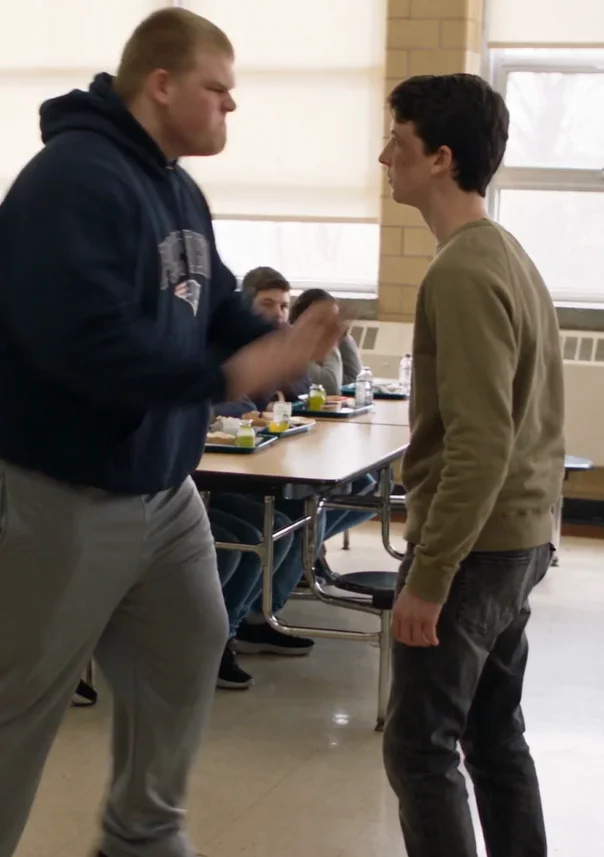
Marcus looked at the students watching. Eli didn’t have to raise his head to know that part. He could hear it in the silence, in the pause of somebody deciding how he wanted this story told afterward. The smaller boy at the table wasn’t afraid enough. That made Marcus look foolish. And there was almost nothing Marcus hated more than looking foolish.
His open hand cracked across the side of Eli’s face.
The sound was sharp and clean, loud enough to cut through the room. Eli’s head snapped sideways. There were several gasps close by, somebody saying, “Yo,” and then the roar of the cafeteria seemed to drop away all at once, as if everyone had inhaled and forgotten how to breathe back out.
For one strange second Eli could hear the radiator clicking behind him.
His cheek flared hot. He set the sandwich carefully onto a dry corner of foil.
Marcus glared at him. “Pay attention when I’m talking to you.”
Eli stood.
The metal-backed chair screamed against the linoleum as he dragged it backward. He was not a large boy. He knew exactly how he looked standing across from Marcus, and maybe because he knew it so well, he also knew how much power there could be in refusing to act frightened when fear was the reaction everybody expected.
He lifted his head for the first time and met Marcus’s eyes.
“You picked the wrong person to hit,” he said.
He didn’t say it loudly. He didn’t need to. The words cut through the hush and landed hard enough that Marcus’s mouth twitched before he arranged it into a scoff.
Several feet away, one of Marcus’s friends barked out a laugh meant to sound supportive. It only deepened the color in Marcus’s face.
Marcus shoved him with both hands.
The push hit Eli high on the chest. He stumbled back half a step and caught himself. The chair legs scraped under his fingers.
Marcus puffed himself up like the shove had made a point. “I just hit a spineless coward.”
Eli’s right hand tightened on the curved metal back of the chair until his knuckles went pale. His left cheek stung. Milk dripped off the notebook onto the table. Somewhere close by, one of the watching students slid halfway out of a seat but didn’t stand.
Eli looked at Marcus and said, very quietly, “That chair is mine.”
For a flicker of a second Marcus glanced at the chair, not because the object mattered, but because pride did. There were now too many people watching for him to back away from a junior who had refused to move, survived a slap, and was still speaking calmly.
Marcus dropped his shoulder and lunged.
“I’m taking it right now!”
A lot of retellings later would make Eli’s next move sound flashy. It wasn’t. It was small, quick, and practical, the kind of thing a person did when a larger body committed fully in one direction and left itself no room to stop. Eli didn’t throw the chair. He didn’t swing it. He pivoted on his heel, slid his own body out of the line of impact, and planted the chair’s steel legs squarely into the path Marcus had already chosen.
“Then you can take the floor instead.”
Marcus’s forward shin struck the reinforced tubing with a metallic crack.
Momentum did the rest.
His size turned against him all at once. He pitched forward, arms wheeling too late, and slammed onto the linoleum hard enough that the sound bounced off the cafeteria walls. His face hit first, then shoulder, then the heavy sprawl of the rest of him. A split opened in his lip. He rolled onto his side with a stunned groan and a string of furious language choked off by pain.
For one breathless beat, nobody moved.
Then the room detonated.
Students shouted over one another. Benches scraped. Several people stood on the lower rails of seats to see over the crowd. Somebody near the back yelled for a teacher. Somebody else laughed once, then stopped as if realizing too late how ugly the whole thing looked lying there on the floor.
Eli still had both hands on the chair.
He hadn’t lifted it to strike. He hadn’t taken a single step toward Marcus after the fall. If anything, he looked like he was braced for what came next, not from the injured boy at his feet but from every assumption that would gather around the scene before the facts did.
The cafeteria doors banged open.
Mr. Harrison came through fast, broad-shouldered in a gray quarter-zip, a half-eaten expression of irritation already on his face from whatever he had been pulled away from. He pushed through the widening ring of students, looked down, and saw exactly what the room was most likely to show first: South Harbor’s starting defensive lineman on the floor, blood at his lip, and quiet Eli Carter standing nearby gripping a chair.
The teacher never asked who had done what.
He grabbed a fistful of Eli’s sweatshirt collar and jerked him backward.
“Drop that chair! Have you completely lost your mind?!”
Eli let go immediately. The chair clattered sideways onto the floor.
A hot burst of anger shot through him then, sharper than the sting in his face. Not because an adult had stopped the situation—that part was necessary—but because the adult had arrived late and decided early, and the shape of that mistake was familiar. He could already see how the scene would sound once reduced: big athlete down, smaller kid with chair, obvious conclusion. Everything that came before would become a preface people might not bother learning.
But even with Mr. Harrison’s hand still tight in his collar, Eli didn’t pull away. He didn’t start talking over the noise or point at Marcus and demand justice in front of everybody.
His gaze slid past the teacher’s shoulder to the table he had just left.





