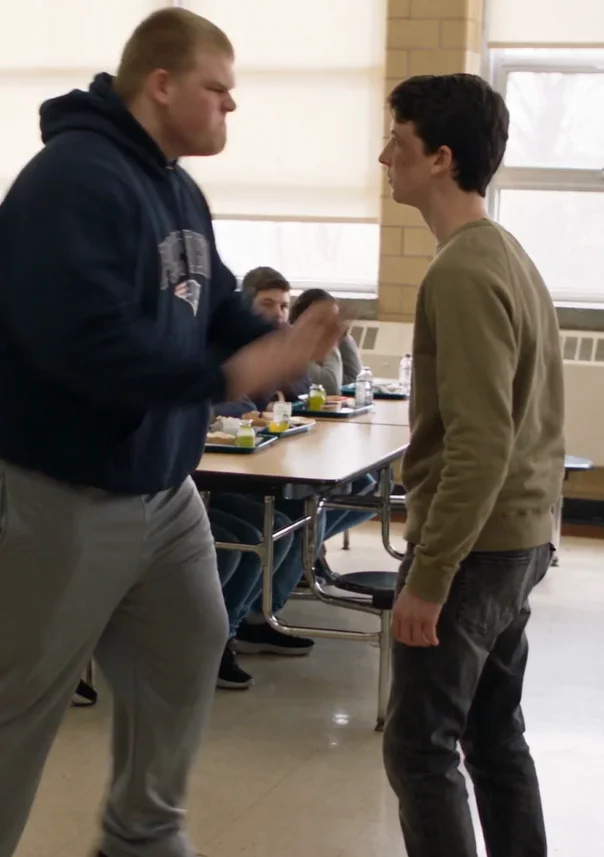
The rest came in uneven fragments. The screech of the chair. His own voice: You picked the wrong person to hit. The shove had no name, only a bump and a slide of shoes. Then, distinct as if the room had briefly leaned in to help, Marcus saying, I just hit a spineless coward.
Eli closed his eyes.
He did not keep listening because the file turned into a guaranteed victory. He kept listening because hearing that sentence preserved the shape of the moment against every future simplification.
The charge itself was a burst of footsteps, his own “That chair is mine,” Marcus shouting “I’m taking it right now!”, his answer, a metallic strike, the crash, the crowd. After that, Mr. Harrison’s voice arrived, furious and late: Drop that chair! Have you completely lost your mind?!
The file did not make everything easy. It couldn’t show the shove or prove where each person stood. It couldn’t explain precisely how the chair moved in relation to Marcus’s body. It was one angle, blind by nature. But it also wasn’t nothing.
He replayed the relevant minute once more, this time paying attention not to the evidentiary value but to the strange intimacy of hearing his own silence. On the recording he sounded almost absent until he chose not to be. There was no soundtrack to anger, no cinematic warning that the room had crossed from ordinary cruelty into something reportable. Just a demand, a spill, a slap, a few flat sentences, and a body moving too fast toward another body. It struck him that this was how a lot of school harm probably sounded when stripped of gossip: shorter, pettier, and more revealing than the legends people built around it. Marcus didn’t sound like a mastermind or a monster. He sounded entitled. Somehow that made the whole thing feel worse.
He set the headphones down carefully on his desk. A smarter person, maybe, or a less tired one, might have felt triumphant. Instead he felt steadier in a painful way. The recording wasn’t going to rescue him from uncertainty. It was simply going to keep one piece of the day from being replaced by somebody else’s convenience. Maybe that was enough. Maybe enough was all evidence ever really promised.
Eli took off the headphones and walked to the kitchen where Dana was loading the dishwasher.
“It got the slap part,” he said.
She turned. “Clear?”
“Clear enough. And him saying he hit me.”
Dana dried her hands. “Then tomorrow we tell Bennett exactly that. Not more.”
“Should I send it tonight?”
“No. We don’t start emailing recordings around because we’re scared. We ask how she wants it handled.”
That was Decision One after the cafeteria, though Eli did not think of it in those terms yet. He wanted badly to use the file like a shield, to thrust it into the middle of the narrative before anyone could warp it further. Instead he let caution win.
In bed that night, sleep came in pieces. Every time he drifted off, he landed back in the moment between Marcus lowering his shoulder and the chair leg finding the exact place it needed to be. He kept waking before the fall, not after, as if his brain preferred suspense to replaying the sound of another person’s body hitting the floor.
By morning his cheek had gone from red to faintly mottled. He stood in the bathroom and touched the mark, wondering whether it made him look more believable or merely more involved.
South Harbor High smelled of floor polish and wet wool jackets when he walked in. News had outrun him. Conversations pinched off as he passed. A freshman he didn’t know stared openly at his face. Two boys from Marcus’s lunch orbit looked at him with obvious hostility and then away when a teacher rounded the corner.
At his locker, Mia Tran slowed almost to a stop.
Mia was in his AP English class, a junior too, quick with questions in discussion and usually brisk in the hall as if every minute owed her interest. She tucked a dark strand of hair behind one ear and looked at his cheek, then his eyes.
“You okay?” she asked.
“Mostly.”
She shifted the strap of her bag higher on her shoulder. “That was messed up yesterday.”
The simple acknowledgment loosened something in him. “You saw?”
“Some of it.” Her voice dropped. “Not all of it. Bennett emailed me for a statement.”
“Will you do one?”
Mia glanced past him down the hall, where Marcus was nowhere in sight but the possibility of him might as well have been. “Yeah,” she said. “I think so.”
Think so. The phrase sat heavily in Eli’s chest.
“Okay,” he said.
When she moved on, he took out his history book and saw his hands were trembling a little. That bothered him more than fear itself. Fear made sense. Trembling felt like fear becoming visible.
His phone buzzed during second-period study hall with a message from Bennett’s office asking him to stop by at lunch for a check-in and possible evidence transfer instructions. That, at least, meant the process was moving.
But before lunch, before meetings and statements and procedures, Jordan Ruiz caught his eye outside chemistry and gave the smallest possible nod.
Jordan was a senior, not one of Marcus’s friends but not entirely outside that world either—a soccer player, broad-shouldered without being huge, known mostly for never saying more than necessary. He had been one of the names Eli offered Bennett because he remembered where Jordan had been standing after the milk spilled.
Now Jordan paused beside the drinking fountain and said quietly, “I saw him hit you.”
Then the bell rang, and the hallway swept them in opposite directions.
That sentence was small. It was also the first solid thing Eli had been given since the assistant principal closed her office door the previous afternoon.





