That helped. Not enough, but some.
“She also said one student gave a very short statement that confirms a shove happened before Marcus went down. No name.”
Eli thought of Jordan by the fountain. “Okay.”
“Tomorrow she’ll likely want you in a more formal meeting. Maybe Friday, depending on who still drags their feet.”
“Marcus isn’t dragging his feet.”
Dana’s mouth tightened. “No?”
“He glared at me in the office like I broke his face for fun.”
“People who start things often resent consequences most.”
They copied the audio file to Dana’s laptop together, named it with the date and time, and attached it to a reply Bennett had specifically requested. Dana wrote a message so concise it sounded almost stern: Attached is the unedited file referenced in yesterday’s meeting. Eli listened only to confirm the file existed. It has not been shared further.
After she hit send, Eli exhaled, though giving away the file felt less like relief than like releasing something fragile into a system that might still mishandle it.
The next morning brought the first direct reminder that facts alone did not govern school life.
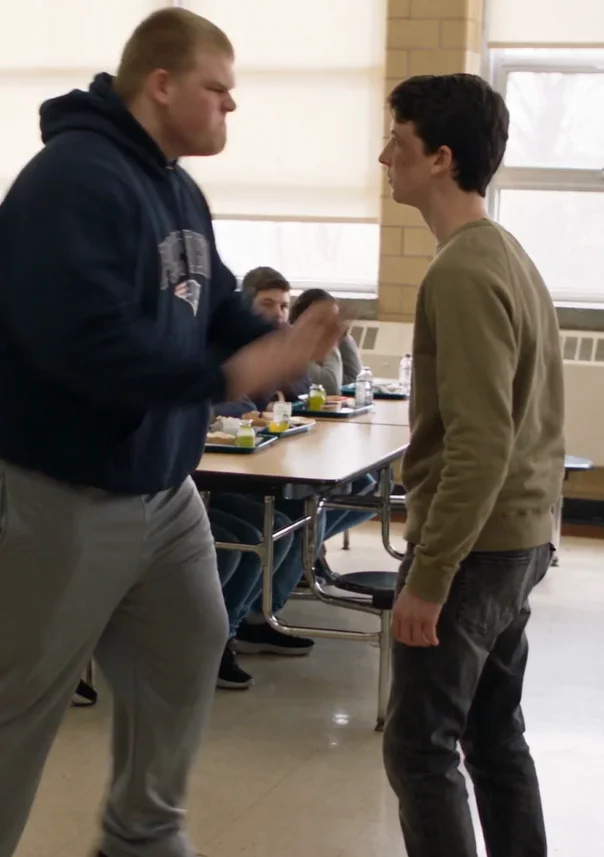
Marcus was not supposed to approach him, but “approach” turned out to be a flexible word in a crowded hallway. Between second and third period, Eli turned a corner near the gym and found Marcus standing by the trophy case with two teammates. Marcus’s lip had scabbed darkly at the center. He was moving stiffly, favoring one leg, but his posture remained pure offense.
One teammate peeled away at sight of Eli, suddenly fascinated by a poster on the wall. The other hung back uncertainly.
Marcus stepped just enough into the path to make the route narrow.
“You think you’re clever?” he said.
Eli stopped a safe distance away. A teacher’s classroom door stood open twenty feet down the hall. He measured that without wanting to.
“I think you should move,” he said.
Marcus’s eyes went hard. “You cost me practice yesterday.”
“You cost yourself practice.”
For a second, Eli saw the exact same thing he had seen in the cafeteria: Marcus realizing that intimidation wasn’t producing the expression he wanted. Not fear. Not apology. Not even drama. Just refusal.
Before Marcus could close the distance, Coach Ellis’s voice cracked down the corridor.
“Doyle.”
The single word stopped all three boys.
Coach Ellis was not a mythic savior. He was a compact, weathered man in a black team jacket whose main talent seemed to be turning his silence into a tool sharper than shouting. He had clearly heard enough of the exchange to know its direction.
“I said no contact,” he told Marcus. “Try listening to a sentence the first time.”
Marcus muttered, “I wasn’t—”
Coach held up a hand. “Office. Now.”
Marcus shot Eli a look full of unfinished anger and limped away.
Coach remained only long enough to say to Eli, “If he talks to you again, report it.”
Then he followed his player down the hall.
Eli stood there another few seconds after both of them disappeared. Students streamed around him toward class, carrying binders and half-finished jokes, and no one looking at the scene would have guessed how exhausting it was to remain composed inside a hallway. He realized, not for the first time, that self-control had a physical cost. His shoulders ached. His jaw felt sore from holding itself still. The urge to go into the nearest bathroom, lock a stall, and breathe for five uninterrupted minutes came over him so strongly that he almost did it. Instead he got to class one minute before the bell and took a seat in the back while his chemistry teacher launched into equilibrium constants as though adolescent power struggles were a rumor from another planet.
It was not comfort, exactly. But it mattered that an adult had witnessed that moment in its own proper order instead of arriving at the tail end and writing a story around an image.
That afternoon Eli made his second important choice.
He could have waited passively for the school’s process. Dana would have approved. Bennett had not instructed him to become his own investigator. But waiting felt too much like surrendering the shape of the truth to whoever felt least nervous. So after AP English he caught Mia in the doorway and said, “Can I ask you something?”
Mia glanced at the students filing around them and nodded.
They moved to the window alcove outside the classroom where a dead plant sat between two stacks of old yearbooks.
“I don’t need details,” Eli said. “And I’m not asking what you told Bennett. I just… if you’re worried about getting dragged into it, I get that. But if you saw what you saw, please don’t leave parts out because Marcus is bigger.”
Mia folded her arms. “You think I’m going to lie?”
“No.”
He regretted the answer the instant it sounded harsher than he meant. He started again.
“I think people shave things down when they don’t want trouble. I just mean—please don’t do that.”
Mia looked at him for a long moment. “I saw him hit you,” she said. “Not super clearly at first because people were moving, but I saw your head snap. And I saw the shove.”
Relief came with a side of embarrassment so sharp it almost hurt. “Okay.”
“But,” she added, “I also saw you use the chair. You know that matters too.”
He nodded. “I know.”
She let out a breath. “It’s not as simple as, you know, hero and villain.”
“Marcus slapped me because I sat in a chair.”
“I’m aware,” Mia said. “I’m just saying when adults hear ‘chair,’ some of them stop listening.”
That sentence followed him the rest of the day because it was brutally accurate.
Jordan was harder to catch. After seventh period Eli found him by the bike racks, tightening the strap on a soccer duffel.
“Hey,” Eli said.
Jordan looked up. “Hey.”





