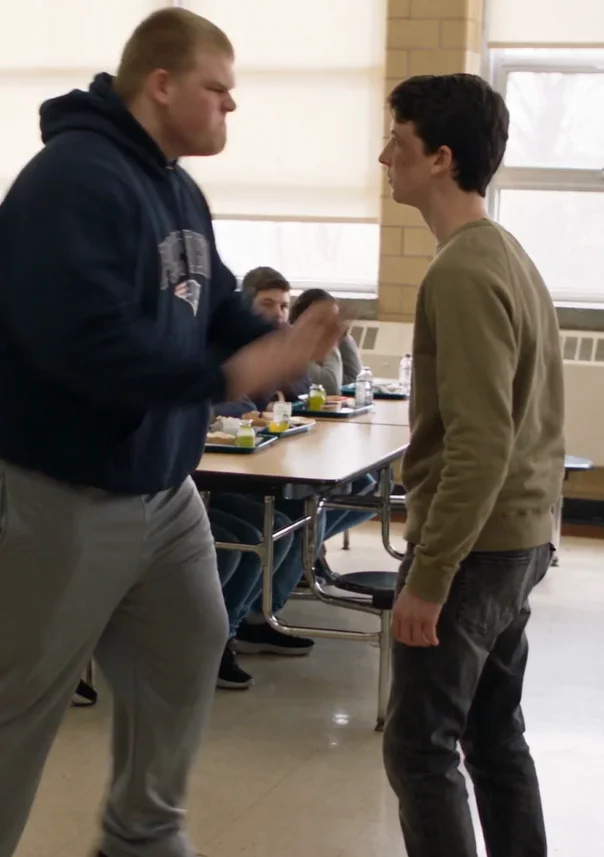
When they split up, Eli went upstairs to the apartment feeling slightly steadier than he had an hour earlier. Dana came home at two with coffee from the corner place and found him cleaning the kitchen counter, which was what he did when his mind ran too fast. He told her Jordan had come by and, to her credit, she didn’t overreact or treat the visit like a cinematic turning point. She only listened, set the coffee down, and said, “People usually tell the truth better once they stop picturing who will be annoyed at them for it.” It was one of her maddeningly concise observations, and because it was true, there was nothing useful to say back.
Monday morning’s follow-up review included one new chair at the table and one new participant.
Coach Ellis sat along the wall, not as judge but because Marcus’s status as a varsity athlete made the team context relevant. He did not wear school colors that day, only a dark quarter-zip and a face giving away nothing.
Bennett began by summarizing the additional witness information. Jordan had confirmed the slap, the verbal admission afterward, the shove, and the fact that Eli moved rather than swung the chair. Mia had confirmed seeing Marcus’s open hand connect with Eli’s face, Eli’s stumble after the shove, and the chair remaining low rather than being lifted like a weapon. A cafeteria aide near the serving line had not seen the slap but remembered students gasping before any fall and then turning en masse toward the radiator table.
“Taken together,” Bennett said, “these statements materially support the sequence Eli described.”
Mr. Harrison shifted in his seat. Marcus was not in the room yet; his meeting had been scheduled separately again, a structure Bennett had explained as necessary to keep the conversations from becoming theatrical.
“What about intent?” Harrison asked.
Coach Ellis looked up at that, just slightly.
Bennett folded her hands. “We evaluate intent by context and action. Eli remained seated until struck, stood after being slapped, spoke, was shoved, held the chair, warned Marcus verbally, and moved as Marcus charged. There is no evidence Eli pursued Marcus or continued force after he fell.”
That last sentence should have calmed Eli. Instead it made him aware of how close he had come to not having anyone say it out loud.
Dana, who had taken another hour off work and sat beside him again, said, “So what remains unresolved?”
Bennett didn’t answer immediately. “School response has two tracks,” she said. “Fact finding and consequences. Fact finding is much stronger today. Consequences still require careful proportionality, especially because we are dealing with a chair in a school setting.”
Mia’s warning echoed again in Eli’s head.
Bennett went on. “I also met with Marcus this morning. He denies slapping Eli.”
Coach Ellis’s gaze turned fully to her.
“He admits to demanding the seat and to jerking the table,” she continued. “He characterizes the physical contact afterward as a shove only. He claims Eli then ‘jabbed’ the chair into him.”
Eli’s mouth went dry. The audio proved enough to make that version shaky, but not enough to show every motion. He hated how lies could still live in unlit corners once truth illuminated only part of the room.
Bennett slid a paper across the table. “However, his own written statement also includes the sentence, I wasn’t trying to hurt him, I was just trying to move him because he got disrespectful after I smacked him.”
Silence held for one astonishing second.
Then Harrison looked up sharply. Coach Ellis shut his eyes briefly, not in surprise, but in the tired recognition of a self-inflicted disaster.
Dana said, very softly, “He wrote that?”
“He did,” Bennett said.
Eli felt something inside him uncoil. Not joy. Not even relief, not yet. Just the sudden absence of a tension he had held so long it had become structural.
“He later claimed he used ‘smacked’ figuratively,” Bennett added, “which I find less than persuasive given the audio.”
Coach Ellis spoke for the first time. “Did his mother see that statement before he submitted it?”
“No.”
Coach nodded once as if a puzzle piece had clicked into place. “That tracks.”
The rest of the meeting became more practical. Bennett asked Eli to clarify exactly how he had been holding the chair, where his feet were, and whether he remembered saying anything besides the lines already in evidence. He answered carefully. She asked Harrison to state precisely from which doorway he entered and what his sightline was upon arrival. Harrison did so, and as he mapped it, the limitation became plain: students standing, a crowd forming, Marcus already down, Eli nearest with the chair. He had not been able to see the table itself from the threshold, much less the moments before the fall.
When the room emptied, Harrison lingered.
“Eli,” he said.
The boy looked up.
The teacher’s face had lost its certainty and gained a kind of discomfort that might, in time, become humility if he let it. “I responded to what I thought I saw.”
Eli waited.
Harrison swallowed. “I should have asked more before I grabbed you.”
It was not a full apology. Not yet. But it was the first honest crack in the wall.
By lunchtime, half the school seemed to know that Marcus had contradicted himself in writing. Eli hadn’t told anyone. Dana hadn’t. Mia swore later she hadn’t. Information in schools escaped through vents.
He ate in the counseling suite again, this time joined by Jordan for ten minutes because Jordan had an open lunch and apparently decided that sharing a table with the recently controversial junior was either solidarity or curiosity or both.
“You look less like you’re about to throw up,” Jordan observed.
“High praise.”
“You’re welcome.”
Eli picked at the corner of his sandwich wrapper. “Bennett says they still need to decide consequences.”
Jordan made a face. “For what? Existing while someone bigger ran at you?”
“For using the chair.”





