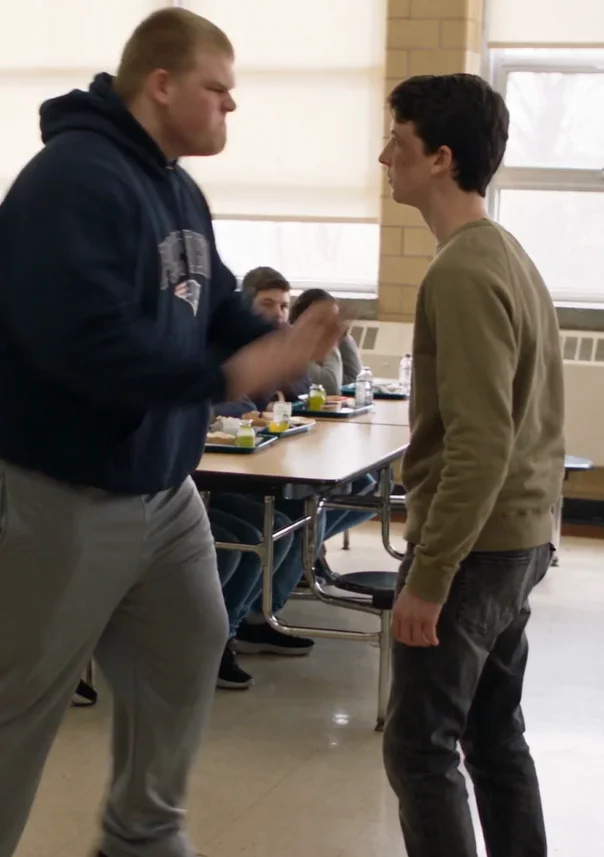
Dana Carter arrived thirty-five minutes later, still in her navy cardigan from the billing office where she worked downtown. She looked from Eli’s cheek to his damp notebook and inhaled once, sharply, as if forcing herself to postpone panic until somebody gave her a room to place it in.
Bennett gave her that room.
The second retelling took longer because adults kept stopping to ask procedural questions. Dana listened with one hand around a paper cup of office coffee she never drank. When Eli mentioned the slap, the hand tightened. When he mentioned the pen, her eyebrows lifted in brief surprise and then settled again.
Mr. Harrison read from the incident notes he had started writing, and the problem with his version was not that every word was false. It was that the order made them false. He had written that he entered to find Marcus on the floor and Eli “holding a chair in a threatening manner.” He had written that the cafeteria crowd was agitated and that Marcus had a bleeding lip. None of that was wrong. But because he had not seen the shove or the charge or the slap, the version leaned toward the story suggested by the frozen image he arrived to.
Bennett stopped him twice.
“Did you personally observe Eli strike Marcus with the chair?”
“No.”
“Did you witness the events before the fall?”
“No, I responded after students started shouting.”
Dana set down the untouched coffee. “Then I need the report to reflect exactly that.”
Mr. Harrison’s jaw set. “I can only write what I saw.”
“Then write only what you saw,” Dana said.
Eli had inherited his quiet from her, but on the rare occasions she chose not to be quiet, people usually found out quickly that the softness of her voice was not weakness.
Bennett took control before the exchange could harden. She explained the next steps. There would be witness statements from students and supervising adults. The nurse would document visible injuries. Eli’s pen would be temporarily inventoried without anyone making assumptions about what its audio file did or didn’t contain. No determination would be made that day about discipline. Marcus and Eli would be separated pending review, which meant no contact and staff awareness around shared spaces. Coach Ellis would be informed because the incident involved a varsity player during school hours.
Eli heard the words and understood them. What he felt was something less orderly: relief that the process wasn’t closing on him immediately, humiliation that there had to be a process at all, and a private dread that witness memories might already be rearranging themselves around the easiest version of the story.
Before they left, Bennett handed him a copy of a preliminary statement to read over for accuracy. It contained his name, the date, the location, and a plain summary. One sentence caught his eye: Student reports being slapped and shoved prior to deploying chair defensively.
He stared at the word deploying.
“That’s a weird verb,” he said without thinking.
To his surprise, Bennett almost smiled. “Probably. Do you have a better one?”
Eli thought about Marcus’s shoulder dropping, the instinctive sidestep, the cold certainty that if he didn’t move he was going to end up underneath somebody more than eighty pounds heavier. “Using,” he said.
She crossed out the word. “Fair.”
When he and Dana finally got home, the apartment smelled like garlic and onions because Mrs. Alvarez downstairs was already cooking dinner. Eli set his backpack on the kitchen table and only then realized how exhausted his hands felt, as if his grip on the chair had traveled forward in time and stayed in his fingers.
Dana heated tomato soup from a carton because neither of them had much appetite and soup counted as trying.
“You did the right thing telling it clean,” she said after they sat down. “No embellishing.”
“I don’t know if clean matters if people already picked a side.”
“It matters most then.”
He rubbed the sore place along his cheekbone. The heat there had faded into a dull throb. “I keep replaying the look on Harrison’s face. Like he saw me with the chair and the whole story was finished.”
Dana stirred her soup slowly. “People like fast stories. They’re less work.”
“Marcus is going to say I attacked him.”
“Maybe.”
“He kind of already is.”
She nodded once. “And your job stays the same.”
“Tell the truth.”
“Tell the truth. Preserve what you have. Let the parts you don’t know stay unknown until they’re known.”
That included the pen.
Bennett had sent it home after the office documented the device and confirmed with Dana that they wouldn’t alter anything without instruction. Eli wasn’t forbidden to listen, but the warning not to treat it like a magic solution still rang in his ears. After dinner he went to his room, set the milk-stiff notebook on his desk, and looked at the black pen for a long time before uncapping it.
The audio file was there. One long recording, time-stamped from first period through lunch.
He put on headphones and skipped through static bursts, bits of algebra class, the scrape of notebook paper, his own voice murmuring formulas under his breath, hallway noise, then the cafeteria.
At first it was mostly exactly what Bennett had warned him it might be: trays clattering, too many voices overlapping, the radiator clicking, his own sandwich wrapper rustling. Marcus’s demand to move came through faintly. The table jerk and the milk spill were sound without sight. Then, very clearly, there was Marcus’s voice, close enough to clip the microphone slightly: Quit acting like you can’t hear me.
A crack followed. Somebody gasped.
Then Marcus again, sharper: Pay attention when I’m talking to you.
Eli sat straighter.





