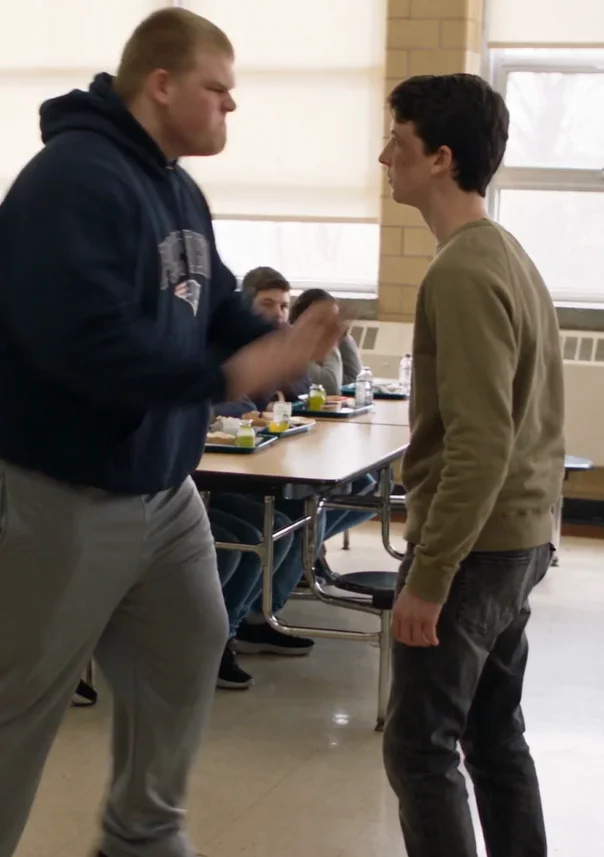
His sandwich lay ruined on wet foil. Milk spread in an uneven lake across the notebook. And on top of the damp spiral, perfectly undisturbed, the thick black smart-pen kept blinking its tiny red light in a calm, steady rhythm.
The assistant principal’s office felt colder than the cafeteria even though the heat was on.
Mr. Harrison marched Eli there with one hand on his upper arm as if there were any chance he might bolt. Marcus, limping and muttering through a napkin the school nurse had pressed to his split lip, came behind them with a security aide and one of the assistant athletic trainers who had been called down from the gym. Eli caught only scattered fragments in the hallway: “Need ice,” “He charged—,” “Tell Coach,” “Watch your step.”
The walk itself gave the story time to harden.
By the time they reached the front office, two secretaries, the nurse, and one sophomore messenger all looked up with the same alert curiosity. Eli became aware of his appearance in pieces: the hot cheek, the damp front edge of his notebook, the collar stretched slightly where Mr. Harrison had seized it, the ugly feeling of being half seen and half interpreted.
Assistant Principal Laura Bennett met them outside her office. She was in her forties, precise without being stiff, and had the kind of calm that made people either settle down or feel guilty for refusing to. She took in Marcus’s bloody lip, Eli’s reddened face, and Harrison’s clenched jaw in one efficient glance.
“Mr. Harrison,” she said, “take one breath and start at the beginning. Nurse, get Marcus cleaned up. Eli, you’re coming with me.”
That was the first useful sentence anyone had said since the cafeteria.
Inside her office, Bennett shut the door but didn’t sit behind the desk. She stayed in one of the guest chairs so the conversation felt less like a verdict.
“Are you hurt anywhere besides your face?” she asked.
“My cheek’s fine,” Eli said.
“Did you hit your head?”
“No.”
“Did anyone hit you before I got the call?”
The question made him pause. Not because he didn’t know the answer, but because of how quickly answers could become positions.
“Yes,” he said. “Marcus slapped me. Then he shoved me.”
Bennett watched him steadily. “Tell me everything in order.”
So he did.
He described the seat, the demand to move, the table jerk, the milk on the notebook, the slap, the shove, his holding the chair, Marcus charging, the pivot, the fall, and Mr. Harrison arriving afterward. He heard how flat his own voice sounded and didn’t know whether that helped him or made him seem rehearsed. He did not add flourishes. He did not claim Marcus threw punches he hadn’t thrown or invent cheering crowds or say he had been terrified when in truth he had mostly been angry.
Bennett let him finish.
“Did you swing the chair at him?” she asked.
“No.”
“Did you lift it off the ground?”
“I picked up the back and moved it in front of him when he ran at me.”
“Did you intend for him to fall?”
Eli met her eyes. “I intended not to get tackled.”
For the first time, something in her expression shifted—not agreement, exactly, but attention sharpening around the distinction.
“Who saw the beginning?” she asked.
“A lot of people were there.”
“A lot of people were there is not the same as a lot of people were looking. Names?”
Eli thought. “Mia Tran was at the table by the windows. Jordan Ruiz was two tables over. I don’t know who else saw the slap.”
Bennett wrote the names down.
Then his gaze flicked to the notebook in his lap, and the thought that had been pressing at the edge of his mind since the cafeteria finally formed into words.
“My pen was recording audio notes,” he said.
She followed his glance. “Recording what?”
“Not, like, on purpose. I use it for class. I turned it on earlier. The red light was blinking the whole time.”
Bennett held still for half a beat, considering. “Does it capture clear audio?”
“Sometimes. If it’s close.”
“Do you know what it picked up?”
“No.”
“Where is it now?”
“In my notebook.”
“All right.” She set down her pen. “We are going to handle this carefully. Do not delete anything on that device. Do not play it for other students. Do not upload it anywhere. Understood?”
“Yes.”
“Good.”
There was no triumph in the moment, which oddly made Eli trust it more. Bennett wasn’t reacting like a television lawyer handed the miracle piece of evidence that solved every problem in twenty seconds. She was reacting like an administrator who knew objects complicated stories as much as they clarified them.
Mr. Harrison was waiting outside when Eli emerged. His face had cooled from anger into the defensive stiffness of a man starting to realize there might be more to learn than he had wanted. He did not apologize.
Bennett called him in next.
Eli sat in a vinyl chair near the nurse’s room while secretaries worked the phones and students came and went with passes. Through the partly open door he could hear only snatches of adult voices. Marcus limped past once on the way to get ice, his lip swollen, a red scrape visible along his shin where it had met the chair leg. He glared at Eli like pain itself were proof of innocence.
“What the hell was that?” Marcus muttered.
Eli looked at him. “You charged me.”
Marcus’s nostrils flared. If the nurse had not been ten feet away, maybe he would have said more. Instead he hissed, “You put a chair in front of me.”
“Yes,” Eli said.
Something about the simple answer made Marcus turn away harder than if Eli had shouted.





