Internally, he was in the conference room waiting for Jordan Ruiz to decide whether truth was worth social inconvenience.
He knew that was unfair. He knew it because he had heard himself sound unfair outside the bike racks and had apologized. Yet fairness did not always arrive before feeling.
When the final bell rang, he checked his phone before he had even cleared the classroom door. No message from Dana. No message from Bennett. Nothing.
At home he attempted homework, failed, and sat on the floor beside his bed listening to the harbor wind whistle faintly through the older apartment windows. At six twenty-three, Dana called from the kitchen.
“Eli.”
He found her leaning against the counter with his phone in her hand. “Bennett emailed,” she said.
His pulse jumped. “And?”
“She wants us Monday morning for a follow-up review. She says Jordan provided useful detail that changed the evidentiary picture but didn’t want to discuss conclusions over email.”
That was not enough information to settle anything. It was, however, enough to ruin the rest of the evening’s ability to pretend at calm.
Saturday dawned clear and colder. Dana had a half shift at work, so Eli spent the morning doing laundry and trying not to turn every stray thought into prediction. Around noon there was a knock at the apartment door. He opened it to find Mrs. Alvarez from downstairs holding a foil-covered plate of empanadas because neighborhood women in South Boston had their own information networks and apparently one of them had carried word that the Carters had “a school thing.”
Dana would have called it community. Eli called it the reason private lives in old buildings were theoretical.
While the empanadas warmed in the oven, he looked again at the milk-stiff notebook and found himself remembering the first week he had started carrying it everywhere.
His father had been the kind of man who wrote things down on any paper available—receipts, envelopes, the backs of church bulletins. Two years earlier, after his father’s heart attack, Eli had started keeping cleaner notes partly because grief made memory unreliable and partly because recording details felt like a way of refusing sudden disappearance. The smart-pen had never been sentimental in the same way. It was merely useful. But now, because it had been there when other people were careless, usefulness itself felt intimate.
He was still thinking about that when his phone buzzed with a text from an unknown number.
It’s Jordan. You home?
Eli stared, then replied, Yeah.
Two minutes later Jordan appeared downstairs at the building entrance and texted again: Can you come out?
Dana was not home, but Eli left her a note and headed downstairs.
Jordan stood on the sidewalk in a gray hoodie and soccer slides, hands shoved deep into his pockets against the cold.
“I didn’t know where else to do this,” he said when Eli came out.
“Do what?”
Jordan exhaled. “Explain.”
They walked half a block toward a corner coffee shop, then stopped under the awning because neither of them had actually intended to buy coffee.
“I told Bennett everything,” Jordan said.
Eli’s shoulders loosened despite himself. “Okay.”
“Everything I actually saw,” Jordan corrected. “Not cafeteria legend.”
“What did you tell her?”
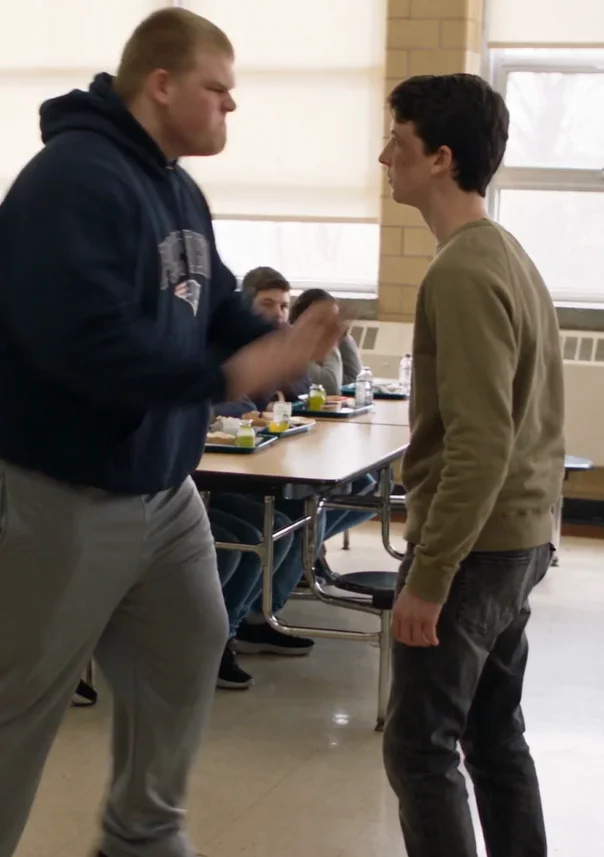
Jordan looked down the street, watching a bus kneel to the curb. “That he slapped you. That I heard him say he hit you. That he shoved you. And that when he charged, you moved the chair into his path but didn’t swing it.”
Eli leaned back against the brick wall. “Thank you.”
Jordan shrugged, but not dismissively this time. “I kept trying to tell myself it wasn’t my business. Then Coach Ellis pulled me aside after practice yesterday and asked if I saw anything. He didn’t tell me what to say. He just said if players start thinking size gets them a different truth, then everybody else pays for it eventually.”
Eli absorbed that. “Coach said that?”
“Basically.” Jordan’s mouth twitched. “In coach language.”
“Which is fewer words.”
“Way fewer.”
They both smiled a little, and the ease of it surprised Eli.
Jordan’s expression grew serious again. “For what it’s worth, Mia’s statement matters too. She and I saw different angles. Bennett likes that because it sounds less scripted.”
“What did Mia say?”
“I don’t know all of it. She was in the office before me. But she told me she saw your head snap and the shove.”
A gust of cold air pushed under the awning. Eli tucked his hands into his jacket pockets.
“I keep thinking maybe I should’ve just moved,” he said before he could stop himself.
Jordan frowned. “From the chair?”
“From all of it. Like maybe if I had gone somewhere else, none of this happens.”
Jordan stared at him with open disbelief. “He slapped you because you sat in a seat.”
“I know.”
“So why are you carrying his decision around like it was yours?”
Because that’s what quieter people learned to do, Eli almost said. Instead he looked at the bus pulling away and said, “Habit.”
Jordan nodded once, as if he understood enough not to press. They stood there another moment with the cold creeping through their sneakers, both of them apparently aware that they had moved past the practical purpose of the conversation and into the stranger territory where two boys who had barely spoken before an incident were suddenly saying things that mattered.
“You know,” Jordan said, shoving his hands deeper into his pockets, “I almost left right after the fall. Not because I didn’t care. I just didn’t want my name attached to it.”
Eli looked at him.
“I’m glad you didn’t,” he said.
Jordan gave one short nod. “Me too.”





