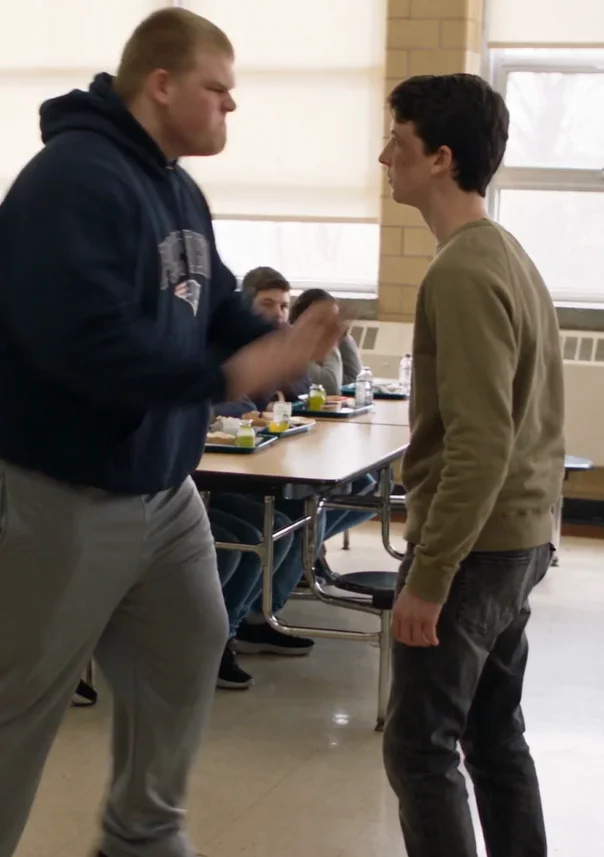
For the first time since the cafeteria, he believed the room might yet be described in the right order.
The school day after a public incident always felt longer than the incident itself.
Every corridor at South Harbor had a separate version of what happened in the cafeteria. By third period, Eli had already heard fragments of three of them without trying. In one, he had “taken Marcus out with a chair” like a wrestler with a folding prop. In another, Marcus had “jumped him” and the fall was pure karma. In a third, which he caught from two freshmen whispering outside the library, both boys had apparently been “beating each other up” until a teacher “threw one of them against a wall.”
Rumor treated time like loose change. It spent details badly.
At lunch, instead of going to the cafeteria, Eli carried a cafeteria-issued turkey sandwich in a paper bag to the counseling suite, where Bennett had arranged a temporary supervised space so he wouldn’t have to navigate the radiator table spectacle while the review was pending. He would have preferred the library, but the librarian was out sick and the substitute couldn’t supervise student separation plans.
He sat at a round table under a bulletin board full of college pennants while a guidance secretary pretended not to notice how often he checked the hallway.
Bennett arrived five minutes later carrying a legal pad and a plain evidence envelope.
“Your mother emailed this morning,” she said. “She says you listened to the file but did not forward it to anyone.”
Eli nodded. “I wanted to know if there was anything on it.”
“That was reasonable.” She took the seat across from him. “I’m going to ask again in a very boring way so we’re clear: did you edit, trim, rename, or share the recording?”
“No.”
“Good. I’m not confiscating your pen. I am, however, documenting the audio file and asking your mother to provide a copy directly to me tonight so chain of custody is at least minimally clean.”
“Chain of custody?”
“It means later no one gets to say the file grew legs and changed itself in your bedroom.” She slid the evidence envelope toward him. “Put the pen in there for now. You’ll get it back after I log the make and model.”
He placed the pen into the envelope with a strange reluctance. It was only a study tool. By noon it felt like part of the story’s nervous system.
“Did you talk to any witnesses?” he asked.
“I requested statements from six students and three adults who were in or near the cafeteria. Some have already responded. Some have not.”
“What did they say?”
Bennett’s expression settled into professional neutrality. “I’m not going to summarize other students’ statements before the review is complete. I can tell you this: accounts are not identical, which is normal. Multiple people support the fact that there was a verbal confrontation before Mr. Harrison arrived.”
“And the slap?”
“Still being evaluated.”
That answer irritated him even though it was expected. “How hard is it to evaluate if somebody got slapped?”
“Harder than you’d think when half the room was staring at lunch trays until there was already yelling.”
He looked down at his paper bag. “Right.”
Bennett softened slightly. “Impatience is normal too.”
When she stood to leave, he said, “If Marcus says I attacked him with the chair, what happens?”
She answered without theatrics. “Then I compare his statement to the rest of the evidence. Which includes whether his claim matches the physical sequence, witness perspectives, adult timing, and his own conduct beforehand.”
“Can I get suspended while you figure that out?”
“I’m not assigning emergency discipline today.”
Today. The word did not comfort him as much as she probably intended.
When Bennett left, the guidance secretary brought him a paper cup of water and asked whether he wanted the office television on. He said no and spent the next fifteen minutes alone at the round table, peeling the label off the cup one thin strip at a time. Through the doorway he could hear the ordinary life of the counseling suite continuing around him: a student asking for a pass, a printer feeding out forms, a phone ringing twice before someone answered it with practiced calm. The normalcy of those noises irritated him. It made the morning feel like something the building could absorb and smooth over while he still felt pinned inside it. He wondered how many students sat in rooms like this each year waiting to learn whether the adults around them understood the order in which fear had entered their bodies. Probably more than anyone liked to admit.
After school, Dana met him outside the building because she had arranged to leave work early for a scheduled phone conference with Bennett. They walked home under a sky the color of sheet metal. On the train platform, Dana tucked a hand into her coat pocket and said, “How did she sound?”
“Careful.”
“That’s not bad.”
“It’s not good either.”
“It can be both.”
At home, while Dana took the call in the kitchen, Eli sat on his bed with the milk-warped notebook open in front of him. The stain had dried into faint crinkled waves. He found himself tracing its edge like a map.
He could hear only Dana’s side of the conversation.
“Yes… yes, he told me that… I understand you’re being thorough… no, I don’t want a shortcut, I want accuracy… if another student is afraid to state what they saw because the football team intimidates half this building, that’s not the same thing as there being no witnesses… thank you… yes, email me the procedure.”
When the call ended, Dana leaned in his doorway. “She wants the audio file copied tonight. I’ll do it with you.”
“Did she say anything useful?”
“She said Mr. Harrison revised one sentence in his notes to make clear he arrived after the fall.”





