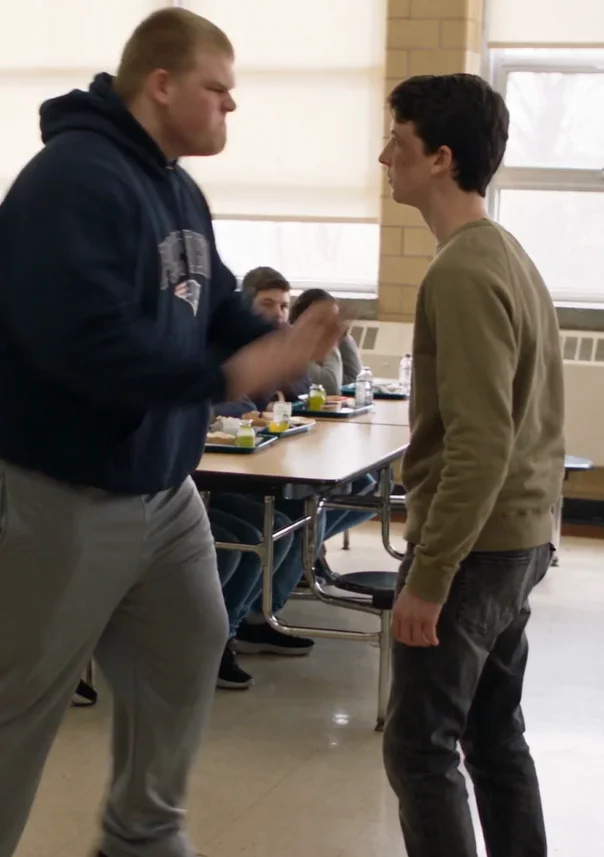
Jordan leaned back. “I mean, I get why they have to say that. But if Doyle had hit the floor because he ran into, like, a table leg, nobody would be acting like furniture was a co-conspirator.”
Eli laughed despite himself. It came out brief and strange, like a sound surprised to exist.
That afternoon Mia stopped him outside English and said, “For the record, I’m glad you asked me not to shave things down.”
He blinked. “Yeah?”
“Yeah. It made me mad at first.”
“Sorry.”
“No, I know why you said it.” She adjusted her backpack. “Sometimes people need reminding that being uncomfortable isn’t the same as being in danger.”
He thought about Marcus and the ways comfort had been mistaken for rightness around him for years. “That’s true,” Eli said.
Mia nodded. “Also, Bennett asked me one very weirdly specific question.”
“What?”
“Whether the chair was already behind you before you stood up.”
“It was.”
“I know. I told her that. I guess they’re trying to figure out whether you went searching for a weapon or grabbed what was already there.”
The phrasing turned his stomach. Weapon.
But Bennett’s actual concern made sense in context, and that mattered. Accuracy wasn’t always flattering.
Tuesday brought the hardest uncertainty of the week.
Bennett called Dana that evening and said a decision memo was being drafted, but before it was finalized she was requiring one more conference: Marcus, his mother, Coach Ellis, and Bennett together. She didn’t detail why beyond “clarity and responsibility.”
After hanging up, Dana told Eli, “That means one of two things. Either she’s pressing him to stop lying, or she’s trying to make sure his parent can’t claim later that nobody heard his side.”
“Which is it?”
Dana lifted a shoulder. “Probably both.”
That night Eli lay awake imagining the meeting anyway.
Marcus’s mother looked, in Eli’s mind, like every overworked adult who had ever appeared at school furious to discover her child was less blameless than advertised. Coach Ellis looked patient until he wasn’t. Bennett looked like Bennett. Marcus looked cornered and mean.
By Wednesday afternoon the imagined scene turned partly real.
Bennett did not call Eli into the meeting, but she did ask him to stay after school in case questions remained. So he sat in the main office for forty minutes with a paperback open on his lap and read the same three pages four times while voices moved faintly behind closed doors. The receptionist eventually offered him peppermints from a glass dish and then, sensing he was too wound tight to enjoy them, left him alone with his unread novel and the soft clatter of keyboards. Every now and then the office phone rang, and he found himself tensing at the sound as if one more call might somehow alter the outcome. It was ridiculous, but waiting rarely respected logic. Waiting turned even harmless noises into possible omens.
To keep from spiraling, he tried a trick his father had once taught him before middle-school debate tournaments: name five things you can see, four things you can touch, three things you can hear. The exercise should have been calming. Instead it made the office hyperreal. The green stapler by the copier. The coffee ring on the receptionist’s desk. The scratch along the conference-room doorknob. The rough weave of the vinyl chair under his fingertips. The click of the wall clock. The muffled hum of adult voices behind the closed door where his name was probably being spoken right then. By the time the conference room finally opened, he had looped through the list twice and felt only marginally more human.
When the conference room finally opened, Marcus came out first.
His face was different.
Not contrite, not exactly. Stripped down. The bravado had been peeled off by some internal friction and left him looking younger in an unflattering way, like a boy caught wearing a man’s expression he hadn’t earned. His mother followed, tight-mouthed. Coach Ellis came last, one hand briefly on Marcus’s shoulder—not comforting, simply directing him toward the outer office.
Bennett stepped out and said, “Eli, I’ll need you and your mother tomorrow at eight.”
That was all.
No hint of outcome. No preview. Just another night suspended above his own future.
On the walk home the harbor wind pushed hard enough to sting his eyes. He told himself it was only the cold. In truth, this was the hardest part: not the slap, not the charge, not even the public embarrassment. Waiting while adults translated lived experience into institutional language—that was its own form of helplessness.
When he let himself into the apartment, Dana was already there.
“Well?” she asked.
“Tomorrow at eight.”
She nodded slowly. “Then tomorrow at eight.”
He dumped his backpack by the chair and stared at the kitchen radiator hissing under the window.
“I don’t want them to do me a favor,” he said.
Dana set down the envelope she had been opening. “Good.”
“I want them to get it right.”
“That,” she said, “is not a favor.”
At seven forty-five the next morning, South Harbor High looked almost peaceful.
The buses had only just unloaded. The front steps were damp from a night mist that had dried into pale patches under a new sun. Inside, hallway lights hummed above nearly empty corridors. Without the rush of bodies, the building showed its age more plainly: hairline cracks in cinderblock paint, scuff marks at the corners, trophy cases with tiny scratches that no one saw after the first week.
Eli preferred it that way.
Silence made spaces honest.
He and Dana checked in with the front desk and were shown again to the conference room. This time the district mission statement had been straightened. The box of tissues remained, as if school conflict ran on predictable supplies.
Bennett came in carrying a folder and did something she had not done in any previous meeting: she closed the folder and left it in front of her untouched.





