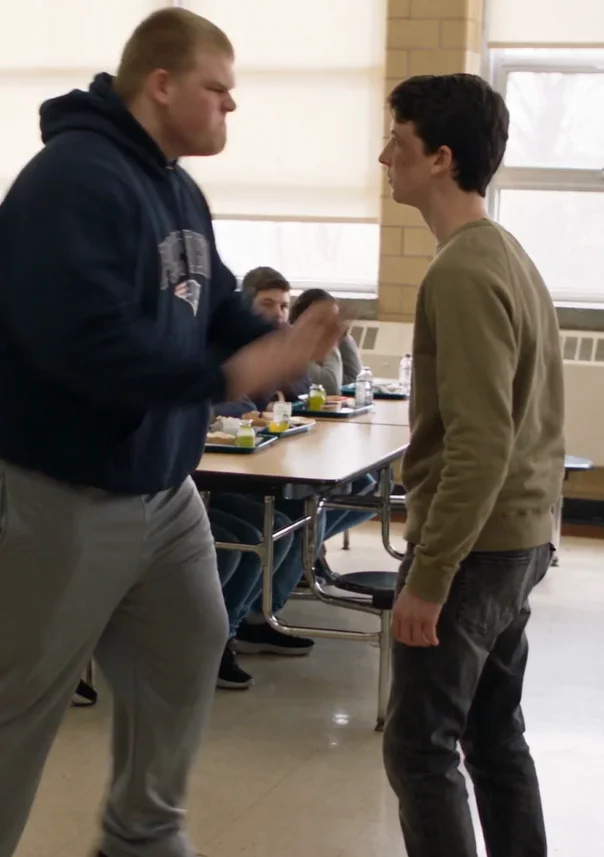
“I don’t want to push. I just wanted to say thanks for what you said yesterday.”
Jordan shrugged. “It was true.”
“Are you giving a statement?”
He tugged once more at the strap. “Bennett emailed me.”
“And?”
“And I’m thinking.”
Something sharp rose in Eli’s throat. “About what?”
Jordan’s expression tightened. “About whether I want Doyle and his friends on me for the rest of senior year.”
There it was—the part adults sometimes called reluctance as if it were a personality flaw instead of a survival calculation.
Eli stared at the cracked blacktop by the racks. “Right.”
Jordan shifted his weight. “I saw him slap you. I saw him run at you. I know what happened. It’s not that.”
“Then what’s there to think about?”
The question came out harsher than he intended. Jordan’s jaw set.
“Easy for you to ask,” he said. “You’re already in it.”
The words landed and stayed there. Eli wanted to argue, to say being “already in it” was exactly why witness silence mattered. But he also knew Jordan wasn’t wrong. Courage cost different things depending on who was being asked for it.
“Sorry,” Eli said after a beat. “That wasn’t fair.”
Jordan studied him, then nodded once. “I’ll figure it out.”
That night the formal meeting notice came.
Friday morning. Eli and Dana. Bennett. Mr. Harrison. Marcus and a parent in a separate slot. Potential additional staff if needed. Preliminary review of witness statements and evidence.
Dana printed the email and set it on the kitchen table beside two grilled-cheese sandwiches she had made for dinner because complicated weeks improved dramatically in the presence of melted cheese.
“Potential additional staff if needed,” Eli read. “That sounds ominous.”
“It sounds like they’re trying to keep options open.”
He rubbed one thumb along the edge of the paper. “What if they decide I should’ve just taken the hit?”
Dana looked at him over the top of her glass. “Then we challenge that. But we don’t challenge something that hasn’t happened yet.”
He knew she was right. It remained irritating.
The audio file lived now in three places: Bennett’s inbox, Dana’s laptop, and a locked cloud folder Dana had set up because she believed in backups the way some people believed in saints. Yet the existence of the file did not erase uncertainty. Eli kept hearing Mia’s line: when adults hear chair, some of them stop listening.
By Friday morning his stomach felt hollow all the way to school.
He spent first period pretending to annotate a chapter of The Great Gatsby and thinking instead about room geometry. Where people had stood. Who could see whom. How far sound traveled over cafeteria noise. Whether honesty sounded weaker when delivered without anger.
At ten fifteen, Bennett sent for him.
The review did not happen in her office this time. It happened in a small conference room with a rectangular table, three legal pads, a box of tissues no one had asked for, and the district’s mission statement framed crookedly on one wall. Dana sat on Eli’s left. Bennett sat at the head. Mr. Harrison sat opposite them, hands linked too tightly in front of him. The evidence envelope with the smart-pen rested near Bennett’s folder.
“We are not concluding this meeting today,” she began. “We are clarifying what still needs clarification. Understood?”
Everyone nodded.
She reviewed the basics. Marcus had a split lip and bruised shin consistent with falling after striking a metal object. Eli had a reddened cheek and reported being slapped. Multiple students placed the confrontation at the radiator-side table and confirmed escalating verbal hostility. One student clearly saw Marcus shove Eli before the fall. One adult—Mr. Harrison—arrived only after Marcus was already down.
Then she turned on a speaker and played a short segment of the audio file.
Eli felt his skin tighten all over.
The room filled with cafeteria noise, Marcus’s voice saying, Quit acting like you can’t hear me, the crack of the slap, gasps, and then the clear, ugly line: I just hit a spineless coward.
Mr. Harrison looked down.
Bennett stopped playback before the charge.
“We are not using the file as a complete visual record,” she said. “But we are acknowledging that this portion strongly supports Eli’s report that he was struck before the fall.”
Dana said nothing. Her stillness in that moment felt more pointed than any outburst could have.
Mr. Harrison cleared his throat. “I didn’t hear the slap when I came in.”
“No,” Bennett said. “You came in after the collision.”
He nodded once, stiffly.
Bennett continued. “Where we still need precision is the exact nature of Eli’s use of the chair and whether that use was proportionate self-protection or excessive force.”
The sentence turned the air in the room thin.
Dana’s eyes sharpened. “He moved a chair in front of a person who was charging him after that person slapped and shoved him.”
“And we are still documenting who observed that movement clearly,” Bennett replied evenly. “One witness described it similarly. Another described Eli ‘sticking the chair out’ without certainty about distance or timing. This is why we do not stop at first impressions.”
Eli sat very still. He could feel hope and anxiety rising together, which was an awful sensation, like being warmed and iced at the same time.
At the end of the meeting, Bennett said one more witness had not yet submitted a full statement but had requested to speak in person that afternoon.
“Who?” Eli asked.
She looked at him for half a beat and answered, “Jordan Ruiz.”
It should have felt like a victory.
Instead it felt like a cliff edge.
All Friday afternoon Eli existed in two places at once.
Outwardly, he attended class. He copied notes on Reconstruction amendments. He solved three geometry proofs. He answered one question in Spanish about weekend plans with a sentence so automatic he barely knew what he’d said.





