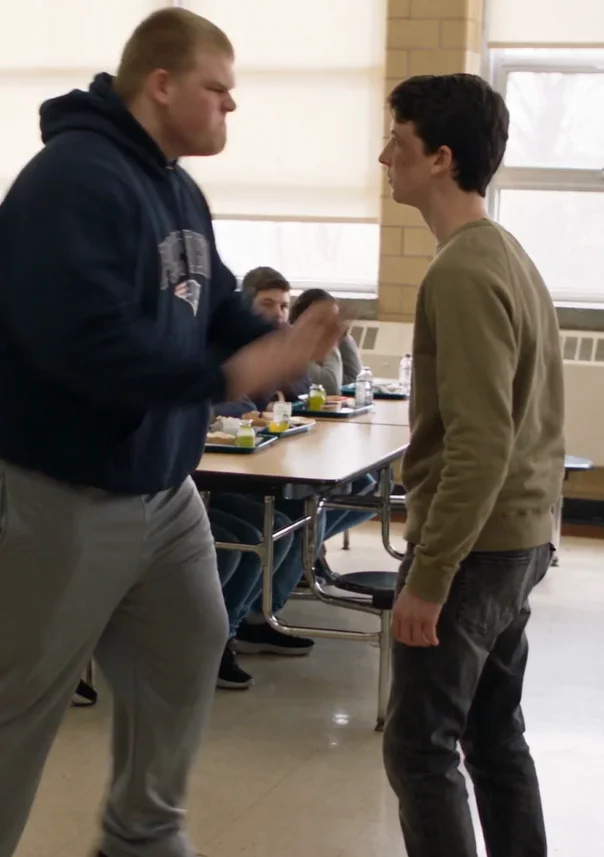
After school, Dana met him outside the building with the look of someone trying not to ask the entire question before her child had both backpack straps on his shoulders.
“Well?”
“It was lunch,” he said.
She narrowed her eyes. “And?”
“I sat there. Nothing exploded. Mia and Jordan joined me. Harrison didn’t act weird. Bennett made a radiator joke.”
Dana blinked. “A radiator joke?”
“It’s a long story.”
She laughed, a sound of actual relief this time, and bumped his shoulder lightly as they walked toward the train.
That evening the written correction from Harrison arrived by email. True to Bennett’s promise, it stated only what he had directly observed, when he observed it, and that subsequent review had established he responded after the precipitating aggression had already occurred. Dana printed the new version and slid it into a folder labeled School in the desk drawer, beside report cards and immunization records and the thousand ordinary papers that make up a child’s institutional life.
“Do you want a copy?” she asked.
“Yeah,” Eli said.
He wasn’t sure whether he wanted it as proof or as closure. Maybe both.
The week that followed settled further.
Marcus served his suspension and returned quieter. The no-contact directive held. In hallways he looked away first. Coach Ellis kept him on limited participation for another stretch, and whatever conversations happened behind team-room doors did not spill out in any dramatic public form. That disappointed students who had hoped for either total ruin or cinematic revenge, but adult life often looked disappointingly procedural from the outside. Eli had come to see that as a strength.
Procedural also meant repetitive, in some useful ways. He went back to quizzes and attendance slips and the tiny absurdities of school life. His calculus teacher returned a test with a ninety-four circled at the top and a note asking whether he had considered peer tutoring. The custodian near the science wing stopped him one morning and, with the discretion of someone who had worked around teenagers for decades, said only, “Glad it got sorted.” Dana began asking less often whether he was okay and more often whether he had remembered to take chicken out of the freezer before she got home. These were improvements. Trauma tried to convince people it should dominate every conversation forever. Routine argued back.
One Wednesday afternoon, while waiting for the late bus because Dana had a double shift, he found himself alone in the library annex with the smart-pen and notebook spread out in front of him.
The pen had been returned after evidence logging, unremarkable again except for history clinging to it. He clicked it once. The tiny red light blinked on.
Then he clicked it off.
He didn’t need it running all the time anymore.
That was not because danger had vanished from the world. It was because he no longer needed every ordinary hour preserved in case somebody stronger tried to rewrite it. Preparedness still mattered. So did breathing.
On the following Friday, Bennett asked to see him briefly.
He stepped into her office expecting paperwork.
Instead she handed him a copy of the final determination memo with all signatures complete and said, “I want you to know something schools are not always good at saying to students. Your calm helped. Not because calm is morally superior to anger—anger was warranted—but because your consistency made it easier to protect the facts from everybody else’s momentum.”
He took the memo. “I wasn’t calm all the time.”
“No,” she said. “You were honest all the time. That’s more useful.”
He thought about that on the way out.
At lunch, the radiator table had become less symbolic by simple repetition. He sat there because he liked the warmth, not because reclaiming space made a speech. Sometimes Mia joined him. Sometimes Jordan. Sometimes nobody. Once Harrison passed by and said, “Table’s popular again,” in a tone so dry Eli couldn’t tell if it counted as humor or self-defense. He decided not to make him work for the distinction.
November edged toward winter. The windows grew colder at the corners. The radiator clicked louder. The school’s appetite for novelty moved on to a teacher engagement rumor, a canceled pep rally, and the fact that someone in senior parking had hit a traffic cone so hard it ended up on the vice principal’s hedges. Human attention was a mercy when it drifted.
Yet some things remained.
Mia and Eli ended up assigned as partners on an English presentation and discovered they worked well together because neither of them tolerated sloppy arguments. Jordan still claimed every math teacher on staff was in a secret contest to underestimate homework time. Dana still kept copies of important documents in folders so orderly they could probably withstand a flood. The ordinary afternoons were the real evidence that the crisis had ended. Once, Dana came home to find Jordan at the kitchen table and automatically started making grilled cheese for two extra people as if feeding witnesses were an extension of due process. Another time Mia stayed on a call with Eli for forty minutes while they argued over presentation slides and somehow ended up discussing which teachers in the building could survive a zombie movie. Nothing about those scenes would have impressed anybody looking for drama. That was exactly why Eli treasured them. They proved the story had moved back into life instead of staying trapped inside the incident.
And Eli, without announcing the choice to anyone, began carrying the smart-pen again exactly as before.
Not as a weapon. Not as a charm. Simply as a pen.
The last warmish day before Thanksgiving break brought one final conversation he had not expected.
Marcus caught him after lunch near the exit to the courtyard where teachers could see both ends of the hall. He stayed well beyond arm’s reach.
“I know I’m not supposed to talk to you much,” Marcus said.
Eli waited.





