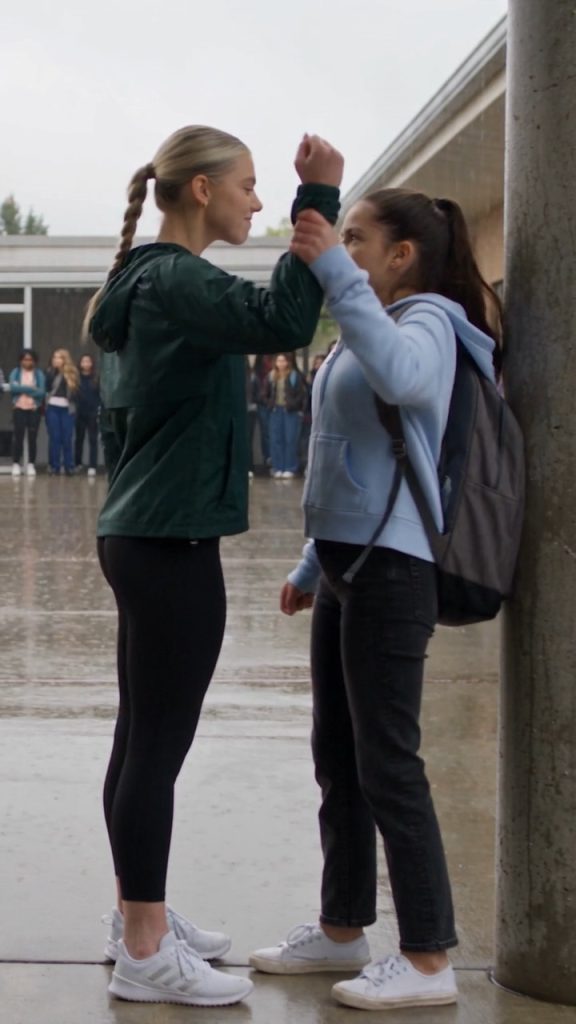
“If you didn’t hear everything, don’t say you did. If you didn’t see the first minute, don’t say you did. Just tell the truth about your part.”
Kenzie stared at me in a way that made me wonder if she had expected me to demand loyalty instead of precision.
“Okay,” she said quietly.
Before I could answer, Brynn’s voice cut across the hall.
“There you are.”
We both turned.
Brynn was walking toward us with Lena half a step behind, a suspicious brightness in her expression. “Practice starts in ten,” Brynn said, then looked from Kenzie to me. “Everything good here?”
Kenzie’s shoulders visibly tensed.
“Fine,” she said.
Brynn smiled at me without warmth. “Hope you’re not trying to recruit people into your little story.”
My pulse kicked, but this time I didn’t shrink from it.
“I don’t need to recruit anyone,” I said. “People were there.”
Brynn’s smile thinned. Lena rolled her eyes.
Kenzie said nothing.
After they left, I stood by the trophy case for another minute, wondering whether I had just watched Kenzie lean toward honesty or away from it.
Thursday’s whispering campaign had another effect I hadn’t expected: it shrank time. Every class period felt slightly unreal, divided between whatever the teacher was covering and the running awareness that somewhere else in the building, adults were comparing videos and statements about me. In chemistry, the teacher explained ionic bonds while I copied half the notes and lost the other half to thought. In algebra, I caught myself staring at Amir’s backpack and wondering what it felt like to carry evidence on a device in your pocket while pretending to care about homework.
At lunch, after Jordan left, Olivia returned to the library table and studied my face for a second before sitting down. “Good meeting?” she asked.
“Useful,” I said.
She accepted that level of detail. Then she began quizzing herself with note cards while I peeled an orange in slow spirals, the citrus smell sharp and clean in the library air. There was something restorative about being near someone who understood silence did not always need to be broken. By the time lunch ended, I realized an hour had passed without my shoulders once creeping toward my ears.
That evening, once homework was finished, I walked the narrow path behind our apartment complex while Mom was on a telehealth work training in the living room. The air smelled of damp bark and cold grass. I called Tessa, my best friend from Eugene, who had been bombarding me with question marks ever since Mom told her there was drama.
“Okay,” Tessa said after I explained. “First of all, Ashley sounds awful. Second, the fact that people are acting like a cropped video is the Ten Commandments is making me violent.”
I laughed despite myself. “Please don’t become a cross-town vigilante.”
“No promises. But seriously, are you okay?”
I thought about the question longer than she probably expected. “I’m more okay now that it’s not just my word,” I said. “I keep thinking that’s bad, like I should trust myself more.”
“That’s not bad,” Tessa said immediately. “That’s just how being believed works half the time. You can know what happened and still need proof because other people are lazy.”
Her bluntness helped. When we hung up, I didn’t feel magically fixed. I felt accompanied, which was almost as useful.
That night, Mom and I ate takeout noodles at the kitchen counter while I filled her in.
“Jordan’s video shows the first part,” I said. “Amir’s shows the second part. And Kenzie might tell the truth.”
“Might,” Mom repeated.
“Yeah.” I pushed noodles around with my chopsticks. “I keep thinking if this were simpler, someone would have fixed it by now. But everything’s pieces.”
Mom leaned against the counter. “A lot of truth is like that.”
I hated how wise and unhelpful that sounded until she added, “Which is why your job remains the same. Tell your piece accurately. Let the pieces line up.”
Later that evening, my phone buzzed with a message from an unknown number.
It was Kenzie.
I got your number from the team directory before you think I’m being creepy. I’m meeting Lewis tomorrow morning.
A second message followed.
I’m scared, but I’m doing it.
I stared at those words until they blurred a little.
Then I typed back:
Tell the truth. That’s enough.
Friday’s match was less than twenty-four hours away. Rumors still swirled. Ashley still had her title. The school still had not announced anything.
But for the first time since Tuesday, I felt the balance shift by a fraction I could actually sense.
The problem was that fractions were fragile.
And as I walked into school on Friday morning, I had no idea whether Kenzie would still be standing on the same side of her own courage when the day demanded proof.
Friday stretched itself tight from the minute I stepped onto campus.
Friday morning, after I dressed, I stood at the bathroom sink with my palms pressed lightly to the counter and tried to slow my breathing. There was something almost comical about how school investigations forced ordinary teenagers to become amateur archivists of their own pain. Had Ashley stood slightly left of me or directly in front? Which teammate had laughed first? Who exactly had been visible by the covered walkway? The facts mattered because the story mattered, and the story mattered because adults could only protect what they were willing to name correctly.
When Mom drove me in, she did not fill the car with advice. She only said, “Whatever happens today, remember that you were honest the whole time.” That should have been enough to steady me. Instead it reminded me how little control honesty gave over outcomes.
The courtyard looked newly innocent under dry weather, and I hated it for that. Rain had at least made the whole scene feel as ugly as it was. Sunshine—thin as it was—made the campus look capable of pretending.





