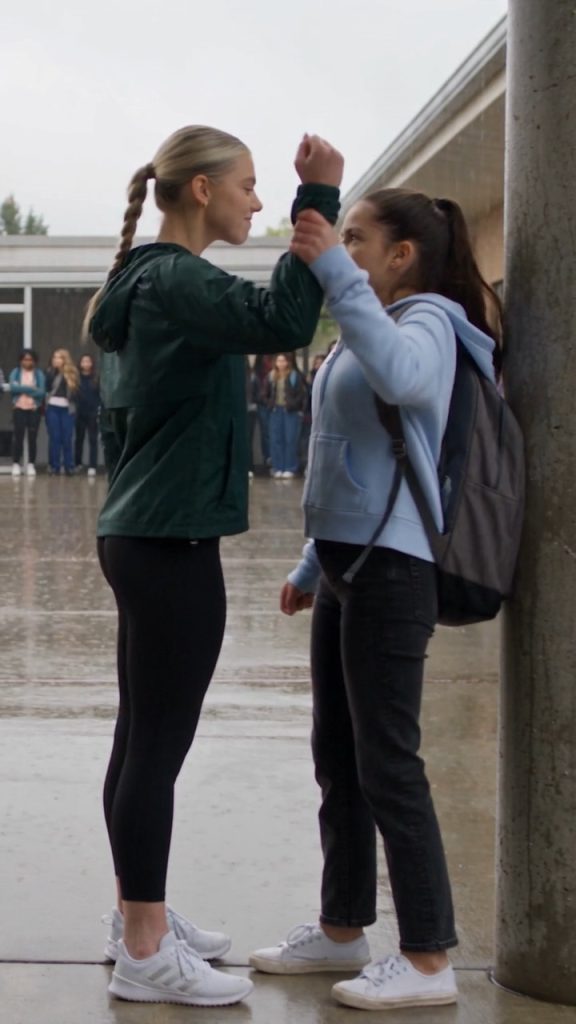
The fact that he had to say that made me wonder how many student investigations got wrecked by edits before adults ever saw them.
“I understand,” I said.
“There’s one more thing,” he said. “The clip circulating this morning is being reviewed, but by itself it is incomplete.”
By itself it is incomplete.
It wasn’t a promise that he believed me. It was better than that. It was a statement that the obvious thing was, in fact, obvious.
When I left the library conference room, Amir was waiting near the drinking fountain.
He glanced down the hallway before speaking.
“I recorded some of it,” he said.
I stopped. “You did?”
He nodded once. “Not the beginning. I was under the walkway on the south side. I started filming when she was talking at you by the pillar. My angle’s different from that clip going around.”
“Did you post it?”
“No.” He looked mildly offended by the idea. “Somebody must’ve gotten a copy from someone else, or from someone screen-recording while people passed phones around. I still have the original on my phone.”
My pulse quickened. “What does it show?”
“Her reaching for you again,” he said. “You catching her wrist. Maybe a second before that.”
Not enough to prove everything. But more than the crop.
“Would you be willing to tell Mr. Lewis that?” I asked.
He adjusted the strap of his backpack. “I’d rather give it directly to him than hand it to random people.”
“That’s exactly what he wants,” I said.
Amir exhaled, as if relieved I wasn’t asking him to become a hallway hero. “Okay. I can stop by after seventh period.”
“Thank you.”
He gave one quick nod and headed to class.
For the rest of the day, I tried to act normal. I took notes in English while the girl beside me tapped a message under her desk. I answered a history question about the Progressive Era while somebody behind me whispered, “That’s her.” I drank water, breathed slowly, and reminded myself that surviving school sometimes looked a lot like doing small ordinary things while your insides were screaming.
At the end of the day, Ms. Ortega met me in her office again.
“There may be more noise before there is clarity,” she said. “I want you prepared for that.”
I almost smiled at the gentleness of her phrasing. Noise before clarity. As if school drama were weather too.
“Amir has the original of one clip,” I told her. “He said he’d give it to Mr. Lewis.”
“That’s helpful,” she said. “And good judgment on your part not to make this into a social-media battle.”
“Good judgment or cowardice?” I asked.
She leaned back slightly in her chair. “Those are not the same thing, Maya. Refusing to perform your pain for an audience is not cowardice.”
I carried that sentence home with me.
But the internet carried something else.
By evening, the cropped clip had moved beyond group texts and into the loose, shapeless online universe of local teen gossip. Someone had added a caption over a reposted version—FRESHMAN GOES AFTER TEAM CAPTAIN—and even though the text was ridiculous, people were reacting to it as if its loudness gave it weight.
Dad texted from Eugene after Mom told him there had been an incident, asking if he should drive down. I told him not yet. I did not want my father storming into a school office on my behalf and accidentally turning my life into a custody-flavored disaster story.
What I wanted was smaller and harder.
I wanted the truth to stay intact long enough to matter.
Near nine that night, Olivia sent me another message.
If you want notes from biology tomorrow, I got you.
A minute later she added:
Also, people are being dumb.
I stared at the screen longer than either sentence probably deserved. Then I typed back:
Thank you. Seriously.
When I set my phone down, the worst part of the day wasn’t the embarrassment anymore. It was the way a three-second crop had slipped into classrooms before I could even get a full night’s sleep.
After school on Wednesday, Ms. Ortega suggested I create a short written log for myself—nothing formal, just a private list of anything that happened while the investigation was active. “If someone says something in the hallway, if a post resurfaces, if you feel unsafe in a specific space, write it down with the date and time,” she said. “Memory can blur under stress. Notes can help.”
So that evening I started a page in the back of my algebra notebook. Wednesday, 7:14 a.m.: saw cropped clip on phone. Wednesday, 12:47 p.m.: spoke with Mr. Lewis in library conference room. Wednesday, 12:55 p.m.: Amir told me he had original recording and would submit it directly. The act of writing each line down didn’t make the week less upsetting, but it did make it feel slightly more containable, as if the chaos had edges after all.
Mom looked over my shoulder while I was doing it and said, “That’s smart.”
“It feels weird,” I admitted.
“A lot of responsible things feel weird the first time.”
I kept the notebook beside my bed that night, not because I expected another crisis before morning, but because I liked the thought of facts waiting where I had left them. So much about the week had involved other people handling pieces of the truth—videos on their phones, comments in their mouths, decisions in school offices. A quiet page in my own handwriting reminded me that I had custody of my own version too.
At school the next morning, I heard two sophomores outside my locker arguing about whether the video “proved” anything.
That was the problem with fragments. They didn’t have to prove things.
They only had to spread fast enough to threaten whatever quiet place I had been trying to build at Riverton.
By Thursday, the weather had cleared, but the school still felt damp.





