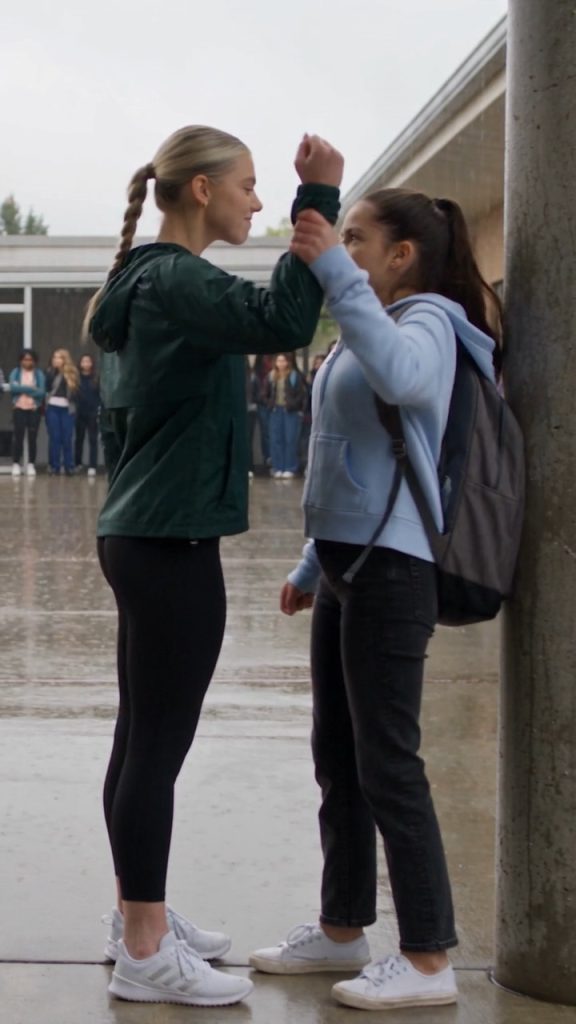
Once I was in the office chair with a paper cup of water in my hands, the adrenaline started to ebb and left me with a hollow, shaky feeling. Ms. Ortega asked me simple questions first—Was I hurt anywhere besides my head? Did I feel dizzy? Had Ashley threatened me before today?—and wrote notes in careful, neat lines.
“No,” I said when she asked if today was the first incident. “Not exactly. I mean, she’s stared at me before. And once in the cafeteria Brynn bumped my tray and then told everyone I was clumsy. But nothing like this.”
Ms. Ortega nodded, not interrupting.
I described the table. The challenge. The first pull. The shove. The second attempt. The fact that I had grabbed Ashley’s wrist only when she came at my hair again.
“Did you hit her? Push her? Twist her arm?” Ms. Ortega asked.
“No. I let go right away.”
“Good to know,” she said, writing that down too. “And there were witnesses?”
“Half the courtyard,” I said. “And some people were filming.”
Nurse Flynn arrived a minute later with a rolling stool and a kindness that somehow didn’t feel fake. She was silver-haired, brisk, and warm at the same time. She examined my scalp, pressed lightly around my shoulders, and checked the strap area where my backpack had hit the pillar.
“You’ve got mild tenderness here,” she said, touching near the base of my skull. “No swelling I’m worried about. Any nausea?”
“No.”
“Headache?”
“A little.”
She nodded and made her own note. “Ice pack for ten minutes. And I’d like you to tell your mother exactly what happened, okay?”
My phone was in the front pocket of my backpack. My hands were steadier by the time I texted Mom: Need to talk ASAP. I’m okay but there was an incident at school.
She called before I could set the phone down.
“Maya?” Her voice was tight. “What happened?”
I explained in pieces while Ms. Ortega and Nurse Flynn gave me privacy without actually leaving the room. My mother listened all the way through before she spoke.
“Are you safe right now?”
“Yes.”
“Do you want me to come get you?”
Part of me wanted to say yes immediately. I wanted to leave the building and pretend none of this school existed. But another part of me knew that if I walked out now, today would become the story Ashley got to tell by herself.
“I want to stay,” I said. “At least until I talk to whoever I need to talk to.”
Mom let out a breath. “Okay. I’m proud of you for saying that. Put Ms. Ortega on the phone for me.”
The next adult I met was Assistant Principal Lewis.
He arrived with a legal pad, a navy tie patterned with tiny silver lines, and the careful expression of a man who had already learned how complicated student stories could get. He introduced himself, thanked me for waiting, and asked Ms. Ortega if we could speak in the conference room beside her office.
There, with a box of tissues on the table and rain ticking against the window, I told the story again.
Mr. Lewis didn’t rush me. He asked where exactly the table had been, who had been present, whether Ashley had ever claimed the table before, whether I knew the names of the other girls, whether I had seen anyone specific recording. He asked what I had said before Ashley grabbed my hair. He asked whether I had cursed at her. He asked whether I had grabbed her first.
“No,” I said. “I only touched her wrist when she reached for my hair again.”
“And then?”
“I let go.”
He wrote that down too.
“I’m going to ask you to complete a written statement before the end of the day if you feel able,” he said. “We’ll also talk to the other students involved. Until we have more information, do you feel safe returning to class today?”
Safe was not a clean yes-or-no question anymore. My body was safe. My pride felt less certain.
“I can go to class,” I said. “I don’t want to be near Ashley.”
“That’s reasonable,” he said. “I’ll speak with Ms. Ortega about temporary separation for the remainder of the day.”
He did not promise instant justice. He did not say Ashley would be suspended before lunch. He did not act like one person’s account was enough by itself. Part of me hated that. Another part understood why it mattered.
By third period, everyone knew something had happened.
What surprised me was how many versions of “knowing” could fit inside a single school day. In geometry, the girl beside me kept stealing glances at the back of my head like she expected to find a chunk of hair missing. In U.S. history, a boy I had never spoken to held the classroom door for me with exaggerated politeness, as if he was trying to demonstrate that he personally did not assault freshmen in courtyards and therefore deserved credit. My English teacher, Mr. Hall, paused when he handed me a worksheet and asked in a low voice whether I needed to go to the nurse again. I told him no, and his relief told me the office had probably already warned my teachers that something had happened without sharing details.
Between classes, I passed the administration window where I had seen Ms. Chen earlier. This time she was standing beside the copy machine, speaking with another teacher. She looked up as the hallway traffic moved by and gave me a distracted, almost apologetic smile that made me wonder whether she had heard enough office rumor to realize her office window had become part of the story. I did not stop to ask. I wasn’t angry at her exactly. I was angry at the whole architecture of being visible and still somehow alone.





