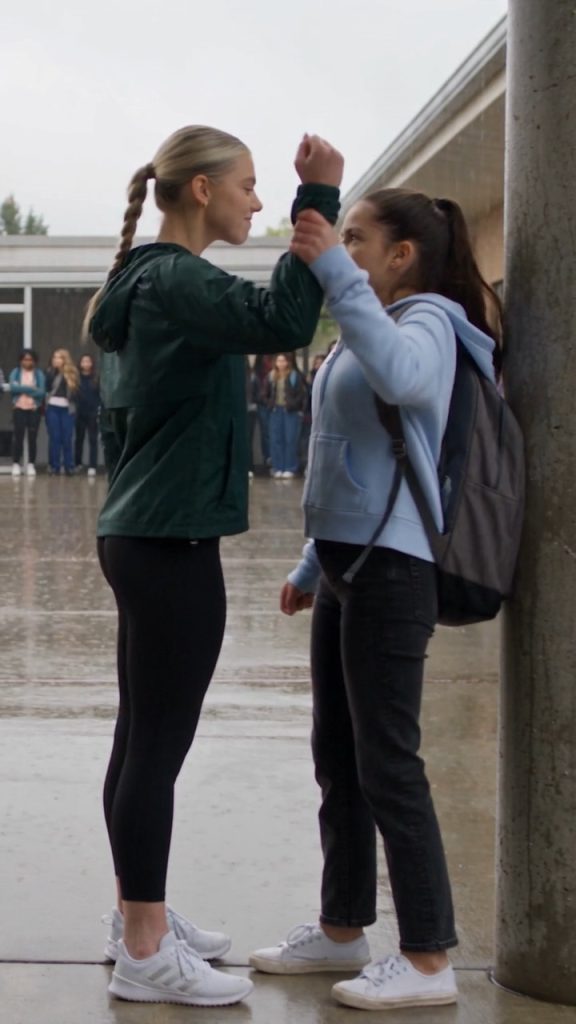
Lying in bed later, I listened to rain ticking against the bedroom window and thought about what Lena had said—Maybe she’ll have to transfer schools again. She couldn’t have known how precise that insult was. At my old school in Eugene, I had spent the second half of eighth grade learning how to navigate divorced-parent schedules and the first half of freshman year learning a new bus route after the move. Riverton was supposed to be the place where things stabilized. I hated that one lunch period had already made me wonder, if only for a second, whether stability could be taken away from me again.
“You do not have to disappear because somebody decided to act like they owned the air around them,” she said.
I wanted to believe her.
But when I went to bed, my scalp still ached where Ashley’s hand had been, and all I could think about was the look on her face when I caught her wrist: surprised, offended, and already planning how to turn it around.
By the time I fell asleep, Ashley’s statement was in the school’s hands too.
And before anyone had even checked a single video, my word and hers were already fighting for space in the same room.
I woke on Wednesday with a headache and a phone full of notifications.
For half a second, before I unlocked the screen, I let myself hope the messages were from my old friend Tessa in Eugene or from my cousin in Salem or from anyone whose life had nothing to do with Riverton High. Instead the top notification came from an unfamiliar number that had somehow made it into one of the freshman group chats.
Did you really grab Ashley?
Below it was another.
Saw the video. Wild.
And below that, from Olivia Perez, the quiet girl who sat two rows over from me in biology and had borrowed my glue stick last week:
Hey. Don’t answer if you don’t want to. People are talking.
My stomach tightened.
I clicked on the video someone had sent.
The clip was less than three seconds long. It began with Ashley’s arm extending toward me, but the angle and the crop made it almost impossible to tell where her hand had been a second earlier. Then my left hand closed around her wrist, and the clip ended there, right on Ashley’s startled face.
No hair pull. No shove. No pillar. No backpack hitting concrete. Just the part where it looked like I had laid hands on the school’s golden girl.
My throat felt raw before I’d even left my bed.
I watched the clip three more times, each viewing somehow making my chest feel tighter instead of looser. The human brain did a cruel thing with partial evidence: it started filling in missing context using whatever emotion came easiest. If someone already liked Ashley, the clip let them imagine me as dramatic and reactive. If someone distrusted athletes or popular kids, they might see my expression and assume I had survived something awful without actually understanding what. Almost nobody who watched that crop would stop and ask the boring question that mattered most: what happened five seconds earlier?
Mom set a plate of toast in front of me, even though I had not asked for food. “People love simple villains and simple victims,” she said. “Especially when there’s video. But the truth is usually more awkward than that.”
I traced my thumb over the edge of my phone. “I hate that the simple version is the one moving.”
She sat across from me. “That may be true for a little while. It doesn’t mean it stays true where decisions get made.”
On the drive to school, those words circled in my head. Cedar Glen was one of those towns that liked to think of itself as big enough for opportunity and small enough for familiarity. In practice, that meant everybody’s older sibling knew somebody’s coach, somebody’s parent worked with somebody’s aunt at the hospital, and every piece of teen drama had roots that reached further than the students involved. By the time Mom dropped me at the curb, I had to consciously unclench my jaw before getting out.
The hallways felt louder that morning, not because more people were speaking, but because every conversation sounded to me like it might contain my name. When I reached my locker, a pair of sophomores in soccer hoodies broke off their whispering as I approached. One of them gave me a sympathetic smile. The other looked embarrassed on my behalf. It was amazing how quickly pity and curiosity could dress themselves alike.
Mom looked up from the coffee maker when I walked into the kitchen. She took one look at me and asked, “What now?”
I showed her the video.
She watched it once, jaw tight, then watched it again. “This is cropped.”
“I know.”
“Who posted it?”
“I don’t know. It got sent around from somebody’s cousin or a screenshot or whatever. It’s just… out there.”
Mom set her mug down. “Are you thinking about posting your side online?”
The fact that she asked instead of telling me what to do made me love her a little harder.
“I thought about it,” I admitted. “I could write that she grabbed my hair first. I could tell everyone they’re idiots.”
“And would that make this easier?”
“No.”
“It might make it louder,” Mom said. “Which is not the same thing.”
I knew she was right. Cedar Glen wasn’t huge. Riverton had one of those ecosystems where a rumor could travel from varsity practice to freshman algebra before the buses even left the parking lot. If I started posting in anger, I’d be giving Ashley exactly what she wanted: a public mess she was better equipped to survive.
So I made another choice.
“I’m not posting,” I said. “At least not now.”
Mom nodded. “Then today your job is to tell the truth where it counts.”





