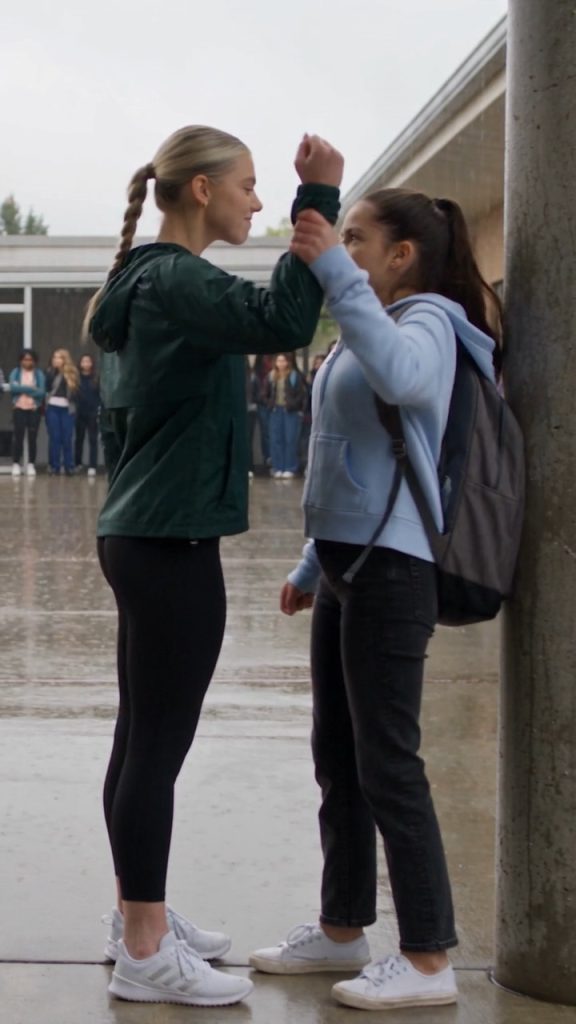
“I’m going back,” I said before she had even finished.
Both adults looked at me.
“To lunch,” I clarified. “I don’t mean today. But I’m not giving up the courtyard forever.”
Mr. Lewis gave a small, approving nod. “That is your right.”
Hearing the word right, not option or preference, made something settle more firmly inside me.
Mr. Lewis continued before relief could make me stop listening.
“The recordings and corroborating statements support that Ashley pulled your hair and shoved you into the pillar. They also support that your contact with Ashley’s wrist was brief and defensive in response to a second attempted grab.”
Mom let out a breath beside me. I hadn’t realized she had been holding it.
Dean Robins slid a paper across the table. “We are implementing a no-contact directive effective immediately,” she said. “Ashley is not to approach you, speak to you, message you, or use other students to communicate with you. We’ve notified the relevant students and staff. If you have any shared spaces, we will help manage them.”
I looked down at the paper. My name at the top looked both familiar and strange.
“Lunch?” I asked.
“You may sit at any open lunch table on campus,” Mr. Lewis said. “That includes the courtyard table involved in this incident. We will also assign additional adult visibility to that area during lunch next week.”
The sentence should not have felt like a gift. It should have felt ordinary. But that was one of the ugliest things about bullying: it made ordinary rights feel like prizes returned by people who should never have touched them.
“What happens to Ashley?” Mom asked.
Mr. Lewis’s expression remained measured. “Specific student-conduct consequences are confidential. I can tell you that this matter has been addressed and documented according to our procedures.”
Which meant there was an answer, just not one they were allowed to hand me in a satisfying little box.
I understood that, even if a childish part of me wanted details.
Dean Robins added, “We are also addressing the circulation of misleading edited footage. Students involved in reposting have been instructed to remove it where possible and refrain from further distribution.”
“Where possible,” I repeated.
She met my eyes. “We cannot promise total internet erasure. But we can respond appropriately within the school community.”
It wasn’t a fairy-tale ending. It was something better: a truthful one.
“Thank you,” I said, and meant it.
When we left the conference room, Mom hugged me in the hallway hard enough to make my backpack slip.
“I am so proud of you,” she said into my hair.
My throat tightened. “I thought they might not believe me.”
“I know.”
Ms. Ortega stood a few feet away, giving us privacy while also making it clear she was still part of the safety net around this moment.
“There may be social aftermath for a while,” she said after Mom released me. “But the school’s findings are clear. If anyone retaliates, you report it. Immediately.”
I nodded. “I will.”
Mom had to go back to the hospital for part of the evening shift, but before she left she asked, “Do you want to go home, or do you want to stay and watch what happens?”
I knew what she meant without her saying Ashley’s name.
After the meeting, Mom and I drove home mostly in silence. Not awkward silence—more the silence of two people whose nervous systems had finally come down enough to hear ordinary sounds again. At a stoplight, she reached over and squeezed my hand.
“You know,” she said, looking back at the road, “when we moved here, I worried most about whether you’d make friends and like your teachers. I didn’t think to worry that some kid would test whether this school knew how to protect you.”
I watched the line of evergreens beyond the shopping center slide past the window. “Do you think they did?”
She considered. “Eventually, yes. Imperfectly. Slowly. But yes.”
That answer felt right. I had wanted lightning-bolt justice on Tuesday. Instead I got forms, interviews, original files, and adults trying not to overclaim what they knew. It was messy and frustrating and still more trustworthy than speed would have been.
At home we ordered pizza and watched half a baking show because neither of us had the energy for anything requiring emotional stakes. Every so often I caught myself smiling for no clear reason except that I was no longer bracing for disbelief. The apartment looked the same as it had all week—the stack of mail on the counter, my sneakers by the door, Mom’s stethoscope looped over a kitchen chair—but now I could move through it without carrying that same heavy, suspended dread.
The volleyball team had a home match that evening.
Part of me wanted to leave campus and let the adults and the team sort themselves out far away from me. Another part wanted to stay—not out of revenge, but because I was tired of leaving first.
“I want to stay,” I said.
So we sat in the gym bleachers with a scattered crowd of parents and students drifting in. I bought a bottle of water from the booster table with money Mom pressed into my hand. We sat high enough to see the bench clearly.
Ashley came out in her warm-up jacket with the team, and for one half second everything looked normal.
Then Coach Park walked to the scorer’s table with the lineup sheet.
She spoke quietly with the officials. A minute later she gathered the team near the sideline.
I was too far away to hear every word, but I didn’t need to. Bodies told their own stories. Brynn stiffened. Lena’s mouth dropped open. Kenzie stood very still. Ashley’s face went pale with anger, then flushed hard red.
When the starting lineup was announced, Ashley’s name was not among the six on the floor.
Neither was her title.





