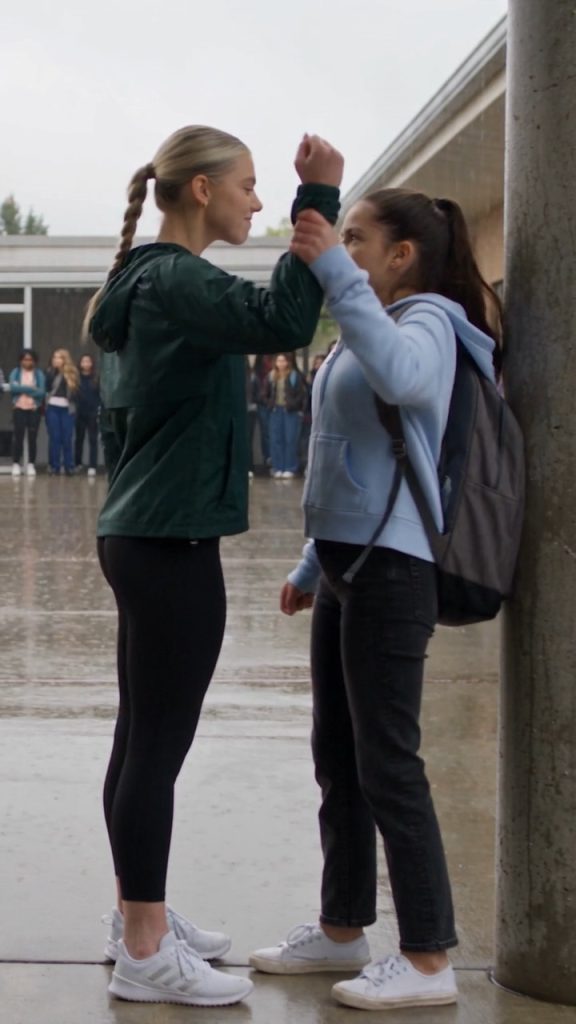
At lunch I ate crackers Ms. Ortega found in her office instead of going back outside. The tiny plastic sleeve of peanut butter sat beside them on a napkin, and I stared at it as if deciding whether to open it required major emotional labor. Ms. Ortega sat across from me for part of the time and asked practical questions instead of dramatic ones.
“Has Ashley approached you in the halls before today?”
“Not directly.”
“Have her teammates?”
“Brynn mostly. Little comments. Nothing I could explain without sounding oversensitive.”
“That doesn’t make them unimportant,” she said.
I appreciated that. There was something healing about an adult who understood that patterns often began as tiny permissions—bumps in hallways, dismissive laughs, public eye-rolls—before becoming something even bystanders recognized as serious.
Before final bell, when I wrote my statement in the conference room, I found myself obsessing over small accuracy questions. Had Ashley said “our table” before she first touched my hair or at nearly the same time? Did Lena make the transfer comment immediately after the shove or half a second later? Was Jordan’s phone already raised then, or had it lifted afterward? I kept crossing out sentences and rewriting them in cleaner order because the idea of getting one detail wrong suddenly felt dangerous.
Ms. Ortega noticed and said, “This is not a courtroom transcript. It’s your statement of what you remember. Be honest, not perfect.”
So I wrote that I believed Jordan’s phone had been visible by the time Ashley shoved me, but I was not certain when exactly recording started. I wrote that Ms. Chen had been looking down from my perspective, but I couldn’t prove what she saw. I wrote that I had caught Ashley’s wrist with my left hand and released it immediately when she told me to get off. The more precise I became about what I knew, the less afraid I felt of what I didn’t.
When I finished, I sat there staring at my signature for a second. Maya Bennett looked like such an ordinary name on paper. It did not look like the sort of name that should have to justify the right to eat lunch in peace. And yet the page in front of me was proof that ordinary girls could end up carrying extraordinary burdens just because someone popular decided to test whether anyone would stop her.
Mr. Lewis returned just before the buses started loading. He accepted the form, glanced over the top line, and said, “Thank you. We’re also receiving a statement from Ashley Reed this afternoon.”
I looked up sharply. “Already?”
“She and the other students involved have the right to submit their accounts as well,” he said.
A cold, tired feeling spread through me that had nothing to do with the rain outside.
“What is she saying?”
He paused. “I can’t share everything another student writes. But I can tell you there is a dispute about who initiated physical contact at the end of the incident.”
Of course there was.
One second. That was all Ashley needed. One second of me stopping her hand, and she could build an entire shield out of it.
That night Mom reheated tomato soup I barely tasted while she sat across from me at the kitchen table and asked if I wanted to talk or watch something stupid on TV and not talk at all. I chose both, in that order. I told her the same story I had told three adults already. She listened carefully, asked whether I wanted Dad to know, and didn’t criticize me when I said I wasn’t ready to make this a bigger family conversation yet.
When I got home Tuesday afternoon, the house felt unusually small, as if school had followed me through the front door and was standing in the kitchen pretending not to be there. Mom’s apartment was a two-bedroom second-floor rental in a complex with narrow outside stairs and a parking lot that always smelled faintly like wet cedar. Usually I liked its size. After moving, smaller had meant manageable. That day it meant there were fewer places to put all the feelings I had dragged home with me.
While the soup warmed on the stove, Mom asked if I wanted to tell the story from the beginning or from the part that was still replaying loudest. It was such a therapist-style question that I gave her a look.
“What?” she said. “I work around doctors. Some language rubs off.”
“The loudest part,” I said.
So I told her again about Ashley’s hand in my hair and the split second after I caught her wrist. I told her how weird it was that the moment I finally did something active was the exact moment Ashley would probably use against me. I told her about the phones, which bothered me more with every hour that passed.
“People keep recording because it lets them imagine they’re outside the situation,” Mom said quietly. “Like they’re documenting it instead of participating in it.”
“But they are participating.”
“I know.”
After dinner I tried to do algebra homework at the kitchen table and spent twenty minutes on one problem because every time I saw the minus sign my brain wandered back to subtraction of a different kind—what gets lost when an incident gets boiled down to whoever tells it loudest. Eventually Mom took the worksheet away, not unkindly, and told me to shower and sleep.
In the shower I discovered a faint red line at the base of my scalp where Ashley’s fingers had pulled hardest. It was not dramatic. Nobody would have taken a picture of it for evidence and gasped. That somehow made me angrier. Harm didn’t become more real just because it looked ugly enough for an audience.





