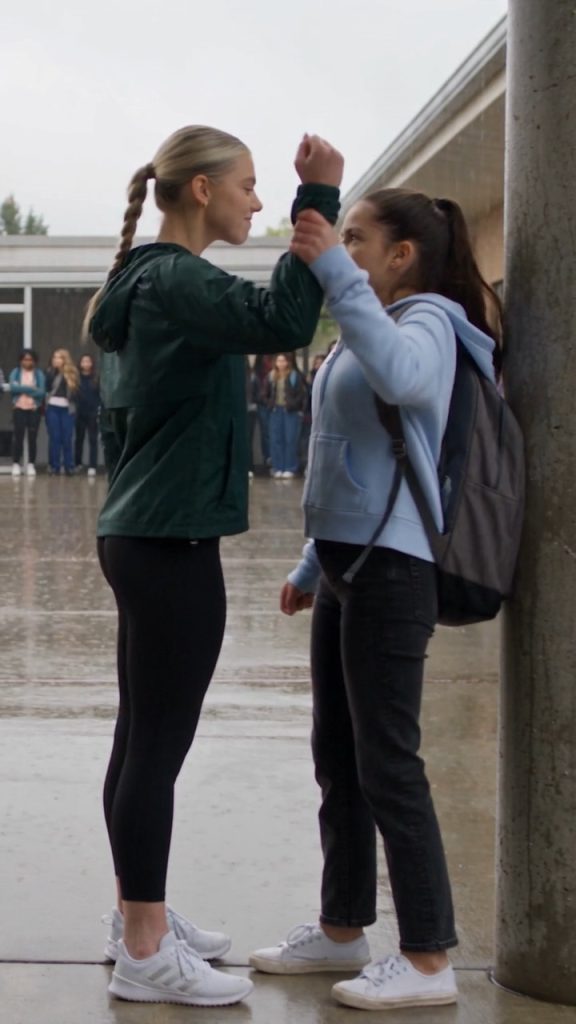
Before first period, I checked in with Ms. Ortega like she’d requested. She had already spoken with Mr. Lewis and typed up a temporary plan on a bright yellow sheet.
“For the rest of this week,” she said, handing it to me, “if you feel unsafe at lunch, you may come here or to the library. But I want to be clear: you also have the right to use any open lunch space on campus. This is a support option, not exile.”
The wording mattered so much that my eyes almost stung.
“Thank you,” I said.
“We’ve also asked Ashley and her teammates not to contact you while the review is ongoing,” Ms. Ortega continued. “If anyone approaches you, report it immediately.”
“What if they don’t talk to me and just…” I gestured vaguely. “Talk around me?”
“That unfortunately may happen,” she said. “Rumors are harder to police. But please tell me if they cross into harassment.”
When I got to second-period algebra, three people looked up from their desks with the specific brightness of people who had already watched a video and then remembered the person in it had to share oxygen with them. Amir Hassan, who sat one row over and one seat back, glanced at me and then quickly at his notebook. He was skinny, soft-spoken, and usually invisible in the way some smart juniors managed to be. I had never had a real conversation with him.
By lunch, the atmosphere had turned from curious to sharp.
Some kids acted like the clip was entertainment. Others acted like they were reserving judgment while still enjoying the drama. A few people avoided looking at me entirely, as if any eye contact might drag them into a problem they had not ordered.
I carried my tray to the library because I did not trust my composure enough for the courtyard.
The library had become a strange kind of shelter by then—not safe exactly, because nothing felt fully safe while the rumor was still alive, but quieter than the cafeteria and less performative than the courtyard. Mrs. Henley, the librarian, had learned my name on my third day at Riverton because I checked out a copy of Their Eyes Were Watching God before I knew whether reading for fun would make me look lonely. Now she gave me the same nod she gave everybody else and did not stare at me as if I were an active headline. That alone felt generous.
Olivia unpacked her lunch with the deliberate neatness of someone who alphabetized note cards for pleasure. “If you want me to tell people the clip is obviously chopped up, I will,” she said after a while.
I glanced at her. “Would that do anything?”
She considered. “Probably not to the people enjoying themselves.”
“Exactly.”
She popped a fry into her mouth. “For the record, though, the people enjoying themselves are the worst.”
I smiled despite myself. Her bluntness worked because she never sounded like she was trying to audition for savior status.
When Mr. Lewis called me into the conference room, I expected a short logistical check-in. Instead he spent several minutes explaining, in more detail than adults usually gave kids, why original files mattered. Time stamps could show when a video was made. Metadata could establish that a file had not been obviously edited. Compression and screen recordings could obscure what had been visible in the original frame. Most students probably would have found the explanation boring. I found it oddly reassuring.
It meant someone in the building was thinking about truth as a process instead of a vibe.
“Social media compresses events,” he said. “The school should not.”
I stored that sentence away immediately.
It also struck me that he kept using words like review and context instead of control and punishment. It was slower than I wanted. It was probably also the reason his eventual decision would hold up against the confidence Ashley naturally carried into every room.
Halfway there, Olivia caught up with me.
“Hey,” she said, keeping her voice low. She had dark curly hair in a clipped-up puff and wore a green cardigan over a Riverton band T-shirt. “Do you mind if I walk with you?”
I was so unused to anyone asking permission that it took me a second to answer.
“Sure.”
We walked in silence for a few steps. Then Olivia said, “I saw the clip, but I also saw how short it was.”
That tiny sentence settled something tight in my chest.
“Thanks,” I said.
“I don’t know you that well yet,” she went on, “but you don’t exactly seem like someone who attacks varsity captains for fun.”
Despite everything, I almost laughed. “It wasn’t fun.”
“Yeah, I guessed.”
She didn’t push me to explain further. She just sat at the far end of the library lunch table while I picked at fries and answered a text from Mom letting her know I was okay.
At twelve forty-five, the library doors opened and Mr. Lewis appeared.
“Maya,” he said quietly. “Could you step into the conference room for a minute?”
Inside the small room beside the circulation desk, he had a folder under one arm and an expression I couldn’t read.
“We’ve received your written statement,” he said. “Ashley and two of her teammates have also submitted written accounts.”
“Only two?”
“Only two so far.”
That meant Kenzie hadn’t. I wasn’t sure why that mattered to me, except that her hesitation in the courtyard had planted itself in my head.
Mr. Lewis continued. “You mentioned that students may have recorded part of the incident.”
“Yes.”
“I want to stress that original recordings are more useful than circulating snippets. If anyone approaches you about footage, do not pressure them, and don’t ask them to send material to a group chat. Ask them to preserve the original and submit it directly to administration.”





