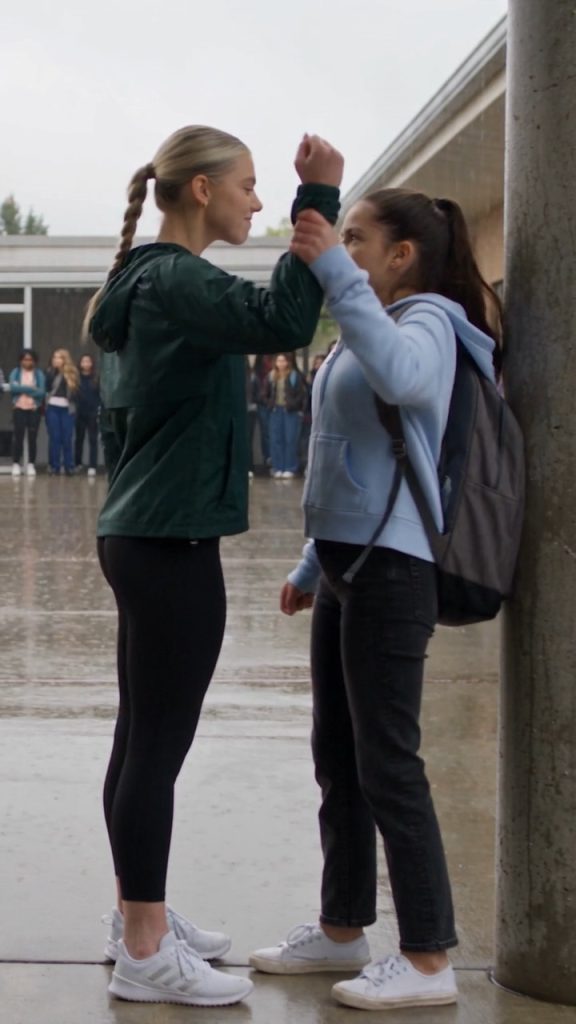
The sky was pale and dry after three straight days of rain, and the courtyard looked deceptively harmless in the morning light. Students crossed it with coffee cups and backpacks as if nothing important had happened there. The table Ashley had defended like a private kingdom sat exactly where it always had, ordinary and silver and deeply offensive in its ordinariness.
I checked in with Ms. Ortega before first period, and she told me Mr. Lewis would call for me when he needed me. There was something steadying about her office now—not because it meant life was normal, but because it meant there was at least one room on campus where nobody asked me to perform being fine.
By ten o’clock, I was in the assistant principal’s office conference room again.
Mr. Lewis sat at the table with the folder from Tuesday, now thicker. Beside him was Dean Robins, the student-services administrator for freshmen and sophomores, a woman with wire-rimmed glasses and a voice so soft I had to lean in to hear her sometimes. Ms. Ortega joined us as support.
“Thank you for coming,” Mr. Lewis said. “I’m going to ask some follow-up questions, and I want you to answer only what you know firsthand. If there’s something you didn’t see or don’t know, say that.”
It was almost the same instruction I had given Kenzie.
So I did exactly that.
We went through the courtyard moment again, slower than before. Where had Ashley been standing first? Where had Brynn and Lena been when I first sat down? Had Ashley said “our table” before touching me or while touching me? Did I remember which hand she used? Was Ms. Chen visible before or after the shove? Had I spoken to any students about the video besides identifying who might have recorded?
The follow-up questions took longer than I expected because Mr. Lewis and Dean Robins were careful about sequence. They asked what I had done with my tray after Ashley first approached; I told them I had set it down on the edge of the table when I stood, and that I had not picked it up again before she pulled me away. They asked where Brynn had been when Lena made the transfer comment. They asked whether Ashley had released my hair before or after saying, “What are you going to do about it?” They asked whether I had taken any step toward Ashley after releasing her wrist.
“No,” I said. “I stepped back toward the walkway. She was the one still in front of me.”
“Did you threaten her verbally?” Dean Robins asked.
“I said, ‘Don’t touch me again.’ That was the threat, apparently.”
The tiniest hint of a smile touched Ms. Ortega’s face before she smoothed it away.
Mr. Lewis also asked whether I had seen the cropped clip before the school did. I told him yes, Wednesday morning, and described how it had circulated. He wrote down the wording of the overlaid caption exactly as I remembered it. That level of detail comforted me more than sympathy would have.
At one point he said, “There is a difference between being physically involved in an incident and initiating aggression. Our role is to determine sequence and context.”
I wanted to frame that sentence and hand it to every person who had texted me asking whether I ‘really grabbed Ashley.’
“I told Amir to give his original directly to you,” I said. “And I asked Jordan what his showed after he had already sent it.”
Mr. Lewis nodded and wrote that down.
Then he asked, “Would you be willing to participate in a facilitated conversation if our office felt it could help prevent future conflict?”
My whole body went rigid.
Dean Robins clarified immediately. “This is not a decision. It’s a question.”
I took a breath.
“A conversation about what?” I asked.
“In some situations,” she said carefully, “students prefer to meet with support present and discuss what happened from both sides. Sometimes that can help with future boundaries.”
The phrasing was gentle. The implication still landed like sand in my mouth.
“A mutual misunderstanding?” I said.
“No one is calling it that,” Mr. Lewis said.
“But that’s what it turns into,” I said. I surprised myself by how calm I sounded. “I’m okay answering questions. I’m okay with you looking at whatever evidence there is. But I’m not going to sit in a room and act like being pulled by my hair and shoved into a pillar was just a communication issue.”
Silence sat in the room for a beat.
Then Ms. Ortega said, “That is a clear and appropriate boundary.”
Dean Robins gave a small nod. “Understood.”
The meeting moved on.
There were costs to choosing that boundary in front of adults. I could feel them even as the words left my mouth. Girls were supposed to be agreeable, cooperative, willing to smooth sharp edges so rooms stayed comfortable. New girls especially were supposed to be grateful for any opportunity to resolve conflict quietly. If I had said yes to a face-saving conversation, some people would have praised my maturity. They would have called it gracious. They might even have used it to blur the difference between Ashley’s aggression and my refusal to absorb it politely.
What I wanted, though, was not grace measured by how gently I handled somebody else’s harm. What I wanted was accuracy.
After the meeting, I sat for ten minutes in Ms. Ortega’s office before going back to class. She handed me a stress ball shaped like a blue star and said, “You were clear in there.”
“I was scared,” I admitted.
“You can be both.”
I rolled the rubber star between my palms. “I don’t want people saying I made everything worse because I wouldn’t do a restorative circle or whatever.”





