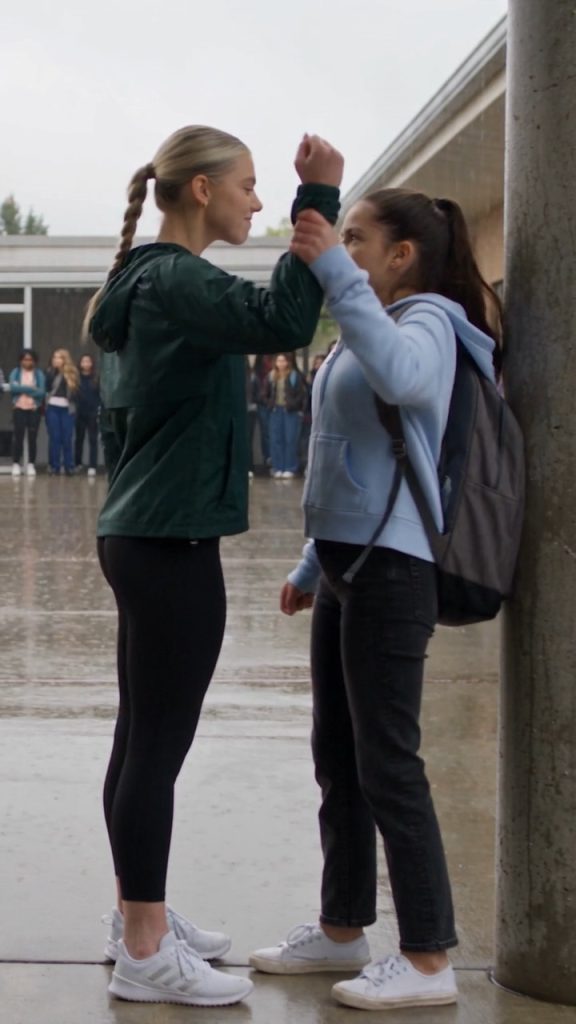
Thursday morning began with the exhausted clarity that comes from several days of hypervigilance. Every routine action—pulling my hair into a ponytail, zipping my hoodie, checking whether my phone was charged—felt weirdly ceremonial, as if I were preparing for a difficult appointment rather than a normal school day. Mom noticed me retie my hair twice and said, “You don’t have to wear it that way if it bothers you.”
I looked at myself in the hallway mirror. “If I change everything because of Tuesday, then she still gets to decide things.”
Mom nodded like that answer made painful sense. “Then wear it how you want.”
At school, a few pieces of the atmosphere had shifted. Students were still talking, but the certainty had gone out of some of the gossip. One reason, I suspected, was that people were beginning to realize there was more than one video. Another was that Ashley herself had gone comparatively quiet. She passed me in the hall after homeroom with Brynn and Lena, but instead of making a comment, she kept her face angled straight ahead, jaw set tight enough to show the muscle there. Silence from someone like Ashley was never surrender. It was strategy.
That was why Ms. Ortega’s update about an original recording mattered so much. The school wasn’t merely hearing narratives now; it was beginning to compare them against something stubborn.
Maybe that was because I carried the courtyard around with me wherever I went. Every glance in the hall could have been curiosity or sympathy or judgment; after a while they all started to feel the same. Even the places that had seemed neutral on my first week—the science wing, the library hallway, the bench outside the attendance office—now felt mapped by who had heard what.
After first period, Ms. Ortega stopped me in the counseling office long enough to say, “Mr. Lewis would like you to know one student submitted an original recording yesterday afternoon.”
“Amir?”
She smiled a little. “I can’t discuss other students in detail. But yes, that is consistent with what you told me.”
The relief that moved through me wasn’t total, but it was real.
At lunch I chose the library again, not because I believed I should have to hide there, but because I had arranged to meet Jordan.
He appeared five minutes late, hair dripping from a shower after PE, holding his phone with the solemn expression of someone who understood he had something more valuable than gossip.
“Hey,” he said, sliding into the chair opposite mine. “Uh. I should’ve checked on you Tuesday. I just…”
“Didn’t,” I said, not unkindly.
He winced. “Yeah.”
For a second we sat in the awkwardness of that truth.
Jordan unlocked his phone. “I talked to Mr. Lewis this morning,” he said. “He asked me to keep the original file and email it directly from my account. I did that already. But I figured you should at least know what’s on it.”
He turned the screen toward me and pressed play.
The footage began with Ashley’s hand already in my ponytail. The image shook slightly because Jordan had clearly started recording in a hurry, but the essentials were there: Ashley jerking my head back, me reaching toward her hand, the hard line of the pillar behind me. Then the shove—the ugly, quick forward motion of Ashley’s arm and my backpack striking the concrete. I heard Lena’s voice in the recording, clear as rainwater: “Maybe she’ll have to transfer schools again.”
The video ended before Ashley’s second lunge. It did not show the wrist catch.
But it showed enough.
Jordan kept the phone on the table between us for a while after the clip ended, as if putting it away too quickly would make the evidence less real. He told me he had gone home Tuesday feeling awful and had replayed the video enough times to memorize exactly where he had started recording. He had not shown it to anyone besides his older sister before forwarding it to Mr. Lewis, partly because he didn’t want it becoming another piece of school theater and partly because, in his words, “seeing somebody get yanked around shouldn’t become content.”
That sentence made me look at him differently. Until then, Jordan had been filed in my mind with the rest of the crowd under witnessed and did nothing. He still belonged there. But he also belonged in the messier category of people who failed in one moment and tried, imperfectly, not to fail forever.
“Why did you start filming?” I asked.
He grimaced. “Because everyone else was pulling phones out, and for a second I thought maybe if something bad happened, there should be proof. Then while I was doing that, the bad thing was already happening.”
It was a terrible answer and probably the truest one. Bystander behavior did not always come from cruelty. Sometimes it came from paralysis dressed as practicality.
I told him so.
“I’m not proud of it,” he said.
“You shouldn’t be,” I said, and when he nodded instead of getting defensive, my own anger eased by a fraction.
I swallowed. “Thank you.”
Jordan rubbed the back of his neck. “I know filming instead of helping was messed up.”
I looked at him for a moment, because he was not wrong and he also wasn’t asking for me to make him feel better.
“You weren’t the only one,” I said finally. “But this matters.”
“I figured.” He hesitated. “For what it’s worth, everybody acts like Ashley’s untouchable. Coaches like her, teachers know her, people on the team would follow her into traffic. I think sometimes students see that and decide it’s safer to record than interrupt.”
That explanation did not excuse anything, but it clarified the shape of the cowardice around me. Safety and goodness were not the same instinct.





