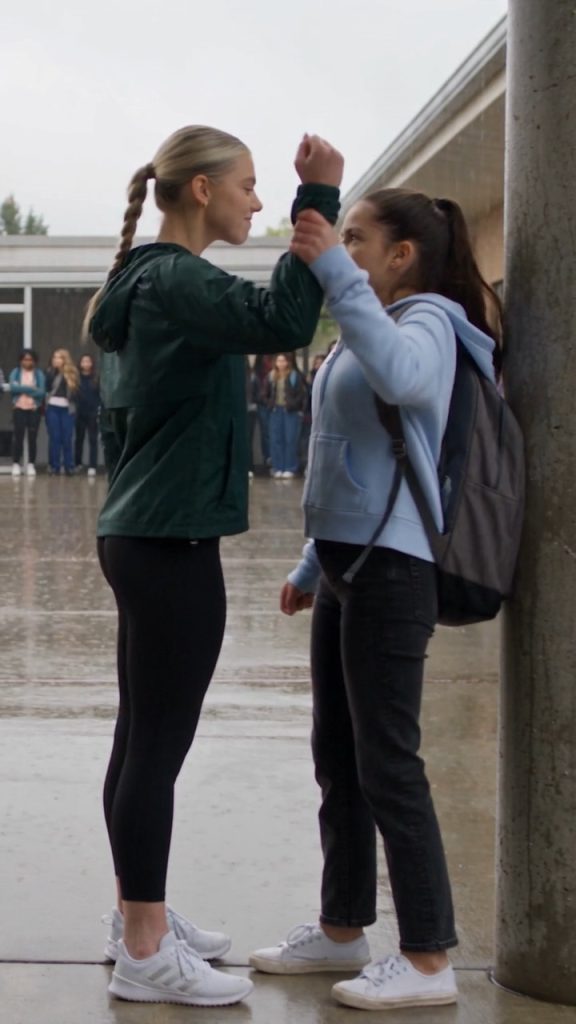
The gym that evening looked exactly like every high-school gym in every sports movie ever made and also nothing like one. The banners hanging from the rafters still celebrated old championships. The bleachers still creaked when families climbed them. The student section still tried to start chants that were too coordinated to catch on. But I watched all of it with a new understanding of how institutions spoke through ordinary rituals. A lineup card changed at the scorer’s table could say more than a public speech. A missing title could say, without saying names, that some forms of power had limits after all.
When Kenzie was announced as game captain, I watched her glance briefly toward the bench where Ashley sat. There was no triumph in Kenzie’s face, only nerves and concentration. That mattered to me too. I did not want the story to turn into one queen bee replacing another while the rest of us applauded. I wanted a smaller, saner world than that.
Coach Park seemed determined to insist on it. She treated the change as business. She gave instructions. She called time-outs. She congratulated good plays and corrected missed coverage. She did not allow the match to become a public referendum on one student’s humiliation. In her own way, that restraint was another kind of accountability.
The announcer introduced the new game captain instead: Kenzie Moore.
The gym buzzed with instant, hungry confusion. A few students turned to one another. Somebody two rows down whispered, “Wait, what?”
Ashley did not start the match. She sat on the bench in her warm-ups, arms crossed so tight they looked painful. Coach Park never once looked uncertain.
I didn’t feel triumphant.
That surprised me.
I had imagined, in my most exhausted fantasies, that accountability would arrive with fireworks and satisfaction. Instead it arrived with something quieter and steadier: the sense that the world had tilted back by a few needed degrees.
During the second set, my phone vibrated.
It was a message from Jordan.
Looks like Coach isn’t messing around.
A moment later another one came from Amir.
A bunch of people deleted the crop. Not all. But some.
I slipped the phone back into my pocket without answering right away. The changes online would never be complete. Copies would survive in screenshots and side chats and private folders. But the difference now was that the crop no longer got to pretend it was the whole truth inside school walls.
When the match ended, Riverton won in straight sets. Students filed out buzzing about the captain change almost as much as the score.
On the way to the parking lot, Kenzie caught up to me near the gym doors.
She was still in uniform shorts under her warm-up jacket, knee pads in one hand.
“Hey,” she said.
I paused.
“You played well,” I said, because it was true and because awkward honesty seemed to be our language now.
A flicker of surprise crossed her face. “Thanks.” She shifted her weight. “Coach told us Ashley’s benched for tonight and Monday, and she’s not captain anymore. For the rest of the season.”
So that was the visible athletics consequence.
“I figured,” I said.
Kenzie looked down at the knee pads in her hand. “I’m sorry I laughed on Tuesday.”
This time I believed she understood what she was apologizing for.
“I appreciate that,” I said. “I’m still not really over it.”
“You don’t have to be,” she said.
Again, that respect for the truth of things. It mattered.
Brynn and Lena came through the gym doors behind her then, faces closed off, and Kenzie stepped aside without another word. Neither girl spoke to me. Neither one blocked my path. It was a small thing and a huge one.
Saturday was the first day all week that my body felt like mine again.
Mom slept late after her shift, and I did homework at the kitchen table while rain threatened the windows without fully arriving. Dad called and asked how the meeting had gone. This time I told him everything. He was angry on my behalf, but he was proud too, and by the end of the call he managed not to sound like he wanted to drive to Riverton and personally interrogate a volleyball team.
Saturday and Sunday brought smaller aftershocks. Jordan texted me that the version of the video with Ashley’s initial hair pull had never been posted publicly in full, which I appreciated; he understood that proving a point and spreading someone’s worst moment were not identical goals. Amir reported that Mr. Lewis had thanked him for preserving the original instead of forwarding it around. Olivia sent a picture of her dog wearing what looked suspiciously like a child’s raincoat, apparently because she sensed I needed proof that the universe still contained ridiculous things.
I spent part of Sunday doing homework and part of it simply relearning quiet. The house sounded normal again: the dishwasher running, Mom taking a work call in the next room, the local weather report muttering from the TV. I cleaned out my backpack and found the paper from the no-contact directive tucked beside my English notebook. Holding it in my hands, I thought about how different safety felt when it was written down. Safety was still not guaranteed by paper. But paper could mark that adults had taken a side—and that the side they had taken was reality.
That night, before bed, I looked up Riverton’s lunch schedule on the school website like I had forgotten it. I hadn’t. I was just preparing for Monday as if it were an exam in courage.
Sunday evening, Olivia texted.
Do you want company at lunch tomorrow?
I stared at the message for a long moment.
Not because I didn’t know the answer, but because I did.
Yes, I typed back. If you’re sure.
I’m sure, she replied.
Monday arrived cold and bright.





