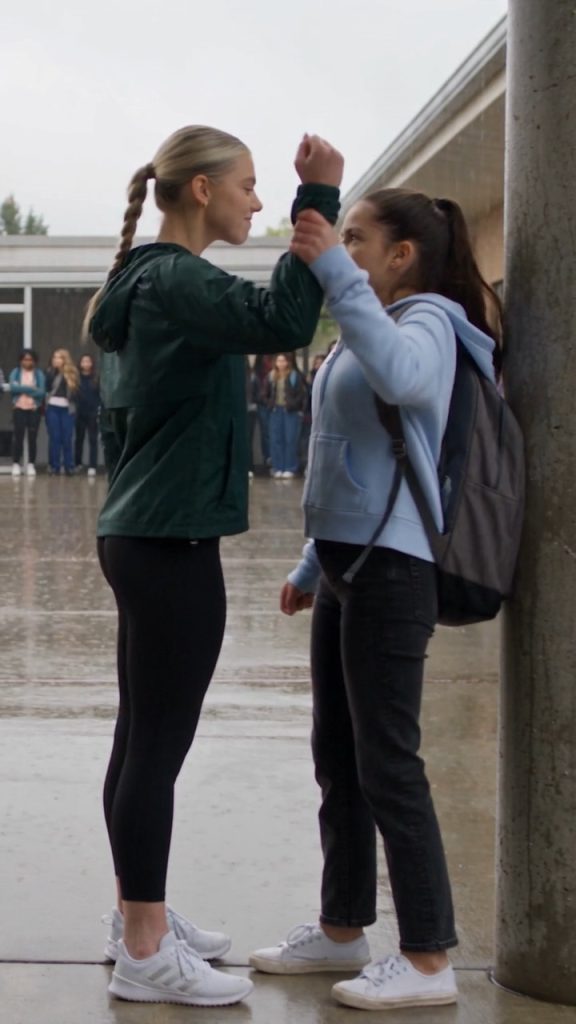
Ms. Ortega leaned back in her chair. “Restorative practices are not magic. They only work when there’s honesty, accountability, and a genuine willingness to repair. They are not supposed to pressure the harmed student into helping the person who harmed them feel comfortable.”
I let that settle. It had not occurred to me until then how many adults used the language of peace to hurry kids past truth.
Near the end, Mr. Lewis told me, “We have now reviewed two original recordings from different vantage points.”
He didn’t say what they proved. He didn’t have to. The fact that there were two mattered more than any reassurance he could have offered without finishing the process.
He also told me he had spoken with Ms. Chen.
“She reports that she was working at her desk and did not observe the interaction,” he said.
That, too, mattered.
It would have been easy—comforting, even—to imagine the adult at the window as a secret witness who could descend and save me in the story’s final pages. But reality did not owe me literary neatness. Ms. Chen had been nearby without seeing. That was frustrating, but it was also true.
By lunch, my nerves were so taut I could feel them under my skin.
I carried my tray to the counseling office because I knew I would not taste food if I sat anywhere else. Ten minutes later, Ms. Ortega got called out to the front desk, and when she came back she said, “Kenzie Moore submitted her statement this morning.”
Relief hit me so abruptly it almost made me dizzy.
“Did she…” I stopped myself. “Never mind. You can’t say.”
Ms. Ortega gave me a sympathetic look. “I can say only that she provided information relevant to the investigation.”
That was enough.
An hour later, as I was leaving history, I found Kenzie by my locker.
Her expression alone told me the meeting had not been easy.
“Did Brynn find out?” I asked.
Kenzie laughed once without humor. “Everybody finds out everything eventually.”
“What happened?”
“She guessed when I got called in. After practice warm-ups were posted, she cornered me by the gym and asked what I’d said.” Kenzie leaned against the lockers, arms folded tight. “I told her I said what I saw. She acted like I betrayed the team.”
“You didn’t betray the team,” I said. “Ashley did.”
Kenzie looked at me for a second, and her eyes went shiny in a way that made me look away to give her some privacy.
“She kept saying it would blow over if everyone just stuck together,” Kenzie said quietly. “Like sticking together means agreeing with the worst person in the room.”
“That’s convenient for the worst person in the room,” I said.
A tiny smile pulled at one corner of her mouth, then disappeared.
“I told them Ashley grabbed you,” Kenzie said. “And shoved you. And that there’s no such thing as our table.”
I exhaled, slow and careful. “Thank you.”
She nodded once. “I’m not saying this because I need you to forgive me for laughing.”
“Good,” I said. “Because I’m not there yet.”
Kenzie accepted that without argument. It was the first thing about her I fully respected.
The final period of the day crawled.
The rest of the school day passed in a haze of ordinary obligations layered over extraordinary tension. In chemistry we were assigned lab partners for the following week’s experiment, and I wrote Olivia’s name beside mine because the teacher had paired us without realizing she was doing me a favor. In government, we discussed due process, which would have been funny if it hadn’t made me want to bury my face in my arms. I kept hearing fragments of the morning meeting in my head—the words sequence and context and original recordings—until even multiple-choice questions sounded like they were asking for testimony.
At one point, on the way to the restroom, I saw Ashley at the far end of the sophomore hallway speaking sharply to Lena with Brynn planted beside them. None of them noticed me. Ashley’s posture was different now from the one she had worn on Tuesday. The swagger was still there, but something brittle had entered it. She looked less like a person enjoying power and more like a person straining to hold on to a version of events that was slipping in her hands.
I did not feel sorry for her.
But I did recognize something important in that sight: consequences often arrived long before official announcements. They arrived in changed body language, in teammates who no longer knew which expression to wear, in the narrowing of a hallway’s easy confidence.
When I got back to class, I found myself writing a sentence in the margin of my notebook that had nothing to do with government: Not being believed is exhausting. Then, a few seconds later, I added: Being believed late is exhausting too.
Because that was the uncomfortable truth. Even with evidence moving in my direction, the week had already done its work on my nervous system. I had learned which stairs squeaked outside the counseling office because I’d walked them so often. I had memorized the faces of people who looked away when things got ugly. I had learned that a no-contact plan was a relief and a reminder at the same time.
Near the end of seventh period, Olivia slid a folded paper onto my desk while the teacher was collecting assignments. It was a cartoon of a volleyball wearing a tiny crown and the word RETIRED underneath.
I looked over at her in alarm because if a teacher saw it, we would both die of embarrassment.
She widened her eyes innocently and mouthed, Too soon?





