I bit back a laugh and folded the paper into my pocket. The joke wasn’t kind enough to share with a crowd, but privately it did what Olivia probably intended: it broke the suffocating seriousness for a second and reminded me that humor could exist without cruelty.
After the final bell, I stopped by my locker and found Kenzie there again, this time with her practice bag at her feet.
“I didn’t know if I should say this earlier,” she said, “but Ashley told us Tuesday morning that she was tired of ‘freshmen forgetting their place.’”
The phrase made my stomach twist.
“She said that before lunch?” I asked.
Kenzie nodded. “Brynn laughed. I didn’t think she meant she was going to actually put her hands on you.”
It wasn’t a new piece of official evidence—I couldn’t prove the conversation happened, and Kenzie sounded unsure whether she had repeated it in her statement—but it confirmed the mood I had sensed when Brynn first spotted me at the table. This had not been an impulsive misunderstanding caused by one rude answer from me. Ashley had arrived ready to make a point.
“You don’t have to tell me things that you didn’t include formally,” I said. “Especially if you’re not sure you can stand behind them.”
Kenzie gave me a tired half smile. “That’s the thing. I am sure. I’m just learning the difference between knowing something and knowing where to put it.”
That sentence stayed with me long after we parted.
There were truths for the office file, truths for private conscience, truths that only made sense once a person understood how a group operated from the inside. Kenzie was only beginning to sort those categories, and maybe I was too.
By the time Mom arrived, the Friday-match noise had swelled. Students were buying tickets. Someone from the booster club rolled a cart of bottled water past the counseling office. The world had no interest in pausing for my emotional convenience. In a strange way, that steadied me. The school was still itself—messy, busy, imperfectly supervised, full of kids moving toward their own concerns. My problem mattered. It was also only one part of a larger place I still had to learn how to live in.
Every click of the classroom clock sounded louder than usual. My teacher had to call my name twice when she asked for volunteers because I’d drifted so far into my own thoughts. Somewhere after three o’clock, my phone buzzed with a message from Mom.
I can leave work early if you need me.
I wrote back:
Please.
She replied immediately:
On my way.
By four o’clock, the halls had mostly emptied and the school had begun to transform itself into Friday-game energy. Students in team hoodies clustered by the gym. A pep-band warm-up drifted from somewhere near the music wing. The normalcy of it all felt surreal.
Ms. Ortega met Mom and me in the counseling office waiting area. Mom squeezed my shoulder once, grounding me.
“You don’t have to guess the ending before it arrives,” she murmured.
Easy for her to say. She wasn’t the one whose lunch table, hallway, and name had become a referendum.
At four thirty, Mr. Lewis stepped into the doorway.
“Maya, Ms. Bennett,” he said. “Would you come with me, please?”
The conference room seemed smaller than ever.
There were two chairs on one side for Mom and me, one for Ms. Ortega, and across from us Mr. Lewis with the thick folder and Dean Robins with a laptop open. No one else. No Ashley. No dramatic confrontation. No neatly staged final showdown.
For one wild second my mind raced ahead anyway—what if they were going to say there wasn’t enough, what if the videos contradicted each other, what if Kenzie backed down, what if all the pieces I had spent three days holding together still somehow didn’t add up to a shape adults were willing to call by its name?
Mr. Lewis folded his hands.
“We have completed our review,” he said.
And then he stopped.
Not for effect, I realized after half a breath, but because he was choosing his words carefully. Still, the pause felt endless.
Everything that mattered now was on the other side of whatever sentence he said next.
“We have completed our review,” Mr. Lewis repeated, “and based on the two original recordings, the written statements, witness interviews, and your prompt report, we determined that Ashley Reed initiated the physical contact in the courtyard on Tuesday.”
For a second I just sat there, the words entering my ears more easily than they entered my body.
Then my shoulders dropped all at once, as if some invisible brace inside me had finally been unfastened.
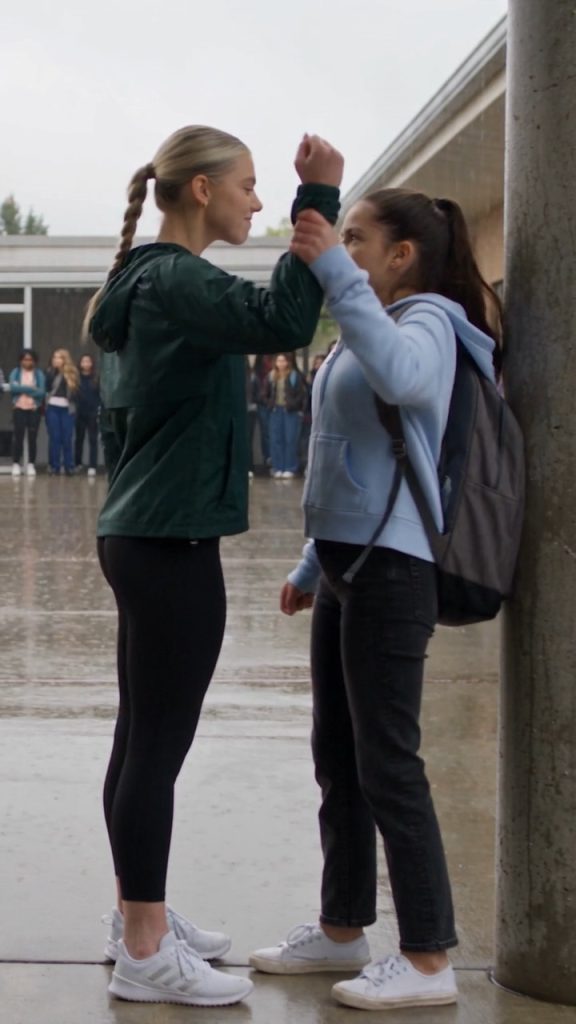
Mr. Lewis went on to explain the evidence in plain language. Jordan’s original recording captured Ashley maintaining a grip in my hair and shoving me toward the pillar. Amir’s captured Ashley making a second reach after the release, followed by my brief interception of her wrist. Kenzie’s statement matched those sequences from where she had stood. Brynn and Lena’s accounts, he said carefully, conflicted with one another in places that mattered. That was as close as he came to saying they had tried to protect Ashley.
“There is no evidence that any team had authority to claim that lunch table,” he added. “Coach Park and lunch staff confirmed it was open seating.”
I almost laughed at the ridiculousness of how much misery had grown from a fact that simple.
Dean Robins explained the no-contact directive point by point. If I saw Ashley approaching, I should move to the nearest supervised adult and report it. Teachers who supervised lunch and passing periods had been notified on a need-to-know basis. If any student retaliated online or in person because of the investigation, that too should be reported. She also offered me the option of checking in with Ms. Ortega before lunch next week if returning to the courtyard felt overwhelming.





