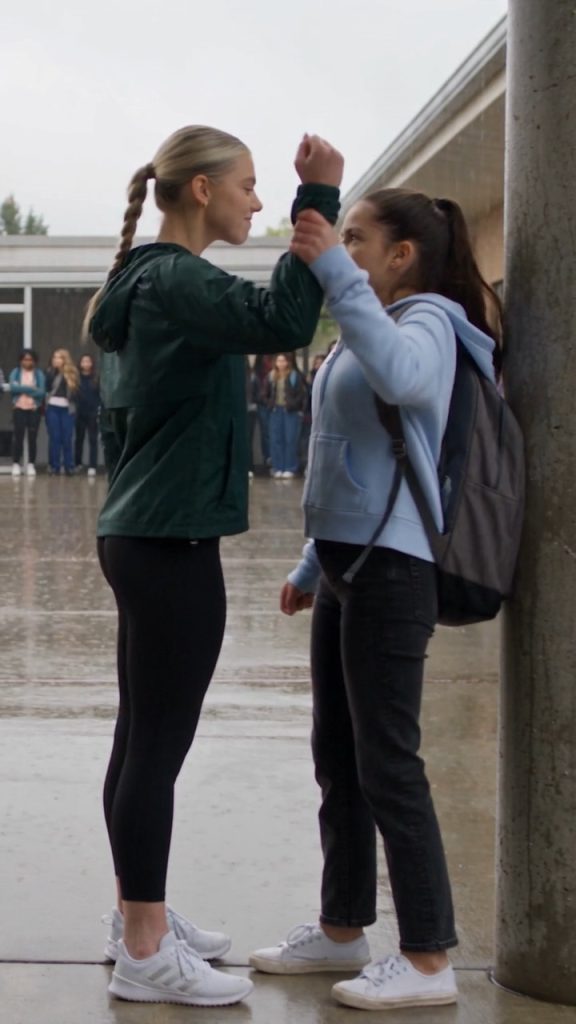
After Jordan left, I sat for a minute staring at the table. Not because the video had magically solved everything, but because it had anchored my memory to something outside myself. Ashley could say I was dramatic. Brynn could claim I had overreacted. The internet could run in circles with a cropped clip. None of that changed the fact that somewhere in Mr. Lewis’s email inbox, there was a shaky original video of Ashley’s hand in my hair and my backpack slamming into a pillar.
When I stepped out of the library, Coach Nina Park was standing near the main office speaking with a lunch supervisor.
I recognized her from the gym hallway and from the posters advertising the Riverton Ravens girls’ volleyball season. She was in her forties, with close-cropped black hair, a whistle lanyard in one hand, and the kind of posture that made even stillness look decisive.
She noticed me lingering and gave a small nod. “Maya Bennett?”
I stiffened instinctively. “Yes?”
“I’m Coach Park. I won’t keep you long.” Her tone was direct without being hard. “I was informed there was an incident involving several members of my team. I’m not here to ask you to relive anything in the hallway. I only want to state one thing clearly: the volleyball team does not own any lunch table on this campus.”
Something like bitter relief flickered through me.
When Coach Park stopped me in the hallway, I expected one of two things: a vague statement about “team drama” or an awkward request to show grace because sports were important to school culture. Instead, she gave me the gift of administrative specificity. There was no such thing as a captain’s table. There never had been. If players had built that tradition in their own minds, then it was exactly that—in their own minds.
What impressed me most was that she did not use the truth to flatter herself. She did not say, I would never allow this on my team, as if saying it after the fact could undo what had happened. She simply established a reality line and left it in place.
That mattered because so much of bullying relied on fog. It relied on kids like me wondering whether maybe there was some unwritten rule we had broken, some social code we were too new or too awkward to know. Ashley’s confidence had fed on that uncertainty. Coach Park’s refusal to honor it took away at least one of Ashley’s favorite weapons.
“Okay,” I said.
“If any student implied otherwise, that implication was false,” Coach Park continued. “Athletic status gives students responsibilities, not private territory.”
The lunch supervisor beside her, Mrs. Daugherty, made a sound halfway between a hum and a scoff. “Every table in that courtyard is open seating unless there’s an official event. There wasn’t one.”
I nodded again, because speaking felt harder than it should have.
Coach Park’s expression softened by half an inch. “Mr. Lewis is handling the student-conduct side. I’ll address team expectations on my end. That’s all.”
She walked away without asking me to forgive anyone or care about the team’s reputation. I appreciated that more than I could have explained.
That afternoon, I found Kenzie waiting near the stairwell outside the language wing.
She was alone, which immediately made the moment feel unusual. Without Brynn and Lena on either side of her, she seemed younger—still a junior, still athletic, but less like a moving part in Ashley’s machine.
“Can we talk?” she asked.
Every instinct I had told me to say no.
But her face carried that same strained uncertainty I’d noticed in the courtyard when Ashley reached for me the second time.
“For a minute,” I said.
We moved to the side of the hall where trophy cases muffled some of the passing traffic.
Kenzie crossed her arms, uncrossed them, then shoved her hands into the pockets of her sweatshirt. “I’m not here because Ashley sent me.”
“That’s good,” I said.
“I just…” She exhaled. “Tuesday got out of hand.”
I stared at her. “It was out of hand the second she touched me.”
Kenzie flinched. “Yeah. I know.”
For a few seconds I said nothing. It was not my job to help her choose honesty.
“She was mad before she even walked over there,” Kenzie said eventually. “Brynn told her some freshman was sitting at the usual table and acting like she belonged there.”
“Acting like I belonged there,” I repeated.
“Yeah.” Kenzie gave a helpless shrug. “Which is stupid. I know that. There’s no assigned table or anything.”
That was clue number three laid bare in actual words, and hearing it from one of Ashley’s own teammates did something sharp and clarifying inside me.
“What did you see?” I asked.
Kenzie looked over my shoulder to make sure nobody was close enough to hear. “I saw Ashley grab your ponytail. I saw her shove you. And I saw her go for you again.”
“So why didn’t you say that the first day?”
Her face tightened. “Because Ashley’s been captain since last year, and Brynn worships her, and Lena laughs at whatever she laughs at, and if I cross her before playoffs, I’m the problem. That’s how it works.”
The honesty of it was ugly, but at least it was honesty.
I thought of Jordan saying people saw Ashley as untouchable. He had been right.
“I’m not asking you to be my friend,” I said. “I’m asking you not to lie.”
Kenzie’s eyes met mine. “Mr. Lewis asked me for a statement.”
“And?”
“I told him I needed time.”
I could hear students moving past the corner, smell floor cleaner and cafeteria pizza drifting together in the stale air. Somewhere down the hall someone laughed, loud and ordinary.
“I won’t beg,” I said. “But if you tell the truth, tell the part you actually saw. Don’t make yourself into more of a witness than you are.”
She blinked. “What?”





