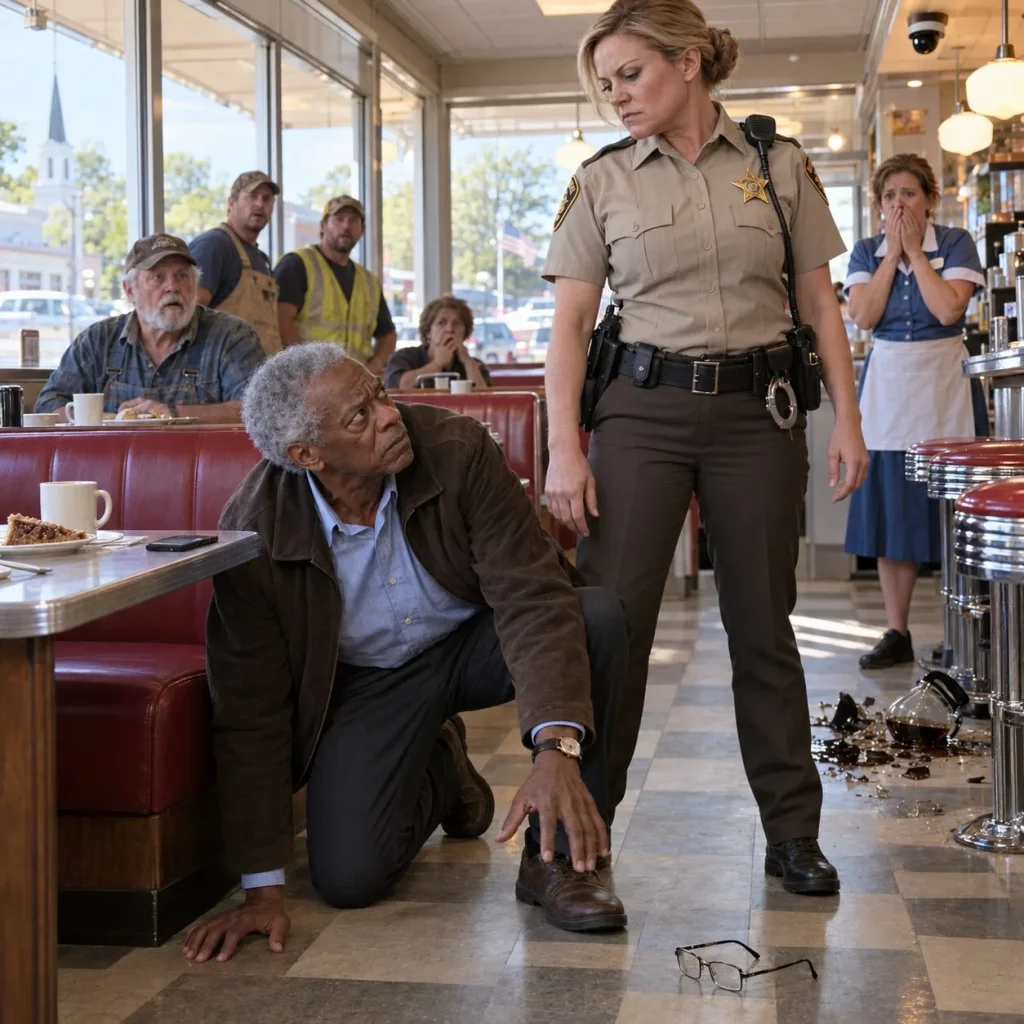
Aaron put me in the back of the patrol car but did not slam the door.
That small kindness almost made me angrier.
Not at him.
At the system that turned decency into something performed quietly.
He crouched beside the open door.
“Are the cuffs too tight?”
“They’re cuffs.”
“I can loosen them.”
“Then loosen them.”
He did.
“Thank you.”
He looked toward the diner.
“Mr. Bennett, I’m sorry.”
“Sorry for what?”
His eyes met mine.
“For this.”
“You didn’t slap me.”
“No.”
“But you’re taking me in.”
His jaw tightened.
“She’s the sheriff.”
“That isn’t an answer.”
He looked away.
I had said variations of that sentence to students for decades.
A title is not an argument.
Authority is not evidence.
Procedure is not morality.
Aaron closed the door.
Through the window, I watched Erica step out of the diner with my phone still in her pocket.
Donna followed her to the doorway.
They were arguing.
I could not hear the words.
Then Erica pointed at the camera.
Donna crossed her arms.
A minute later, Erica walked toward the patrol car.
She opened the front passenger door.
“Let’s go.”
Aaron got behind the wheel.
“What about the scene?”
“What scene?”
He glanced at her.
“The diner.”
“There is no scene.”
I almost laughed.
She heard me.
“You think something’s funny?”
“No.”
“Good.”
We drove three blocks to the county sheriff’s office.
Riverside was the county seat, but calling the building large would be generous.
Brick exterior.
Flagpole.
A lobby with two plastic chairs and a bulletin board of hunting-safety notices.
I had brought students there on civics field trips years earlier.
Thomas Mullen had once greeted my class in the same lobby where his daughter now led me in handcuffs.
History has a sense of irony.
At the booking desk, the clerk looked at me.
Then at Erica.
“What’s the charge?”
“Disorderly conduct.
Resisting lawful instructions.”
The clerk typed.
I said, “I was sitting at breakfast.”
Erica turned.
“You need to stop talking.”
“I’m answering the clerk.”
“I didn’t ask you to.”
The clerk stopped typing.
Erica stared at her.
“Continue.”
I looked at Aaron.
He had gone pale.
The clerk asked for my property.
Erica put my wallet, keys, and phone in a plastic tray.
I said, “The phone was taken from my hand after I called counsel.”
“Your son is not counsel.”
“You don’t know who my son is.”
She smiled again.
“Should I be impressed?”
“No.”
That irritated her more than if I had threatened her.
She leaned closer.
“Your whole problem, Marcus, is that you’ve spent your life convincing people your opinions matter more than everybody else’s.”
There it was.
Not Mr. Bennett.
Marcus.
Personal.
I looked at her.
“How old were you when your father started talking about me at home?”
Her face froze.
Aaron looked at the floor.
Erica said, “Put him in interview room two.”
The clerk hesitated.
“He hasn’t been medically cleared.”
“I said interview room two.”
I touched my cheek.

“I would like medical attention documented.”
That sentence changed the room.
Documentation.
Erica hated it.
“You’re fine.”
“I am requesting medical evaluation after being struck by a law enforcement officer.”
The clerk looked at Erica.
Then at me.
“I’ll call EMS.”
Erica said, “That isn’t necessary.”
The clerk answered quietly, “Policy says if a detainee requests medical attention after reported use of force, we call.”
For the first time that morning, policy worked against Erica.
She walked away.
The paramedic who arrived knew me.
Everyone knew me.
That was not power.
It was simply what happens when you teach in one town for decades.
“Mr. Bennett, what happened?”
“The sheriff slapped me.”
He looked toward the hallway where Erica had disappeared.
Then back at me.
“Any loss of consciousness?”
“No.”
“Dizziness?”
“Only from the glasses.”
He examined my cheek.
Mild swelling.
No obvious fracture.
He documented the scratch along my temple where the frame had hit.
“What happened to your glasses?”
I pointed.
“They left before I did.”
He almost smiled.
Then he wrote everything down.
While I waited, I asked Aaron for my phone call.
“You already made one,” Erica said from the hall.
“That call was interrupted when you took my phone.”
“You can call from the desk later.”
“I want to call my son.”
She looked at Aaron.
“No calls until processing is complete.”
Aaron nodded.
I could see conflict in his face.
I remembered him at seventeen.
He had written an essay about the Birmingham campaign and ended it with a sentence I had kept in my desk drawer for years:
The hardest moment is not knowing what is right.
It is deciding whether you will do it when someone stronger tells you not to.
I wondered whether he remembered writing it.
At eleven-fifteen, they put me in an interview room.
No bars.
Just a metal table, three chairs, and a camera in the upper corner.
I looked at it.
“Is that recording?”
Aaron said, “Yes.”
“Good.”
Erica stood behind him.
“You planning another history lesson?”
“No.”
“Good.”
She sat across from me.
Aaron stayed near the door.
“Let’s make this simple.”
“I thought breakfast was simple.”
She ignored that.
“You were asked to comply with a lawful instruction.”
“What instruction?”
“To remain seated and stop creating a disturbance.”
“I was seated.”
“You were arguing.”
“I answered you.”
“You refused to follow commands.”
“Which command did I refuse?”
Her face tightened.
“You reached for your phone after being told not to.”
“Calling someone is disorderly conduct?”
“You escalated.”
“How?”
“You challenged my authority in front of a room full of people.”
There it was.
I looked at the recording camera.
“You might want to say that again.”
Erica followed my eyes.
Then she smiled.
“You think cameras scare me?”
“No.”
I leaned back.
“I think facts do.”
She stood.
The interview ended.
At eleven-forty, the door opened.
A man I did not know entered wearing a navy suit.
He introduced himself as Paul Grant, an attorney from Birmingham.





