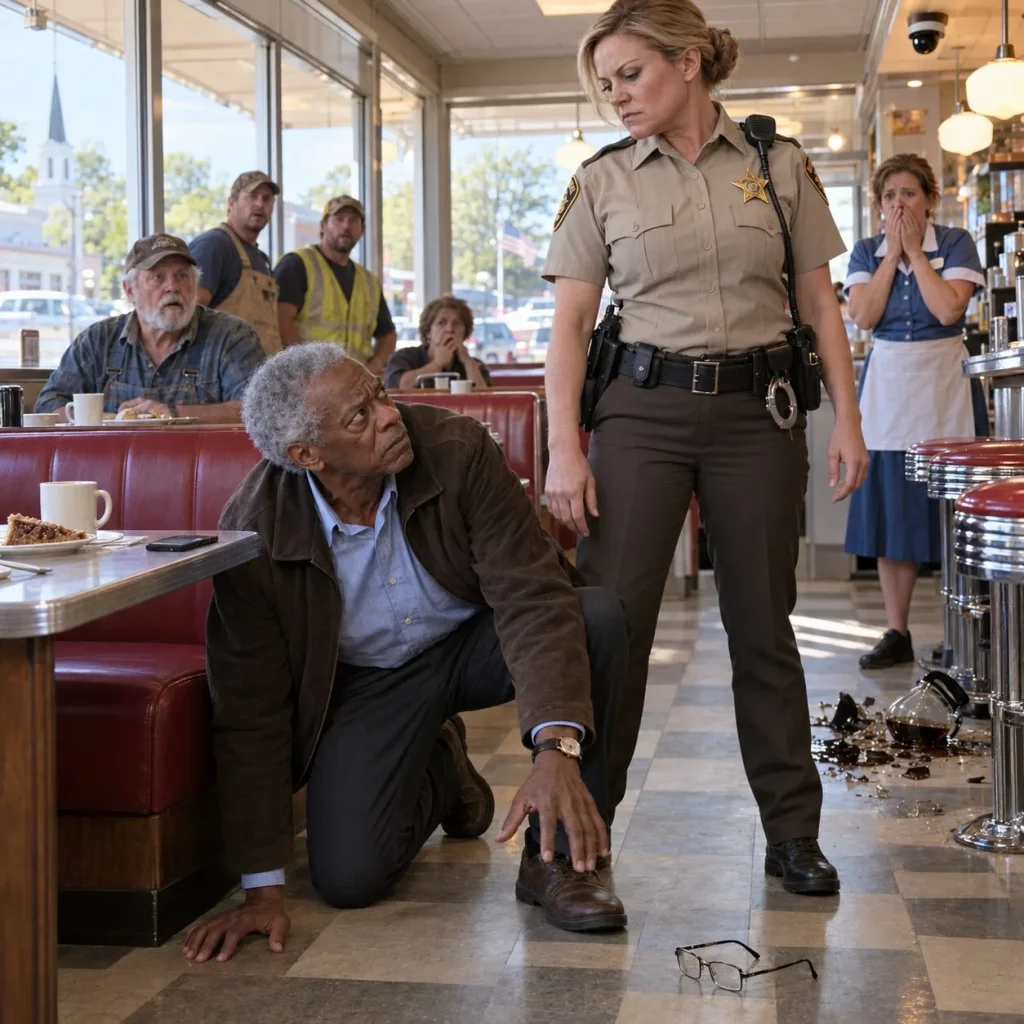
“I don’t want to live in a county where I need permission from law enforcement to pick up a customer’s glasses.”
No lawyer could have written a stronger statement.

She continued.
“I’m not here because I hate police.”
She looked toward the deputies in the room.
“My brother was a deputy for twenty years.”
Then:
“I’m here because the badge should make people safer to tell the truth, not more afraid.”
She sat down.
People applauded until the chair asked for order.
Aaron testified in closed session about personnel issues, then made a brief public statement.
“I followed an arrest instruction I believed was questionable because I was afraid to challenge my superior.”
He did not excuse himself.
He did not dramatize.
“I later refused to make statements I believed were false.”
He swallowed.
“Departments should train officers for that situation before they are in it.”
A commissioner asked, “Are you saying deputies should disobey sheriffs?”
Aaron answered carefully.
“I’m saying every officer swears to law, not personality.”
That line stayed with me.
The hearing also produced criticism of me.
A man named Calvin Ross took the podium.
He owned a towing company.
“Mr. Bennett has spent forty years making law enforcement the enemy.”
I almost stood.
Henry, sitting beside me, put one hand on my arm.
“Let him speak.”
I did.
Calvin continued.
“My family has known the Mullens for generations.
Sheriff Mullen helped find my niece when she ran away.
She sat with my mother after a burglary.
Nobody talks about that.”
He looked at me.
“One mistake doesn’t erase a career.”
The room murmured.
When he returned to his seat, he passed near me.
I said, “You’re right about one thing.”
He stopped.
“What?”
“Good things she did still happened.”
He stared at me.
“You saying that now?”
“I’ve always said it.”
“Then why destroy her?”
“I didn’t.”
His jaw tightened.
I continued.
“The video did not erase the night she found your niece.”
He looked confused.
“And finding your niece does not erase what happened to me.”
We stood facing each other.
Both true.
Neither canceled the other.
Calvin sat behind me.
After the meeting, he approached.
“I still think the punishment’s gone too far.”
“That’s your right.”
He nodded.
“But I watched the full video.”
I waited.
“She shouldn’t have hit you.”
“Thank you.”
“That doesn’t mean I’m on your side.”
“I didn’t ask you to be.”
He almost smiled.
That interaction mattered to me.
Accountability does not require total agreement.
A community can share facts and disagree about consequences.
That is healthier than disagreeing about reality.
The hearing ended after midnight.
I walked outside exhausted.
Reporters waited.
I avoided them.
Henry and I drove home.
At a red light, he said, “You did good.”
“I spoke for two minutes.”
“You also didn’t punch Calvin.”
“I’m sixty-eight.”
“You looked tempted.”
“I was tempted to give him a lecture.”
“Worse.”
We laughed.
Then Henry became serious.
“Dad, you know policy changes won’t make this feel worth it.”
“I know.”
“Nothing will.”
“I know.”
“Good.”
I looked at him.
“Why good?”
“Because I don’t want you waiting for some reform package to justify what happened.”
That was wise.

Meaning can come from response.
Meaning does not retroactively make harm necessary.
I did not need the slap to become a gift.
I did not need to say everything happened for a reason.
Some things happen because someone does something wrong.
Then people decide what comes next.
That is enough.
The commission adopted several reforms three weeks later.
Not all.
The complaint portal passed.
Body-camera retention expanded.
Senior-command force complaints triggered external review.
The whistleblower proposal was narrowed but survived.
I attended the vote.
No applause.
Just motions.
Seconds.
Votes recorded.
Democracy again.
Boring and consequential.
Afterward, Denise Carter, the librarian with the binder, closed it with satisfaction.
“Now we monitor implementation.”
I laughed.
“You never stop.”
“No.”
“Good.”
Rules on paper are promises.
People like Denise make institutions remember they made them.
The criminal case ended eleven months after the slap.
Not with a dramatic trial.
With a negotiated plea.
Erica admitted to an unlawful use of force and to directing a subordinate to include information in an official report that was not supported by the evidence.
She agreed to resign as sheriff.
She accepted a period of probation and a permanent restriction that prevented her from serving in sworn law enforcement during that period.
The exact legal terms mattered to lawyers.
To me, the most important part was the statement she made in court.
I attended.
Henry sat beside me.
Donna sat behind us.
Aaron sat near the back.
Erica stood at the defense table.
She looked smaller without the uniform.
Not weak.
Human.
The judge asked whether she understood the rights she was giving up.
She said yes.
Then he asked whether she wished to make a statement.
Her attorney whispered to her.
She nodded.
Erica turned toward the courtroom.
“I was angry.”
Her voice shook.
“I approached Mr. Bennett because of resentment I had carried for years about my father.”
Nobody moved.
“I interpreted his questions as disrespect because I expected disrespect from him before he spoke.”
She looked at me.
“I used my office to turn a personal grievance into a law-enforcement action.”
I felt Henry’s hand tighten on the bench.
Erica continued.
“The force I used was not necessary.”
Her eyes filled.
“And when evidence contradicted my arrest decision, I tried to protect myself instead of correcting the record.”
That was the sentence I had waited for.
Not “I’m sorry you were offended.”
Not “mistakes were made.”
Not “the situation escalated.”
I tried to protect myself instead of correcting the record.
She looked toward Aaron.
“I pressured a deputy who worked for me.”
Then back at me.
“I cannot undo that.”
She stopped.
The judge asked if she had anything else.
Erica shook her head.
No apology.
At first I felt disappointed.
Then I realized accountability did not require the performance I had imagined.





