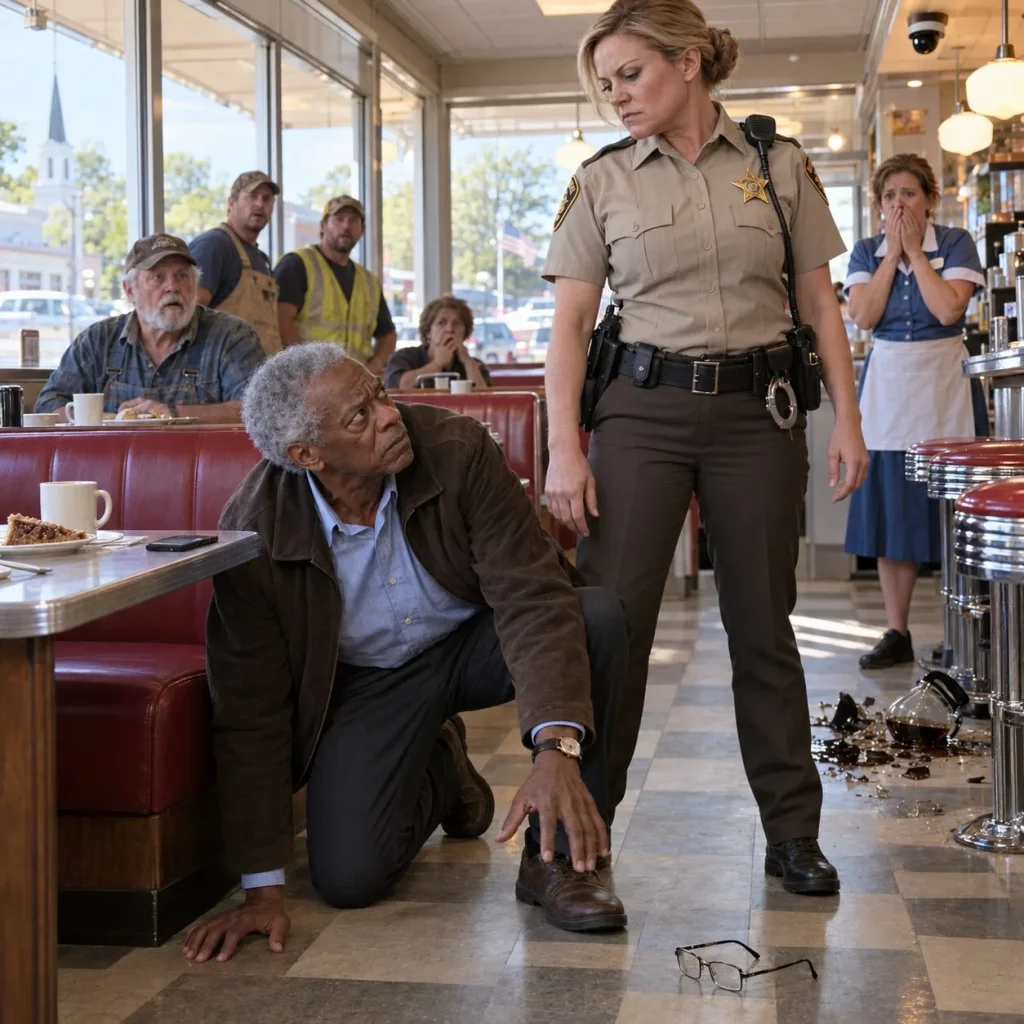
One man accused me of trying to destroy the sheriff’s department.
I answered, “If one truthful video can destroy an institution, the problem is not the video.”
He shouted.
The pastor intervened.
Afterward, Aaron approached me.
“You made things worse for yourself.”
“How?”
“Half the department thinks you’re calling us all corrupt.”
“I said the opposite.”
“I know.”
“Then why do they think that?”
“Because people hear what they’re afraid you mean.”
I understood that.
“Do you think I’m calling you corrupt?”
“No.”
“Do you think what Erica asked you to do was corrupt?”
He looked at me.
“Yes.”
“Then say that.”
“I did.”
“To investigators.”
“Yes.”
“Good.”
“That doesn’t make work easy.”
“No.”
He looked tired.
I remembered him at seventeen again.
The hardest moment is not knowing what is right.
It is deciding whether you will do it when someone stronger tells you not to.
“You wrote something in my class once.”
His eyes narrowed.
“Oh no.”
I smiled.
“You remember?”
“I wrote a lot of nonsense.”
“Not this.”
I quoted the sentence.
He stared at me.
“You kept that?”
“For years.”
“Why?”
“Because I thought it was good.”
He laughed.
Then his eyes filled.
“I wish I had remembered it faster.”
“You remembered it.”
That was enough.
The investigation took months.
Long enough for outrage to cool.
Long enough for rumor to mutate.
Long enough for people to become bored with a story that still controlled my life.
I received hate mail.
Not much.
Enough.
One letter said, GO BACK TO TEACHING HISTORY AND STOP TRYING TO MAKE IT.
Another called Henry a federal thug.
He framed that one.
“Why would you frame it?”
“It’s ridiculous.”
“Your mother would hate that.”
“My mother would laugh.”
He was right.
My wife, Evelyn, had died five years before the diner incident.
She had been the person who taught me that not every insult deserved a response.
She would have hated the television cameras.
She would have loved Donna.
I missed her especially during those months.
There were nights I wanted to ask whether I was becoming consumed by the case.
Henry tried to answer for her.
“Mom would tell you to eat something.”
“She told me that about everything.”
“She was usually right.”
He cooked dinner.
Badly.
I ate it.
The federal civil-rights review eventually separated from the state administrative case.
Henry recused himself from any professional involvement once my situation became formal.
That was important.
His office had rules.
His relationship to me created a conflict.
People online still claimed my son was “running the investigation.”
He was not.
After the first emergency calls and preservation requests, he stepped away professionally.
He remained my son.
That was enough.
Paul handled my legal matters.
State and federal investigators handled theirs.
I made sure to say that publicly whenever asked.
I did not want justice contaminated by the appearance that my family had special access.
The irony was obvious.

Erica had treated me as if I believed rules did not apply to me.
My strongest response was to insist that they did.
Months after the slap, a grand jury returned charges related to unlawful use of force and falsification of official records.
I will not pretend the legal language felt satisfying.
Charges are allegations.
I had taught that too.
Erica pleaded not guilty.
Her attorney said the video lacked context.
He argued that I had been verbally confrontational.
He said the slap was an instinctive response to a perceived movement.
I watched the video again.
My hand moved toward coffee.
That was the movement.
The record-falsification allegation was harder to explain away because of the interview-room recording.
Still, Erica had rights.
I respected them.
That surprised some people.
A reporter asked, “After what she did, why are you so careful to say she deserves due process?”
I answered, “Because due process is not a reward for people I like.”
That line also made the news.
At school, former colleagues told me teachers were using the case in civics classes.
I hated that.
Then I loved it.
Then I hated it again.
I did not want to become a worksheet.
But perhaps being a history teacher means accepting that real events will eventually be used to explain principles you once taught abstractly.
One afternoon, Riverside High invited me to speak.
I walked into my old classroom.
The desks were newer.
The whiteboard had replaced the chalkboard.
But the windows were the same.
A student asked, “Were you scared when she hit you?”
“Yes.”
“Did you know your son would help?”
“I knew he would answer the phone.”
“Did you call him because he works for DOJ?”
I thought.
“Partly.”
The students laughed.
I smiled.
“I also called him because he’s my son.”
Another asked, “What if there wasn’t a camera?”
The room quieted.
“That is the question I think about most.”
“What’s the answer?”
“I don’t know.”
They looked disappointed.
I continued.
“But not knowing the answer tells us what systems should improve.”
A girl in the second row raised her hand.
“Like body cameras?”
“Maybe.”
“Like witnesses?”
“Yes.”
“Like not being afraid?”
I smiled.
“That’s harder to make a policy.”
She nodded.
“But it’s still important.”
“Very.”
When I left, the current history teacher handed me an envelope.
Inside was a photocopy of Aaron Pike’s old essay.
“I found it in a file cabinet when we cleaned your old classroom,” she said.
I laughed.
The sentence was still underlined in red ink.
The hardest moment is not knowing what is right.
It is deciding whether you will do it when someone stronger tells you not to.
I sent Aaron a photograph.
He replied:
I hate that seventeen-year-old me had better handwriting.
Then:
Thanks for keeping it.
That night, I realized the story had stopped being only about what Erica did to me.
It was becoming a story about what everyone else did afterward.
Donna saved the video.
Aaron refused to falsify a report.

Witnesses gave statements.
Investigators preserved records.





