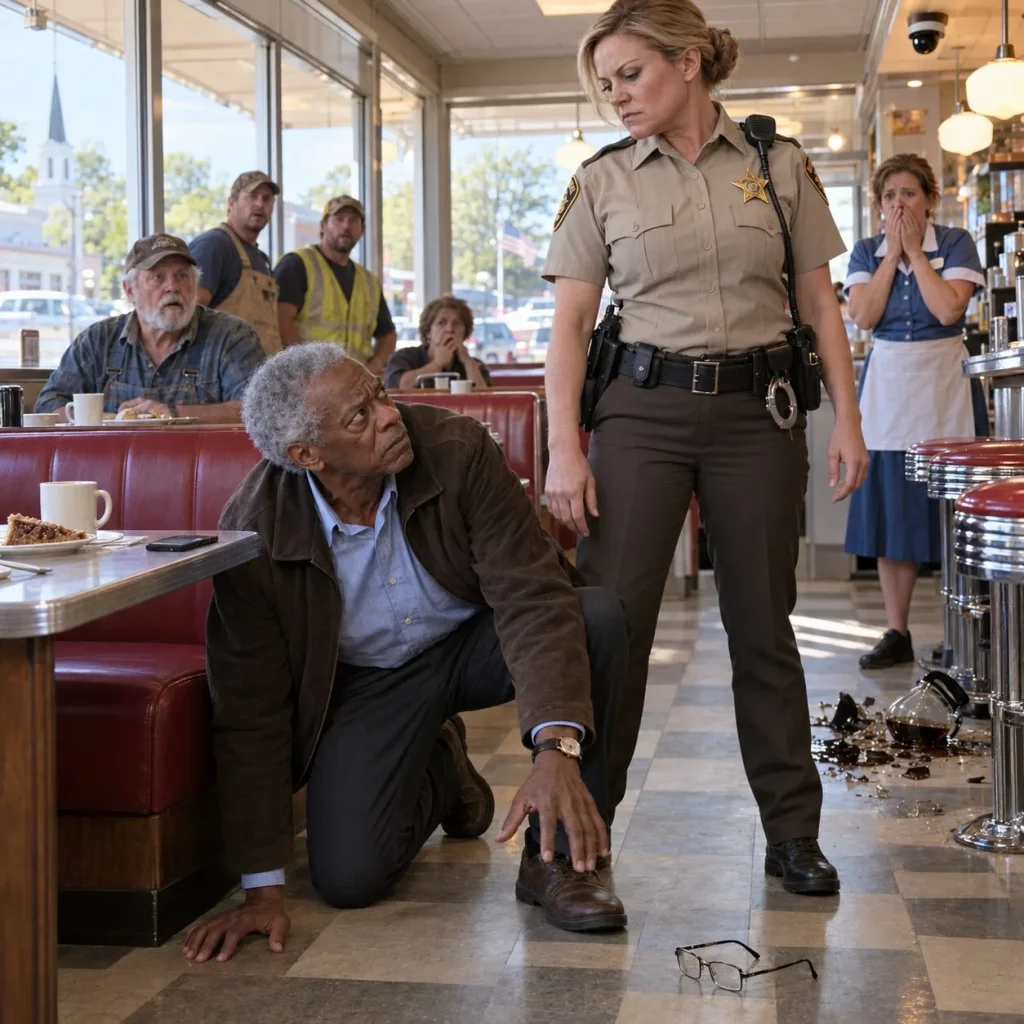
Lawyers maintained conflicts.
Citizens asked uncomfortable questions.
Institutions are not abstract things.
They are people making decisions, often in rooms where nobody else is watching.
The period between the video becoming public and the charges being filed changed Aaron more visibly than anyone else.
For weeks, he was treated like a traitor by some deputies.
Nobody said it officially.
Officially, he was a witness.
Unofficially, coffee stopped when he entered the break room.
People stopped inviting him to lunch.
A supervisor reassigned him to tedious duties.
Nothing serious enough to prove retaliation.
Enough to communicate displeasure.
He told me about it only once.
We were sitting at the diner.
“I expected it.”
“That doesn’t make it acceptable.”
“No.”
“Have you documented it?”
He smiled.
“You really are a teacher.”
“Answer the question.”
“Yes.”
“Good.”
He stirred his coffee.
“Sometimes I think I should have just quit.”
“Do you want to quit?”
“I don’t know.”
“Then don’t let them make the decision for you.”
He looked up.
“What if staying makes me bitter?”
“Then leave.”
“What if leaving means they win?”
“Your life is not a scoreboard.”
He laughed.
“That sounds like something you learned recently.”
It was.
For months, I had thought every decision had to advance justice.
Sometimes a decision only has to preserve a person.
Aaron eventually filed an internal complaint about the treatment.
That complaint triggered another review.
Some behavior was explained as normal scheduling.
Some could not be.
Leadership changed procedures for witness protection inside the department.
It was a modest reform.
Still, it mattered.
Donna faced a different kind of pressure.
A supplier she had used for years suddenly “reconsidered” her account after the video release.
She suspected politics.
Could not prove it.
Another supplier stepped in.
Customers organized a breakfast fundraiser.
Donna hated the word fundraiser.
“I sell eggs.
People can buy eggs.”
So they bought eggs.
A lot of eggs.
The diner survived.
I learned that speaking truth has costs that spread beyond the person at the center.
Witnesses pay.
Families pay.
Businesses pay.
Colleagues pay.
That means communities have a responsibility after asking people to be brave.
Do not applaud a witness and leave them alone with the consequences.
Support must become practical.
A ride.
A lawyer.
A meal.
A customer.
A statement.
A policy.
I began saying that whenever people called Donna a hero.
She hated that too.
“I’m not a hero.”
“You saved the video.”
“I pressed three buttons.”
“Under pressure.”
“Still three buttons.”
I understood.
Hero language can make ordinary courage seem unattainable.
Donna wanted people to believe they could press three buttons too.
The church forum exposed another tension.
Several Black residents said the diner incident received attention because I was educated, retired, well known, and connected to a federal attorney.
That criticism was fair.
A young man stood during the forum.
“My cousin got thrown against a car two years ago.”
The room quieted.
“He didn’t have a camera.”
I looked at him.

“What happened?”
“He complained.
They said he resisted.”
“Was there an investigation?”
“Internal.”
“Outcome?”
“Nothing.”
His anger filled the room.
“So why does everybody care now?”
I did not defend myself.
“I don’t know.”
“You do know.”
He was right.
I took a breath.
“Because some victims are easier for institutions and the public to believe.”
The room went still.
“Because I am old.
Because people know me.
Because I taught their children.
Because the video is clear.
Because my son knows how systems work.”
The young man nodded.
“That’s what I’m saying.”
“And you’re right.”
Someone in the audience shifted uncomfortably.
I continued.
“The answer is not to care less about what happened to me.”
He watched me.
“The answer is to build processes that do not require every victim to be the perfect victim with perfect evidence.”
That conversation changed the forum.
It moved the room away from my case and toward broader policy.
Complaint procedures.
Independent review.
Retention of body-camera footage.
Public reporting.
Whistleblower protection.
Some proposals were adopted later.
Others died in committees.
That was another lesson.
Change is not a movie montage.
It stalls.
It gets amended.
It becomes boring.
It loses votes.
People move on.
Then somebody keeps attending meetings.
A local librarian named Denise Carter became one of those people.
She had never met me before the incident.
She began attending county meetings with a binder.
Every time officials promised a policy review, Denise asked for the date.
Every time someone said “soon,” she asked what soon meant.
I loved her.
Not romantically.
Civically.
At one meeting, a commissioner sighed.
“Ms. Carter, we are working on it.”
She answered, “Then you should have an update.”
I almost applauded.
Afterward I told her, “You would have been terrifying in my classroom.”
She said, “I was.”
We laughed.
Accountability often depends on people willing to be boring repeatedly.
That deserves more admiration than dramatic speeches.
The federal review created tension too.
Because Henry worked for DOJ, critics claimed I had special treatment.
One radio host said, “If Marcus Bennett’s son sold insurance, nobody in Washington would care.”
That sentence bothered me because part of it might be true.
Access matters.
Knowledge matters.
Connections matter.
Henry and I talked about it.
“Did your job help?”
“Yes.”
He did not hesitate.
“How?”
“I knew who to call to preserve a potential civil-rights complaint.
I knew what language mattered.
I knew you needed counsel immediately.”
“So they’re right.”
“About access?
Partly.”
I hated that answer.
He continued.
“That doesn’t make the complaint false.”
“I know.”
“It means systems should be easier to navigate for people without a son who knows them.”
I looked at him.
“That sounds like my next speech.”
“Please do not quote me.”
“I absolutely will.”
He groaned.
Henry formally recused himself and documented the conflict.
That was not only legal ethics.
It was symbolic.
We wanted no hidden influence.
He did not receive internal updates.
He did not speak to investigators about strategy.





