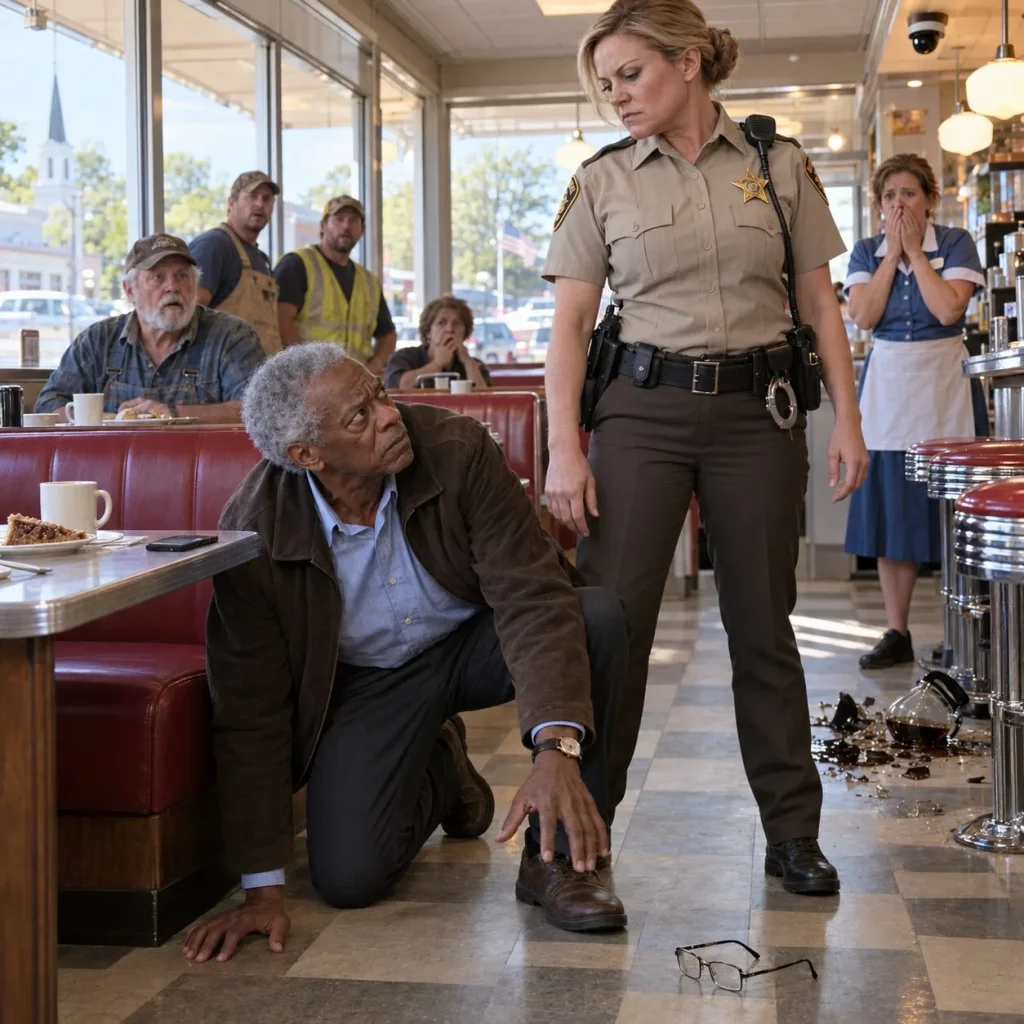
Believe what it shows.
Act.
The same is true of history.

Documents do not teach themselves.
Records can sit in archives for a century until someone asks the right question.
By the second week, I realized the diner camera had become a metaphor I would never escape.
I accepted that reluctantly.
If I was going to be asked about it, I would use it well.
At a church youth group, a teenager asked, “Should we record police all the time?”
I said, “Know your local laws and stay safe.”
“That’s not an answer.”
“It is the responsible answer.”
He frowned.
I added, “Recording can protect facts.
It can also change a situation.
Do not turn yourself into a hero for social media.”
That surprised him.
“What should we do?”
“Think first about safety.
Then documentation.
Then legal help.”
“Boring.”
“Most good advice is.”
He smiled.
I had become old enough to enjoy disappointing teenagers with nuance.
The investigation continued.
So did breakfast.
Every time I passed the diner camera, I nodded at it.
Donna caught me once.
“You thanking it?”
“No.”
“You are.”
“I’m checking whether it works.”
“It works.”
“I know.”
She smiled.
“You’re thanking it.”
Maybe I was.
The note changed the case.
Not because it proved why Erica slapped me.
A handwritten insult in an office drawer does not explain an entire mind.
But it connected the present to the past in a way her own words had already suggested.
“You’ve had an attitude for forty years.”
“You ruined my family.”
Now an old article about her father sat in her desk with a message about me learning my place.
Aaron refused to say whether Erica wrote the note.
“I don’t know whose handwriting it is.”
“Then don’t guess.”
“I’m not.”
“Did you remove this from her desk?”
His face tightened.
“It was in a stack of documents she told me to bring to the file room.”
“Is this an authorized copy?”
He hesitated.
“No.”
I handed it back.
“Then you need to give it to the investigator, not me.”
He looked surprised.
“It could help you.”
“It could also hurt an investigation if you took something you weren’t supposed to take.”
“But you should know.”
“Now I do.”
He stared at the paper.
I continued.
“Aaron, if this is going to matter, it has to matter correctly.”
He nodded.
The next morning, he turned the copy over to state investigators and disclosed how he obtained it.
That mattered.
Evidence gathered badly can become another form of injustice.
I did not want a case built on shortcuts simply because this time the shortcut benefited me.
Henry approved.
“Good call.”
“I taught you everything you know.”
“You taught me the Constitution.
Law school did the rest.”
“I paid for part of law school.”
He laughed.
We needed the laugh.
The story spread through Riverside before any official announcement.
Someone from the diner told a spouse.
The spouse told a friend.
By Sunday, people at church were asking whether I was okay.
I answered carefully.
“There is an investigation.”
“Did she really hit you?”
“Yes.”
“Did the camera catch it?”
“Yes.”
“What are you going to do?”
“I don’t know yet.”
The town divided quickly.
Some people believed me because they knew me.
Some believed Erica because she wore a badge.
Some believed the video would settle everything.
Others began inventing reasons I must have provoked her outside the camera’s view.
That is the thing about visible evidence.
People who do not want its meaning will search for a missing frame.
A radio host from the next county said, “We need context before destroying a sheriff’s career.”
I agreed with the first half.
We did need context.
So I gave it.
Not publicly at first.
To investigators.
The state bureau interviewed me for three hours.
They asked what happened before the camera recording.
What Erica said.
What I said.
Whether I had prior conflicts with her.
Whether I had ever threatened her.
Whether I had been drinking.
At nine in the morning.
I answered everything.
Then they asked about Thomas Mullen.
I told them the story.
It was 1990.
Riverside High had played an away football game.
Three of my students—Darryl Foster, Kevin Price, and Leon Marsh—were leaving the stadium when deputies stopped them.

A wallet had been reported missing.
The description was vague.
Three Black males, teenagers, school jackets.
That description matched dozens of boys.
The deputies searched them anyway.
Thomas Mullen arrived.
He kept them on the curb for nearly an hour.
No parents.
No school administrator.
No evidence.
The wallet was found in the stadium bathroom by a janitor.
The boys were released.
The next day, Darryl told me.
I asked the principal what he planned to do.
He told me not to inflame things.
I asked the school board.
They told me law enforcement had discretion.
I asked the county attorney whether minors could be detained and searched on such a vague description.
That question reached the newspaper.
Thomas Mullen called me a troublemaker.
I filed a formal complaint.
Nothing dramatic happened.
He remained sheriff.
The deputies remained employed.
But the department adopted a written policy about juvenile notifications after school events.
To me, that was the end.
To Thomas, apparently, it was not.
Years later, he would make jokes about me at civic dinners.
“Professor Bennett.”
“Constitution Marcus.”
I ignored him.
His daughter did not.
Erica had been a child during the original dispute.
Then a teenager.
Then a deputy.
Then sheriff.
I had seen her at parades and school events.
We had never had a serious personal conflict.
Or so I thought.
The investigator asked, “Did Sheriff Mullen ever reference her father before the diner incident?”
“No.”
“Any prior stops?”
“One traffic warning four years ago from another deputy.”
“Any complaints against the department?”
“Not since her father.”
He wrote it down.
Then he asked the question I had been waiting for.
“Why do you believe she approached you in the diner?”





