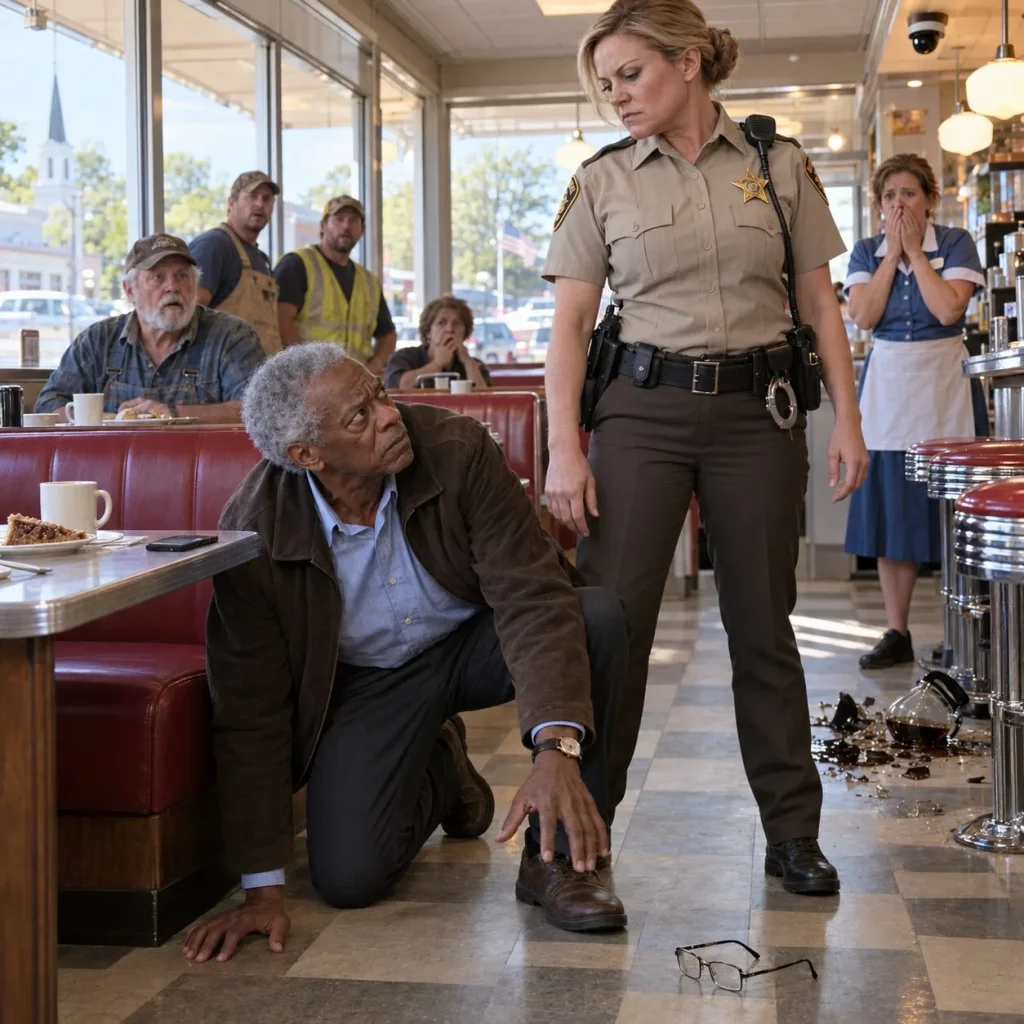
“Donna.”
“Then?”
“Mr. Keene.”
“Then?”
“The worker.”
“So the memory does not end in silence.”
I stared at him.
“No.”
“Your body may be stopping the story too early.”
That sounded suspiciously therapeutic.
It also made sense.
When the memory came, I practiced finishing it.
Slap.
Glasses.
Silence.
Donna speaks.
Mr. Keene stands.
A worker raises his hand.
Camera.
Aaron’s statement.
Henry arrives.
Evidence preserved.
The full story had more than one second.
That did not make the first second harmless.
It made the memory complete.
I also avoided the diner for almost a week after release.
People assumed I went back immediately.
I did not.
The thought of the booth made my stomach hurt.
Donna called.
“You don’t have to come.”
“I know.”
“I can bring breakfast.”
“That defeats the purpose of a diner.”
“Marcus.”
“I’m okay.”
“Stop saying that like it’s punctuation.”
I laughed.
Evelyn used to say the same thing.
The first morning I returned, I did not sit in my booth.
I sat at the counter.
Donna did not comment.
She poured coffee.
I stayed twenty minutes.
The second time, thirty.

Then I sat in a booth on the other side.
Weeks later, I returned to mine.
Recovery was not a triumphant entrance.
It was exposure in small doses.
A place becoming ordinary again.
The same was true of police sirens.
For months, if I saw a sheriff’s vehicle behind me, I checked my speed three times.
Once, a deputy followed me for six miles.
My hands sweated.
Then he turned.
Nothing happened.
I told Dr. Price.
“What did you learn?”
“That I’m paranoid.”
“No.”
“That not every patrol car is Erica.”
“Better.”
I hated how simple these exercises sounded.
I also hated that they worked.
One afternoon, Aaron stopped by my house in uniform.
He had called first.
That mattered.
I opened the door.
For half a second, the badge tightened something in my chest.
Then I saw Aaron.
“Come in.”
He noticed.
“Would you rather I change before I visit?”
“No.”
“You sure?”
“Yes.”
I made coffee.
We sat on the porch.
He talked about training changes.
I listened.
Gradually, the uniform returned to being clothing worn by a specific person instead of a symbol that controlled my pulse.
That was important because I did not want Erica to teach me fear of every officer.
That would give her too much power.
At the same time, I refused to force trust.
Trust is not a civic duty.
Conduct earns it.
Institutions support it.
Transparency repairs it.
Those ideas became personal rather than theoretical.
A few months after the plea, the new sheriff invited me to tour the department and review community-facing policy changes.
I almost refused.
Henry said, “Go if you want.
Don’t go to prove anything.”
I went.
The lobby looked the same.
The bulletin board.
Plastic chairs.
Flag.
My body remembered booking.
I breathed.
The new sheriff, Carla Wade, met me without cameras.
“I don’t want a photo,” she said.
“Good.”
“I don’t want this turned into a reconciliation event.”
“Better.”
She showed me the revised complaint process.
A QR code.
Paper forms.
Anonymous reporting options.
External review triggers for complaints against senior command.
I asked hard questions.
“What happens if the complaint is against you?”
“External referral.”
“Who decides?”
She showed me.
“What prevents informal retaliation?”
“Nothing prevents every human choice.”
I appreciated the honesty.
“We can document assignments, monitor patterns, and investigate complaints.”
I nodded.
“Better answer.”
She smiled.
“Teacher.”
“Unfortunately.”
Before I left, we passed interview room two.
My steps slowed.
Wade noticed.
“Want to see it?”
“No.”
Then I changed my mind.
“Yes.”
She opened the door.
Same metal table.
Same chairs.
Same camera.
Empty.
I stood in the doorway.
Nothing happened.
No flashback.
No speech.
Just a room.
That felt like victory.
Not over Erica.
Over the belief that a place could still command me.
Outside, Wade asked, “Anything you think we’re missing?”
I said, “Teach deputies what to do when the person giving a bad order is the highest-ranking person in the room.”
She nodded.
“We added a duty-to-intervene section.”
“Policy is good.”

“You’re going to say culture matters.”
“Yes.”
“It does.”
We stood in the parking lot.
“I can’t promise nobody in this department will ever abuse authority again,” she said.
“I wouldn’t believe you if you did.”
“I can promise we’ll make it harder to hide.”
That was realistic enough for me.
I drove home.
A patrol car passed in the opposite direction.
I noticed.
Then I kept driving.
That small reaction never made the news.
It may have been one of the most important outcomes of the entire year.
Several weeks after the plea, I received a letter from Erica.
Not from her lawyer.
From her.
The envelope sat on my kitchen table for two days before I opened it.
Henry asked whether I wanted him there.
“No.”
“You sure?”
“No.”
He smiled.
“That means yes?”
“It means go home.”
He went home.
I made coffee and opened the letter.
Erica did not ask me to keep it private.
She did not ask me to forgive her.
She wrote that she had started counseling after resigning.
She wrote that for most of her life, my name had been connected to a story about her father being humiliated.
She said she had never read the original school-board minutes until her attorney obtained them.
That surprised me.
For decades, she had hated a version of an event she had never examined directly.
She wrote:
I believed you attacked my father because that is how the story was told in my house.
When I finally read what you actually said, I realized you asked for a policy.
I built anger around a version I never checked.
I read that sentence three times.
Then another:
None of that excuses what I did.
It explains how long I had been preparing to see disrespect in anything you said.
That was harder to read.
Prejudice often works that way.





