I hated the question.
“You know.”

“I know what I think.”
“What do you need?”
“What you understood at the time.”
I sat at my kitchen table.
“I understood it racially.”
“Why?”
“Context.”
“Explain.”
“She had just said people in town knowing me made me think rules didn’t apply.
Then she said ‘you people.’
I was a Black man sitting alone.
She knew my history with her father over Black students.”
Henry stayed quiet.
“Did she use a racial slur?”
“No.”
“Had she previously made racial comments to you?”
“No.”
“Good.”
“Good?”
“Good that you’re precise.”
I sighed.
“You sound like a deposition.”
“I’m sorry.”
“No, you’re right.”
Precision mattered.
The strongest case was the exact case.
Not the exaggerated one.
That principle became harder when the public debate began.
People wanted labels.
Racist.
Corrupt.
Hero.
Victim.
Traitor.
Whistleblower.
Labels make stories easy to share.
Facts make them harder to distort.
I decided early that I would not call Erica anything more than the evidence supported.
That frustrated allies.
A civil-rights activist told me, “You’re being too generous.”
“I’m being accurate.”
“She assaulted a Black elder.”
“Yes.”
“She falsely arrested you.”
“That is what the evidence suggests.”
“Suggests?”
“I’m not the judge.”
He stared at me.
“You always this careful?”
“I taught teenagers for thirty-six years.
If I overstated one fact, they used it to ignore ten correct ones.”
He laughed.
“Fair.”
My restraint did not mean passivity.
Paul filed records requests.
We obtained dispatch logs.
No call had sent Erica to the diner.
No complaint had been made about me.
She was there for breakfast.
That mattered.
We obtained the booking log.
It showed how quickly the charges were entered after arrival.
We obtained the property record showing my phone had been listed as “evidentiary hold” without a warrant or separate evidence form.
That mattered too.
Not because the phone held secrets.
Because process had been bent to justify control.
I asked Paul, “Could she legally take it?”
“Officers can secure property in some detention circumstances.”
“Could she call it evidence?”
“That requires a basis.”
“What basis?”
“Exactly.”
That was how lawyers answered.
With more questions.
The most painful evidence remained witness statements.
Not because they hurt me.
Because they showed fear.
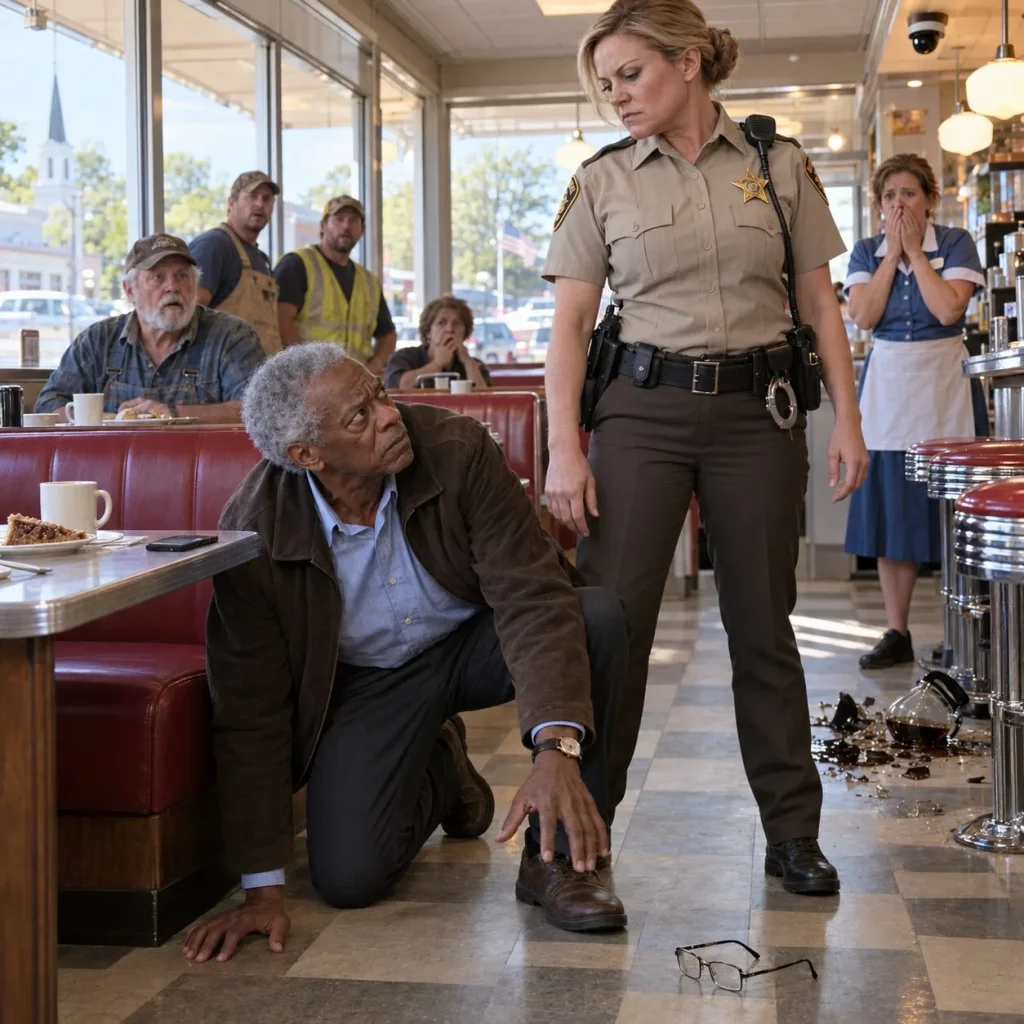
Donna described looking at Erica for permission before retrieving my glasses.
Mr. Keene admitted he wanted to speak but remembered the sheriff controlled concealed-carry permits and other local matters.
The construction worker said his brother had an open probation issue and he did not want “trouble with the county.”
The young mother said she considered recording on her phone but was afraid Erica would take it.
Those fears revealed power beyond the badge.
People interact with local sheriffs through permits, jail, court security, deputies, traffic, family emergencies.
Even citizens who have done nothing wrong can fear becoming inconvenient to someone with institutional reach.
That does not mean every fear is justified.
It means perceived power shapes behavior.
I understood the diner silence differently after reading those statements.
It was not cowardice.
It was calculation.

A room full of people deciding in seconds what speaking might cost.
That made Donna’s decision to speak more meaningful.
It made Mr. Keene’s decision more meaningful.
It made the worker raising his hand more meaningful.
Courage is not the absence of cost.
I had taught that too.
The sheriff’s office tried to limit Aaron’s access to records after he became a witness.
That was reasonable.
But he worried they were treating him like a suspect.
Paul advised him to get independent counsel.
Aaron did.
The first time I saw him with his lawyer at the courthouse, I felt guilty.
“My case is costing him.”
Henry corrected me.
“Erica’s conduct is costing him.”
“That sounds like something you learned in therapy.”
“That sounds like something you taught me about causation.”
He was right.
Victims often absorb responsibility for every consequence that follows disclosure.
If I had stayed quiet, Donna would not face backlash.
Aaron would not need a lawyer.
The department would not be scrutinized.
Erica’s family would not be publicly embarrassed.
That logic is dangerous.
Silence does not erase the original act.
It only protects it from consequence.
I thought of Darryl, Kevin, and Leon in 1990.
They had almost stayed quiet.
Darryl told me later that his father did not want him to complain.
“Sheriffs remember names,” his father had said.
That was fear passed down too.
When I filed the school complaint, Darryl’s father thanked me privately and avoided me publicly.
At the time I had judged him.
Decades later, after watching adults in the diner hesitate, I understood better.
Risk is not distributed equally.
A teacher with tenure had different risk from a teenager.
A retired man with a DOJ attorney son had different risk from a diner waitress.
Justice requires noticing those differences.
That became central to how I spoke publicly.
I refused to shame anyone for not confronting Erica physically or verbally.
People asked, “Why didn’t somebody stop her?”
I answered, “Stop her how?”
Shout?
Touch an armed sheriff?
Block an arrest?
Risk another charge?
Hero fantasies are easy after the danger passes.
Real courage often looks smaller.
Save the video.
Give a statement.
Refuse to falsify.
Call a lawyer.
Preserve a file.
Tell the truth tomorrow if you could not tell it in the first second.
That message resonated.
Donna told me customers started asking how her camera system worked.
“Everybody wants cloud storage now.”
“Good for business?”
“I don’t sell cameras.”
“Missed opportunity.”
She rolled her eyes.
The camera became famous.
I hated that too.
A local reporter filmed it in close-up.
Black plastic box.
Blue status light.
Ordinary object.
People treated it like a witness.
It was not.
It could not interpret.
It could not choose courage.
It simply preserved light and sound.
Humans still had to decide what to do with what it preserved.
That distinction mattered.
Evidence does not enforce itself.
Somebody has to save it.
Review it.
Authenticate it.





