
My phone was still missing.
Paul asked for it.
The clerk looked at the property sheet.
“It says Sheriff Mullen retained it as evidence.”
Paul’s expression sharpened.
“Evidence under what warrant?”
The clerk went pale.
Twenty minutes later, my phone appeared.
No warrant.
No forensic receipt.
No explanation.
Paul photographed the property sheet before I signed anything.
Outside the sheriff’s office, Henry was waiting.
My son was forty-one years old.
Six feet tall.
Gray beginning at his temples.
He had my wife’s eyes.
The moment he saw my face, every bit of professional control disappeared.
“Dad.”
“I’m fine.”
“No, you’re not.”
“I’m standing.”
“That line wasn’t funny the first time.”
He hugged me.
I had not realized how badly I needed it.
Then he stepped back.
“Did she hit you with an open hand?”
“Yes.”
“Once?”
“Yes.”
“Any other force?”
“No.”
“Threats?”
“Plenty.”
Paul said, “Henry.”
My son stopped.
He knew he was becoming a lawyer before becoming a son.
He exhaled.
“Right.”
We drove back to Riverside Diner.
I did not want to.
Henry insisted.
“Why?”
“Because Donna has the video.”
“We can get it later.”
“You need to see the room.”
“I saw the room.”
“After.”
That word mattered.
After.
The place where people had been afraid needed to become something else.
When we entered, the diner was half empty.
Donna saw me and started crying.
She came around the counter.
“I’m sorry.”
“For what?”
“I looked at her before I picked up your glasses.”
I understood exactly why that haunted her.
“You were scared.”
“I should have moved.”
“You moved.”
“Only after she let me.”
I touched her shoulder.
“You spoke later.”
She looked toward the camera.
“I saved everything.”
Henry introduced himself.
Donna recognized his name.
“Your daddy talked about you all the time.”
Henry smiled.
“Only the embarrassing parts, probably.”
She handed him a flash drive.
“Copy of the video.”
He did not take it immediately.
“Keep your original.
My colleague will make a documented copy.”
Donna nodded.
The hardware-store owner, Mr. Keene, came over.
“I gave a statement.”
“Thank you.”
He looked ashamed.
“I didn’t stand up fast enough.”
I heard that phrase again and again over the next week.
Not fast enough.
I wanted people to understand that courage is not measured only by who moves first.
Sometimes courage is second.
Third.
Tenth.
What matters is whether silence becomes permanent.
That evening, Henry and I watched the video in Paul’s office.
The angle was wide.
Clear.
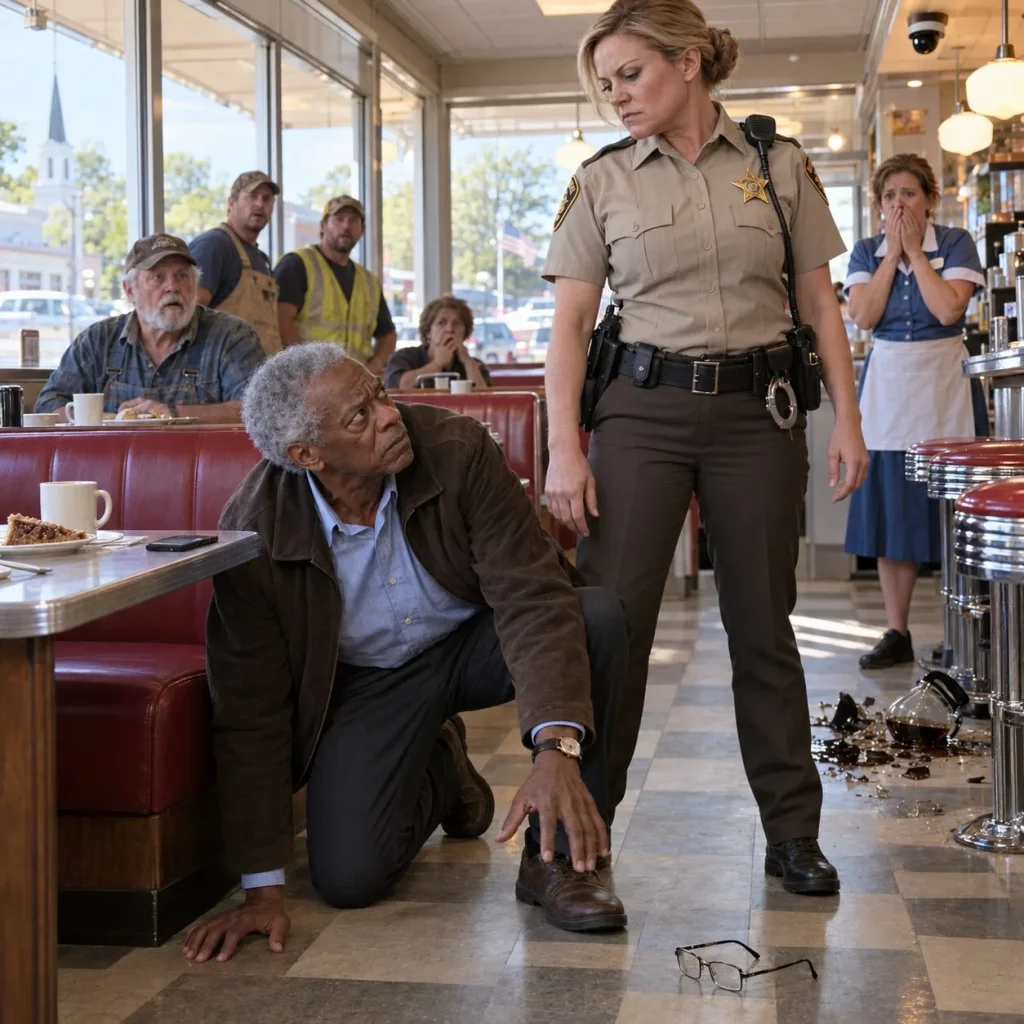
There I was.
Sitting.
Erica standing over me.
Audio captured everything.
“Put that cup down when I’m talking to you.”
“I haven’t broken a rule.”
“You people always know how to make simple things difficult.”
Then my hand reaching toward the mug.
Then the slap.
The glasses flying.
Donna dropping the pot.
The room freezing.
Henry stopped the video.
His hands were shaking.
“Dad.”
“I know.”
He stood and walked to the window.
I had never seen my son look so angry.
“Play it.”
He turned.
“You don’t need to watch again.”

“I do.”
“Why?”
“Because everyone else will.”
He stared at me.
I continued.
“If this becomes public, I need to know what they’ll see.”
He sat.
We watched the rest.
The phone call.
Donna speaking.
Mr. Keene standing.
The camera did not capture every word after I went outside.
But it captured enough.
Henry shut the laptop.
“What do you want to do?”
“Tell the truth.”
“That’s not a legal strategy.”
“It’s the only one I have.”
“Do you want to sue?”
“I don’t know.”
“Do you want the video public?”
“I don’t know.”
“Do you want her removed?”
I thought of Erica’s hand.
Her smile.
Her fear when she saw the camera.
“I want her authority examined by people who aren’t afraid of her.”
Henry nodded.
“That I can work with.”
That night, I slept at my house with the porch light on.
I had lived there for thirty-one years.
For the first time, I wondered whether a sheriff’s car might pull into my driveway because I had embarrassed the wrong family.
At eleven-forty, headlights swept across the wall.
I sat up.
A car stopped outside.
I looked through the window.
It was Aaron Pike.
He stood on the porch holding an envelope.
I opened the door.
“What is it?”
“My written statement.”
“Why are you bringing it to me?”
“I’m not.
I gave a copy to the state investigator.”
He held the envelope out.
“This is something else.”
I opened it.
Inside was a photocopy of an old newspaper article.
The headline was thirty-six years old.
LOCAL TEACHER QUESTIONS FOOTBALL-GAME SEARCH.
There was a photograph of me at thirty-two.
Beside the article, someone had written in blue ink:
BENNETT NEVER LEARNED HIS PLACE.
I looked at Aaron.
“Where did this come from?”
He swallowed.
“Sheriff Mullen’s desk.”
The hours after my release revealed how quickly evidence can disappear if nobody knows to preserve it.
Donna’s security system was cloud-based, but the subscription automatically overwrote older footage after thirty days.
Thirty days sounds like plenty of time.
In legal work, it is nothing.
Henry knew that.
Paul sent a formal preservation letter that afternoon.
Donna downloaded multiple copies.
One went to her attorney.
One went to state investigators.
One stayed with the service provider under a preservation request.
I asked why so many.
Paul answered, “Because someday somebody will ask whether the file was altered.”
“Was it?”
“No.”
“Then why—”
He gave me a look.
I stopped.
“Right.
Evidence.”
“Chain of custody.”
“History teachers call that provenance.”
“Lawyers charge more.”
I laughed.
The audio was clearer than I expected.
You could hear forks.
The espresso machine.
A toddler fussing near the restroom.
Then Erica’s voice.
Then mine.
Then the slap.
The silence afterward was almost louder than the impact.
I listened once.
Then I could not listen again for several days.
Henry did.
He reviewed everything with Paul.
At one point, he called me.
“Dad, when she said ‘you people,’ what did you understand?”





