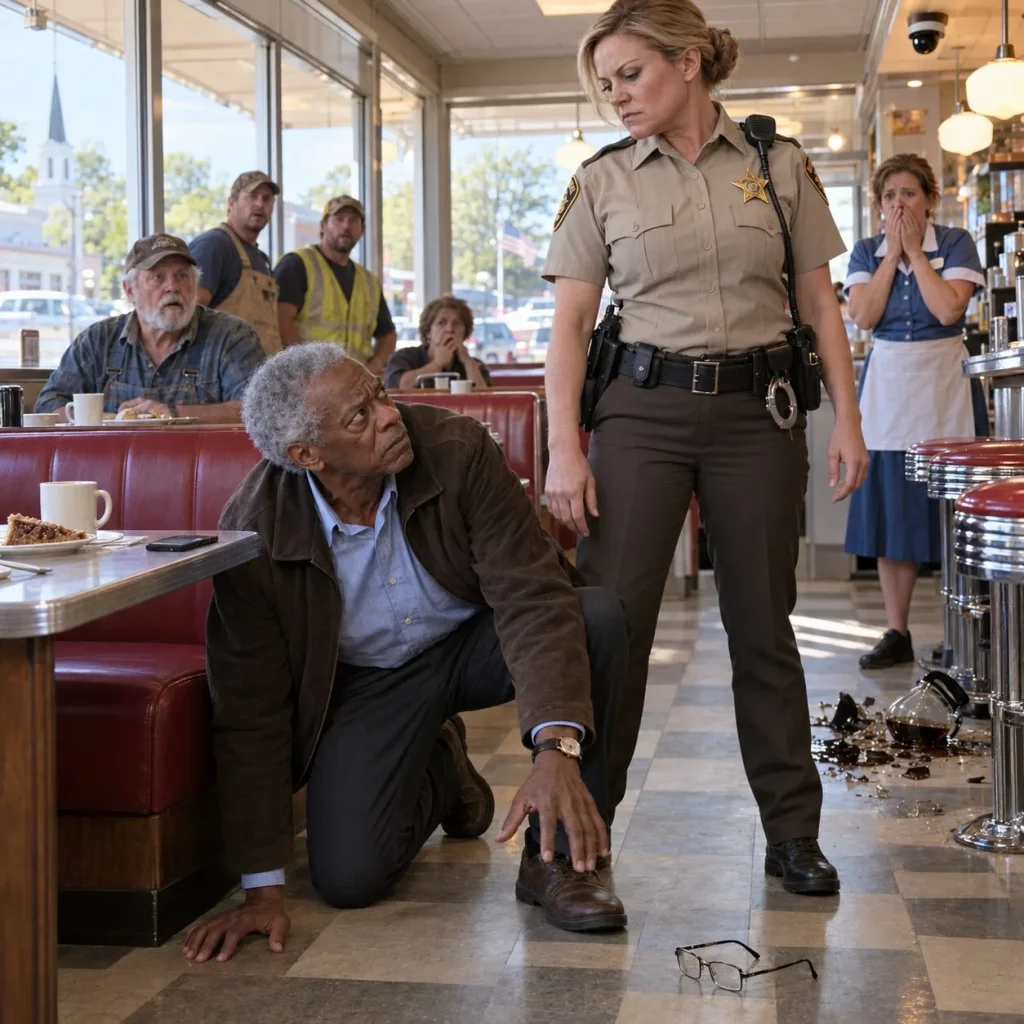
Parents spend years believing children need them.
If we are lucky, we live long enough to need our children too.
That did not make me weak.
It made me human.
A year after the diner incident, Riverside held another community forum.
This one was smaller.
Less angry.
More specific.
The sheriff’s department had a new interim leader and revised policies.
People still distrusted.
Some always would.
I spoke only once.
A teenager asked, “Mr. Bennett, did justice happen?”
I took a long time before answering.
“Some justice happened.”
He frowned.
“What does that mean?”
“Erica faced consequences.
Records were corrected.
Policies changed.
People spoke.
Those are real.”
“But?”
“But I was still slapped.”
The room quieted.
“Donna was still afraid.”
I looked toward her.
“Aaron still had to choose between his job and the truth.”
I looked at him.
“And there are people who go through worse without a camera.”
The teenager nodded.
“So justice doesn’t fix it?”
“No.”
“Then what’s the point?”
I smiled sadly.
“The point is not to make the past unhappen.”

I looked around the room.
“The point is to tell the truth about it, repair what can be repaired, hold people accountable where the evidence supports it, and make the next abuse of power harder.”
That answer satisfied me more than any headline had.
After the forum, I walked home.
Riverside was the same town.
Same courthouse clock.
Same diner.
Same church bells.
Same people who had been afraid.
Same people who had spoken.
Places do not transform all at once.
Neither do institutions.
Neither do people.
Change is usually slower than outrage.
That does not make it meaningless.
Before the plea agreement was reached, there was a long period when nothing seemed to move.
That was harder than the first week.
In the beginning, every hour brought new information.
A video.
A witness.
An interview.
A preservation request.
A statement.
Then the machinery slowed.
Lawyers reviewed.
Investigators compared reports.
Experts examined recordings.
The county waited.
Erica remained out of uniform, but she had not been convicted of anything.
People began asking why the case was “taking so long.”
I wanted to ask them what speed they thought justice should move.
Fast enough to satisfy anger?
Slow enough to protect rights?
Fast for victims?
Slow for defendants?
There was no answer that fit everyone.
Henry explained something I already knew intellectually.
“Dad, process is boring by design.”
“Boring?”
“Compared to outrage, yes.”
“People are losing patience.”
“People are not the jury.”
I smiled.
“You sound like me.”
“That’s unfortunate.”
The months taught me patience I did not want.
I had to stop checking the news every hour.
I had to stop reading comments under articles.
That one took longer.
Strangers had theories about my marriage, my finances, my teaching career, Henry’s job, Donna’s business, Aaron’s ambitions, and whether my glasses had actually been damaged.
One man claimed I had staged the whole event to become famous.
I stared at that comment for ten minutes.
Then Henry took my phone.
“No.”
“Give me that.”
“No.”
“I’m your father.”
“You’re also sixty-eight and arguing with a man whose profile picture is a cartoon alligator.”
I laughed so hard I had to sit down.
He put the phone on the table.
“Stop reading strangers.”
“Some of them live here.”
“Then stop reading neighbors.”
“Excellent federal advice.”
“Free of charge.”
I listened.
Not perfectly.
But more often.
Instead, I returned to routines.
Morning walks.
Grocery shopping.
Church.
Reading.
I started tutoring two high-school students in history because retirement had become too quiet even before the diner incident.
The first session after the video release, one of them stared at my face.
The swelling was gone.
The scratch remained faint.
“Mr. Bennett, are you famous now?”
“No.”
“You’re on YouTube.”
“That is not the same thing.”
He grinned.
“How many views?”
“I refuse to know.”
He knew.
He told me anyway.
I assigned him an extra chapter.
Life continued.
That mattered because public trauma can turn a person into one event.
I was not only the man the sheriff slapped.

I was Henry’s father.
Evelyn’s widower.
A retired teacher.
A bad gardener.
A good chess player.
A man who burned toast because he read while cooking.
I needed those identities.
Otherwise Erica would still control too much of my life.
One Sunday, I found an old box of Evelyn’s things in the attic.
Inside was a note she had written me years earlier after a school-board fight.
Marcus,
You cannot carry every argument home.
Some belong to the room where they happened.
I sat on the attic floor and cried.
Evelyn had known me better than I knew myself.
I carried arguments.
I carried injustice.
I carried sentences people said thirty years earlier.
Sometimes that helped me teach.
Sometimes it made my shoulders ache.
I put the note in my wallet.
At the next legal meeting, I touched it before entering.
Paul noticed.
“Lucky charm?”
“My wife.”
He nodded.
During settlement discussions, the county’s insurer initially offered money with no policy commitments.
Paul asked what I thought.
“I don’t care about the number yet.”
“That is a sentence lawyers hate.”
“I want training and record-integrity provisions.”
“Training language is negotiable.”
“Then negotiate it.”
“The county may resist anything that sounds like admitting systemic failure.”
“I’m not asking them to admit a system failed.”
“What are you asking?”
“To admit systems can improve.”
Paul smiled.
“That sounds more expensive than money.”
He was right.
Money closes files.
Change creates work.
The final settlement included policy review, training, and periodic audits of force reports for a defined period.
Not revolution.
Not transformation.
A mechanism.
I had learned to value mechanisms.
The camera had been a mechanism.
The EMS policy had been a mechanism.
The interview-room recording had been a mechanism.
Aaron’s body camera had been a mechanism.
Good intentions matter.
Systems preserve good intentions when fear arrives.
That became one of the main themes of the public talks I reluctantly began giving.





