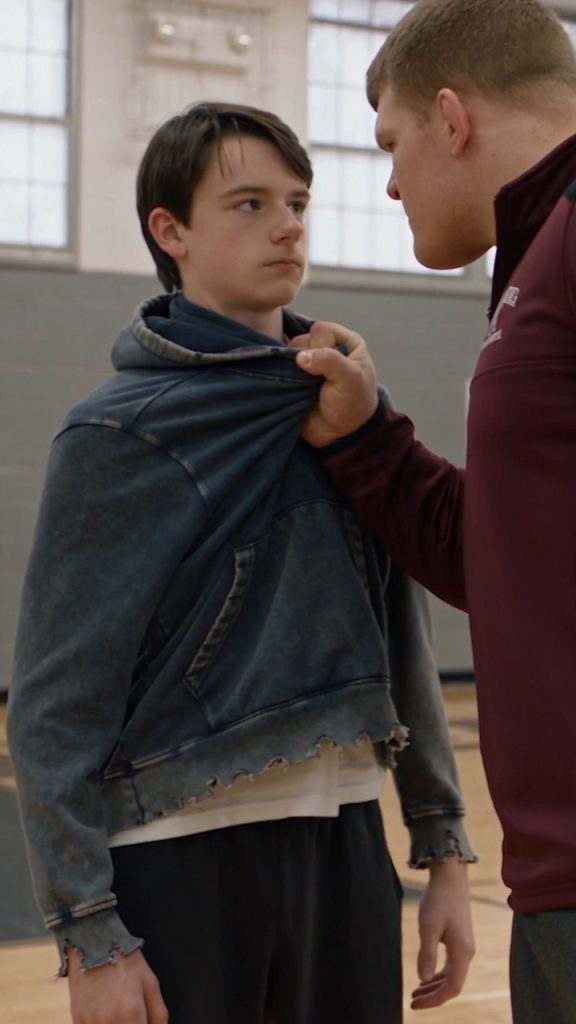
Brody Cole had one hand twisted into the collar of my hoodie, and every phone in the gym seemed to be aimed at the place where I stood.
My back met the cold edge of the east bleachers. The sound was small, just a hollow metallic shiver, but it traveled through the thin fabric between my shoulder blades. Across the hardwood, eight junior-varsity wrestlers had packed themselves in front of the locker-room doors. They were laughing with the confidence of people who believed they had already decided how a story would end.
Coach Miller sat on a blue wheeled equipment box thirty feet away, looking down at his phone. He was whistling a tune I couldn’t place.
“Look at me, charity case.” Brody’s hand tightened. He was tall enough that I had to look up to see his face. The burgundy shoulder of his warm-up jacket filled most of my view. “You think a high-score scholarship means you belong at that back table? You think you can stare at Sarah and get away with it?”
“I wasn’t staring at anybody.”
His smile changed, like I’d handed him permission. “Then get down on your knees and say you’re sorry.”
Behind him, the boys near the doors picked up the old nickname they’d used for me since middle school. I won’t repeat it. Hearing it again was enough to make seventh grade return in a rush: the cafeteria tray held close to my chest, the empty chairs people claimed were reserved, the tiny calculation of whether walking away would hurt less than sitting down.
The incident Brody meant had happened three school days earlier. I had carried my algebra notes to the back cafeteria table because it was quiet there. Sarah was sitting at the other end with two classmates, and she had asked whether we’d been given the same homework. I showed her the last problem on my page. That was the whole conversation. When I looked up toward the clock, Brody was watching from the serving line. He didn’t confront me then. He said something to a teammate, and they both looked over.
It had seemed too small a thing to explain to anybody. People looked at other people in cafeterias all the time. And I had learned to distrust the idea that every unfriendly glance would become a new incident. Most didn’t. Some just settled into the background, another little cost of moving through a place where you were tolerated more easily than welcomed.
What I hadn’t known was that he would carry the moment into the gym like a debt he had the right to collect. His hand on my collar was making the connection explicit now: the back table, Sarah’s name, the scholarship, the nickname. He was taking ordinary parts of my school day and arranging them as evidence against me. I couldn’t persuade thirty filming students to stop believing him in one breath. I could only refuse to give him the kneeling scene he wanted.
I kept my hands loose. My grandmother used to say that anger traveled faster through a body than thought, and my instructor at the community center had said something similar in different words. Neither of them meant that fear was shameful. They meant you could feel it without letting it choose for you.
“I’m not looking for trouble, Brody.”
“Too late.” He gave my collar another wrench, stretching the faded charcoal-blue fabric against my neck. “Trouble found you.”
I had been watching his leading sneaker. It shifted half an inch, a movement too slight for the students recording from the bleachers to notice. His weight moved toward his heel. His right shoulder drew back.
I could have shoved him. I could have shouted for Coach Miller until my voice cracked. I wanted to do both, and I knew neither was likely to help in the next second. Instead I eased the collar from Brody’s fingers as his grip changed, brought my feet together, and bowed once.
Not low. Not theatrical. A brief acknowledgment that someone standing in front of me had the capacity to hurt me, and that I understood the risk. I had been doing that before supervised practice since I was seven. It had never made a room safe by itself. It was a way to remind myself what kind of person I intended to be inside it.
The chanting broke apart. A few people laughed uncertainly.
“What is that supposed to mean?” Brody asked.
I straightened. Both my palms were open where everyone could see them. “This is your last chance to walk away.”
Brody’s leading shoe planted. His right shoulder came forward, and his fist followed.
The first part happened faster than the crowd’s breath. I moved half a step into the open space toward the court. His knuckles passed the place my face had occupied. I guided the moving arm beyond my shoulder, using its direction rather than trying to stop all that weight. Brody stumbled three steps on the polished floor. His black sneakers squealed. He caught himself without falling.
For one strange second I thought he might stop. His face had gone blank with surprise, and the gym was so quiet I heard a basketball rolling in a distant hallway.
Then he turned and came at me again.
I remember the feel of his wrist more clearly than I remember the noise. I found his arm as he rushed in, kept moving instead of bracing against him, and directed him down and away from the bleacher metal. His shoulder and hip met the hardwood. The sound was sharp but ordinary, not the terrible crack everyone seemed to expect. I let go as soon as he stopped advancing and walked backward until there was six feet between us.
I hadn’t thrown a punch. I hadn’t kicked him. I didn’t raise my arms or smile for the phones. I was shaking hard enough that I had to press my fingertips against my palms to hide it.





