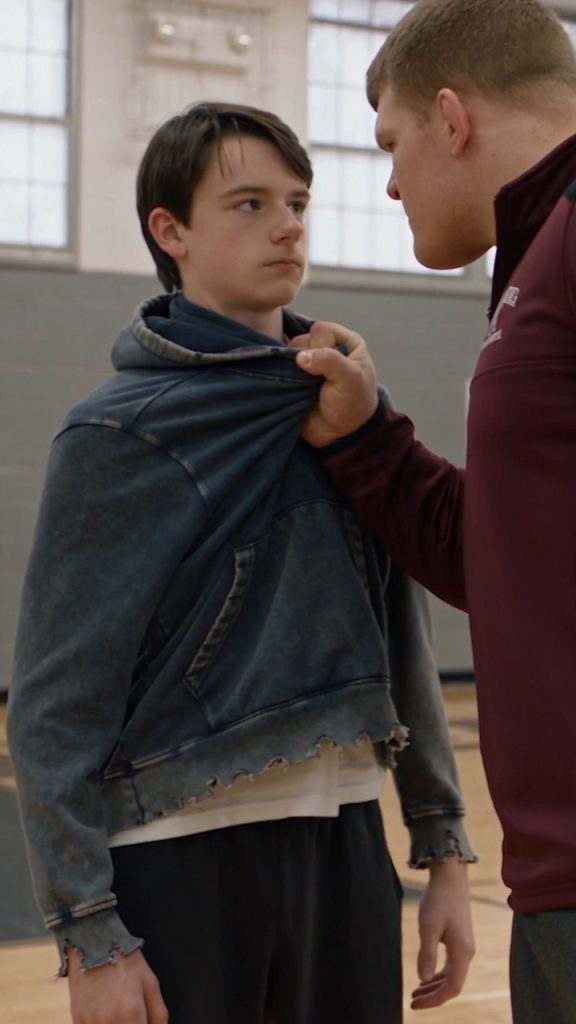
“I didn’t know what else to do either.”
He closed his book. “I guess I can do better next time.”
“I hope there’s no next time.”
For once, both of us laughed. It was brief, and there was nothing triumphant about it. He’d made a choice that helped now, even if it didn’t undo what he’d failed to do earlier. That was more complicated than making him a hero or a villain, and somehow easier to live with.
I saw Marcus after last period near the athletics building, sitting alone on the low wall with his sports bag at his feet. I considered walking over and then stopped myself. He had asked whether I thought he’d be believed, and I hadn’t been able to promise anything. I also didn’t want my concern to become another reason someone could say we were coordinating our accounts.
He noticed me first and raised one hand, a small greeting. I returned it. He stood and came toward me of his own choice.
“I might quit wrestling,” he said.
“You like it, don’t you?”
“Yeah.” He looked out toward the parking area. “That’s why it’s hard. Brody’s a captain. When he tells you where to stand, you stand. You want a chance to wrestle next season, you don’t make trouble for the people who decide whether you’re worth practicing with.”
“Does he decide that?”
“Not officially,” Marcus said. “But you know what I mean.”
I did. At Hawthorne Ridge, some kinds of authority weren’t printed on forms. Brody’s power was partly physical, partly social, and partly built from all the times other people had chosen not to challenge him. Marcus had already disrupted that arrangement with two sentences spoken under the lights.
“If you quit,” I said, “you should get to quit because wrestling isn’t for you, not because you’re afraid to tell what you saw.”
“That sounds nice.”
“It might still be hard.”
He looked at me with an expression that was almost a smile. “You’re terrible at making people feel better.”
“I’ve been told.”
We didn’t discuss the details of his interview. I told him Ruiz had agreed to speak with students separately. He said he knew, and we let the subject rest. Some conversations were useful because of what they didn’t demand.
On Friday evening, Ruiz sent an update to our families. Owen’s original file had been received and reviewed. More individual interviews were still needed. The school had not reached a final decision and would not ask students to debate their accounts in public. The temporary separation arrangement would continue into the next week.
I showed Mom the message while she sorted receipts at the kitchen table. She nodded, read it again, and asked whether I wanted to meet the counselor on Monday. I said I would decide in the morning. She didn’t push.
I took out my timeline and drew two columns on the back. One was labeled What I know. The other was labeled What I don’t. Under the first I wrote: Brody held my collar. He came toward me twice. I left him when he stopped. Marcus said the doorway group had been ordered into place. Under the second I wrote: exactly what each of the seven other wrestlers thought would happen, which students’ recordings began when, and whether Marcus would feel able to repeat his account.
The edited video had already lost some of its power now that a longer original existed. But the original could not show an instruction given before the lens turned toward us. The most important part of the plan was still an event one person had heard and others might be afraid to acknowledge.
I folded the paper and put it beside the official complaint. For the first time I could see why an investigation might take days without being an excuse for doing nothing. The harder part was accepting that every extra day made room for someone to pressure Marcus into silence.
On Monday, Ruiz would begin another round of conversations with the students who had blocked the doors. Brody’s version and Marcus’s version still disagreed about what those eight boys had been asked to do. No amount of zooming into Owen’s recording would settle that private instruction.
I had spent a week wishing the phone would tell the whole story. Now I understood that the one piece it couldn’t tell was the piece the school would have to hear from people.
The second Monday after the incident began with rain against my bedroom window and a message from Ruiz asking me to come to her office before lunch. I read it twice without opening my schoolbag. For a moment I imagined that she had decided Brody’s complaint was true and was calling me in to tell me I would have to accept the consequences.
My mother was in the kitchen tying her hair back. She saw my face and asked what had happened. I showed her the message.
“It doesn’t say there’s a finding,” she pointed out.
“No. But it doesn’t say what she wants, either.”
“Then ask when you get there. You don’t have to fill the silence with the worst answer.”
It was good advice. I resented it anyway. The last week had taught me how long a school day could feel when every unopened message seemed capable of changing my future. I’d kept up with assignments, more or less, but my math homework took twice as long because I’d reread each problem after realizing I hadn’t absorbed a word.
At school, the hall supervisor greeted me by name. The extra adult near the gym corridor was still there. I appreciated the arrangement more than I had expected, and I disliked needing it more than I could explain. Both things were true. I had begun to make small experiments in ordinary freedom: getting water without checking the corridor first, staying after class to ask a teacher a question, walking past a row of athletic posters without thinking about whether Brody’s face would be on one of them.





