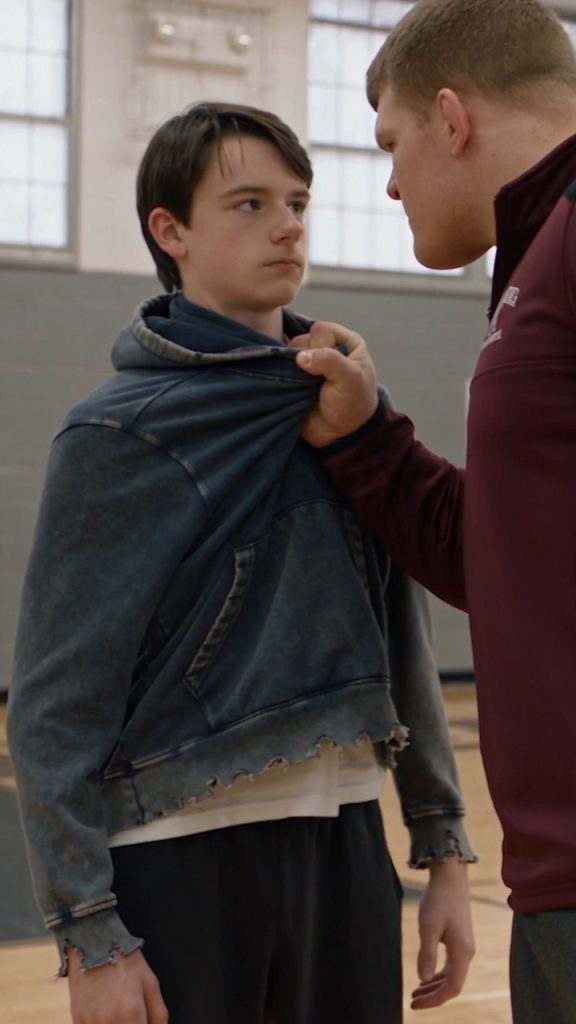
“Ruiz asked me to give a statement,” Sarah added. “I’m going to.”
“Thank you.”
She twisted the lid off her water bottle. “Don’t thank me for telling the truth. I should’ve spoken sooner.”
For the first time since Monday, lunch tasted like something instead of paper. It wasn’t because everybody had suddenly accepted me. It was because the table where Brody said I didn’t belong had become a place where another person could sit without asking his permission.
That afternoon, a message from Ruiz said she had received my written timeline and had scheduled individual interviews. She also wanted a separate conversation with me on Wednesday about the movements that put Brody on the floor. The wording made my stomach tighten: physical contact by both students. I knew it was true, but I was afraid anyone reading quickly would treat that sentence as if our choices had been equivalent.
I went to the community recreation center after school for the first time in weeks. The room smelled of clean mats and floor disinfectant. Younger students were putting shoes into cubbies while their instructor reminded them to keep enough room between partners. I stood in the doorway for a minute without entering.
I’d started classes there when I was seven because Mom wanted me to learn balance and confidence. No one had promised to make me fearless. Over the years I’d learned mostly ordinary things: how to stop when told, how to recognize that another person was losing control, how to practice within boundaries, how to leave room for someone to quit. We didn’t train for school fights. We trained so that people could move safely with people who might be stronger or less careful.
My instructor, who was busy helping a new student, waved from across the room. I waved back but didn’t explain what had happened. I wasn’t there to collect an expert to tell the school I had done everything perfectly. I was there to remember that a moment in the gym wasn’t the whole of who I was.
I sat on a bench near the wall until the younger class ended, then went home without practicing. I couldn’t yet make myself enter the space where a bow normally meant everyone agreed to be careful.
The next morning, Ruiz met me in a small conference room with a glass window onto the hallway. She asked the same questions again, this time slowly. I described both attacks, including where I moved, and said that I chose to release Brody as soon as he was no longer coming toward me. I did not claim that every choice I made was perfect or that I could know how he felt when he landed. I said I was frightened and trying to get away.
“Do you believe he was trying to hit you?” she asked.
“I saw his fist coming at my face the first time. I saw him rush at me again. I don’t know what was in his head. I know what he did.”
She made a note. “That’s a helpful distinction.”
I told her again that Marcus had spoken about the doors while Coach stood there, and that Brody had threatened him within earshot. Ruiz said Marcus had been invited to speak privately, away from his teammates. She wouldn’t tell me what another student’s interview contained. I was grateful for the rule and frustrated by it at the same time.
“People are saying I attacked Brody,” I told her. “He already said it to Coach. Now there’s a video making it look true.”
“I know a partial clip is circulating,” she said. “We’re working to establish the full context. Please don’t try to conduct your own investigation in the halls.”
“I wasn’t going to.” I paused. “Can you make sure nobody has to repeat what happened with Brody standing in front of them?”
“That is the plan.”
After the meeting, I passed the door to the athletic office. Inside, two adults were discussing schedules with the door partly shut. I heard Brody’s name and kept moving. I did not know whether they were discussing practice or discipline. I was starting to understand how dangerous it was to turn every half-heard sentence into a fact.
At the end of the day, a formal notice appeared in my school inbox. Brody had submitted an allegation that I initiated a physical assault and used an unreasonable degree of force. The notice said the review would consider all accounts and evidence, that no finding had yet been made, and that I could provide an additional statement before the decision.
I read it in the library. The carpet muffled footsteps, and the librarian was arranging a display of student essays. My name looked strange in the official subject line, as though it belonged to someone older and more dangerous than me. I knew Brody was entitled to give his account. Knowing that didn’t make it pleasant to see his lie set out in formal language.
I called Mom from the outside walkway. She listened, asked me to forward the notice, and told me not to answer before we’d read it carefully together. She didn’t say I should withdraw from the school or fight back. She asked if I’d eaten.
On my way to the bus, I saw Marcus at the edge of the parking lot. He was standing beside a low brick wall, his sports bag hanging from one shoulder. I started to walk past, unwilling to make him feel cornered. He spoke first.
“Are they making you tell the story again?”
“Yeah.”
He looked toward the athletics building. “Brody says he only told us to stand around because you were going to cause trouble.”
“Were you going to stop me from leaving?”
Marcus didn’t answer immediately. “We stood across the doors,” he said finally. “We knew what that meant.”
“Did you know he’d swing at me?”





