Ruiz scheduled a meeting with me that afternoon to discuss the footage. Mom joined by phone from work, on her break, and we agreed not to record the meeting ourselves. Ruiz said she’d reviewed Owen’s original with him present and would describe the relevant portions and let me clarify details. The school’s file would retain his voluntarily supplied copy under its conduct procedures, not post it or hand it around as entertainment.
Before she began, she put the shortened video on a laptop without playing the sound. It was the one I’d seen in the group chat: a few seconds of my hands at Brody’s arm, his fall, and a freeze. Then she closed it and showed the longer original Owen had given her.
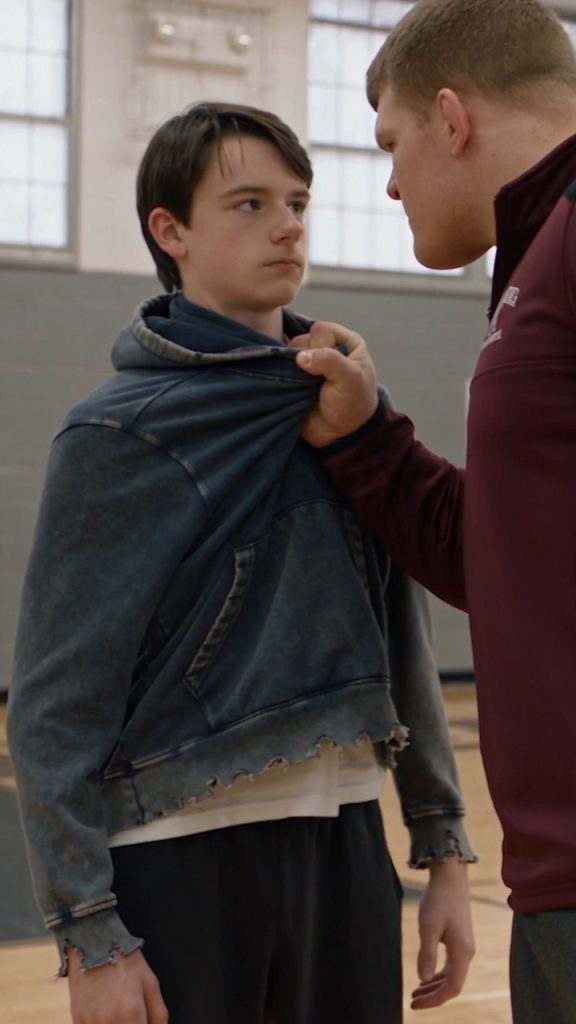
At first the sight of my own back beside the bleachers made me feel ill. The hoodie looked thinner than I remembered. Brody’s hand filled the space at my collar. I could see some of the JV students in the far background, packed near the double doors. Owen’s angle didn’t tell us what anyone near those doors had said before he pressed record. It showed only where they stood and what followed.
The sound was uneven. There were cheers and the sharp squeak of shoes, with fragments of Brody’s voice emerging before crowd noise swallowed them. I heard him demand that I kneel. My own warning was quieter than I remembered, almost lost underneath somebody’s laugh. The brief bow was visible, though it looked oddly small on a screen. I watched myself straighten and expose both palms.
Then Brody moved. The phone shook as someone near Owen shifted. Even from that imperfect angle, the first rush came from Brody’s position toward mine. He stumbled after I moved clear, caught himself, and turned. The second charge was easier to see until bodies in the foreground interrupted part of the view. The camera caught the movement toward the floor and the moment I stepped away. Afterward its angle dipped, as Owen had described. The original continued recording, but the bottom of the bleachers filled much of the frame for a breath before the gym came back into view.
The footage showed Brody lifting himself to a knee, pointing at me, and shouting. It did not give the viewer perfect access to the sound of every word. It also didn’t reveal the details of my hands when they were briefly hidden from Owen’s line of sight. I felt an urge to insist that the camera proved exactly what I remembered. Ruiz had to ask me whether I wanted to stop for a moment.
“No,” I said. “I just didn’t know it would look like that.”
“Like what?” Mom asked through the speaker.
“Like I was somebody else.”
I had been inside the fear. The camera showed a boy moving with his face almost blank. I thought of all the comments describing me as cold, calculating, dangerous. I hadn’t understood that my effort not to panic might look like confidence to people who hadn’t known how I felt.
Ruiz paused on a frame of Brody still holding my collar. “We can say the recording captures him grasping your clothing and that the visible movement toward you begins from his position,” she said. “We can say it supports your account of retreating after the floor contact. We cannot use it to say exactly what he told the team before Owen started recording.”
“Marcus heard that part,” I said.
“Yes. And we’ll assess his account with the other interviews.”
I wanted her to say the whole thing was settled. I could see on the paused screen that Brody had grabbed me. But Marcus had described a plan that happened earlier, outside Owen’s view. If we treated the phone as a kind of magic eye that could see every cause, we would be doing a version of what the people forwarding the cropped clip had done: asking the picture to answer questions it couldn’t.
“Can I correct something in my timeline?” I asked.
Ruiz raised her eyebrows. “Of course. What?”
“I wrote that Owen kept his phone up the whole time. He didn’t. He lowered it for a moment. But he didn’t turn it off. I didn’t know the difference until we saw it.”
She turned to a fresh page. “That’s a reasonable correction. Put it in writing with today’s date.”
I felt a sting of embarrassment, followed by relief. Accuracy was not an exam where admitting uncertainty made me fail. I could revise one sentence without giving up the rest of what I’d seen.
We talked briefly about the training I’d mentioned in my statement. I told Ruiz I had gone to an ordinary supervised community center program since I was seven. The classes included balance, controlled partner movement, and clear rules for stopping when a person wanted to stop. I had no competition medals to produce and no claim of special authority. I described my bow as a practice of respect and awareness, not a challenge.
“Why did you touch him instead of running?” she asked.
“I was next to the bleachers. The doors on the other side were blocked. After the first rush, I thought I could leave if he stopped. When he came again, I just wanted him to stop moving toward me.”
“And after he was down?”
“I let go.”
The recording supported that part of my account where its angle allowed a view. But I tried not to speak as if a camera could relieve me of responsibility for explaining my own choices. I had put my hands on Brody. That had happened. The important question was why, in what order, and whether I had continued after the danger ended.





