I wanted to tell him what his decision would mean for my case. I wanted to say the school needed him, that his statement was the missing part. Both things were true from where I stood, but neither was what he needed to hear just then.
“You get to tell what you know,” I said. “That’s enough.”
He nodded. The office secretary came to the doorway and asked him inside. He went in carrying the paper, and the door closed gently behind him.
I didn’t know what he said once he was out of sight. I couldn’t see the written statement, couldn’t hear the questions, and couldn’t turn his expression into proof that he had held firm. I went to my counselor’s office and spent most of the appointment talking about how hard it was to let a process continue without supervising it myself.
She said something I wrote down afterward: “You did what you could in the moment, and then you did what you could afterward. Those aren’t the same kind of courage.”
It sounded almost too polished to be useful, like one of the posters in the halls. But later, walking back to class, I understood what she meant. In the gym, there hadn’t been time to think about anything except surviving the next motion. Since then, every day had asked me to choose whether I’d make the truth easier or harder to find. I’d chosen to tell the school about the phones, to be honest about placing my hands on Brody, to correct my own account when it needed correcting, and to leave other people room to give theirs.
None of those choices felt as decisive as a bow. All of them had taken longer.
That afternoon Mom met me outside the school office for the scheduled family meeting. She had brought a folder of the notices she’d received and copies of my timeline. I wanted to tell her the folder was excessive. Then I remembered how comforting it had been to have the right date and the right version of a statement available when somebody asked.
Ruiz met us with a member of the school’s athletics administration. They were careful about what they could share concerning other students, but they did not make me wait through a long speech to hear the central finding.
“The review has concluded that you did not initiate the physical confrontation,” Ruiz said. “The school will not impose a disciplinary penalty on you for the defensive contact described in this incident.”
I had imagined relief arriving like a door swinging open. Instead, I felt myself go still. I had spent so long preparing for the possibility that I would have to argue about the first attack that the words seemed almost unreal.
Mom reached across the table and put her hand over mine.
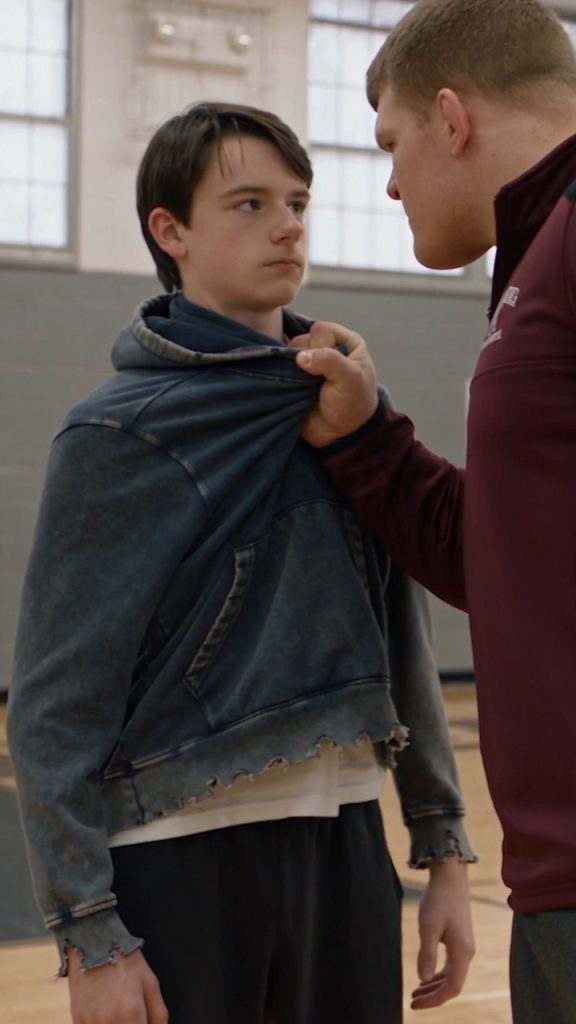
Ruiz continued. “We found that Brody grabbed your clothing and initiated two advances toward you. His account that you went after him without provocation is inconsistent with the original recording and the witness accounts. We also found that he directed JV students to restrict your access to the locker-room exits before the confrontation.”
“How could you tell about the doors?” I asked, though part of me already knew the answer.
“Marcus repeated his account in a separate interview,” Ruiz said. “Others independently confirmed that Brody instructed them to form a barrier. Their understanding of what he intended to do afterward varied. We did not conclude that all eight knew he would throw a punch.”
I pictured Marcus holding the paper near the office door. My chest loosened in a way I hadn’t expected. He had not needed to become a perfect witness. He had needed to say the same limited, consequential truth he’d managed to say under Brody’s warning.
“Did he have to say it in front of them?” Mom asked.
“No. We did not require a confrontation between students. Interviews were handled separately. Any relevant conduct concerns involving other students are addressed through our own process.”
The athletics administrator explained the consequence the school could disclose because it directly affected the no-contact plan and the team environment. Brody would no longer be varsity wrestling captain. He would be kept out of wrestling team activities for five school days and could return only under a written reentry agreement that included no contact with me, no retaliation or pressure concerning witness statements, and compliance with staff direction. The coaching staff would monitor those conditions. School conduct and athletic decisions had been coordinated rather than announced by Coach Miller in the heat of the moment.
I tried to imagine Brody hearing that he’d lost the captain title. For years he’d carried it as if it were proof that everybody else should step aside. I wasn’t delighted to picture him embarrassed. I was glad the position would no longer give him the same leverage over younger wrestlers who were trying to earn a place on a team.
“Are you making him apologize to Noah?” Mom asked.
“No,” I said before Ruiz could answer. Both adults looked toward me. “I don’t want a meeting where he says something because he has to and then expects me to act like we’re fine.”
Ruiz nodded. “We won’t require a face-to-face restorative meeting. Your safety and choice matter.”
There were further details I had to hear slowly. The eight JV students had not been treated as one guilty unit. The school had considered who physically blocked the doors, who led the chanting, who knew the instruction was meant to keep me there, and who had been willing to give an accurate account afterward. There were individual consequences and corrective conversations appropriate to those roles. Marcus’s truthful cooperation had not been treated as a reason to punish him; his admitted participation in the doorway group had been addressed without converting his testimony into betrayal.





