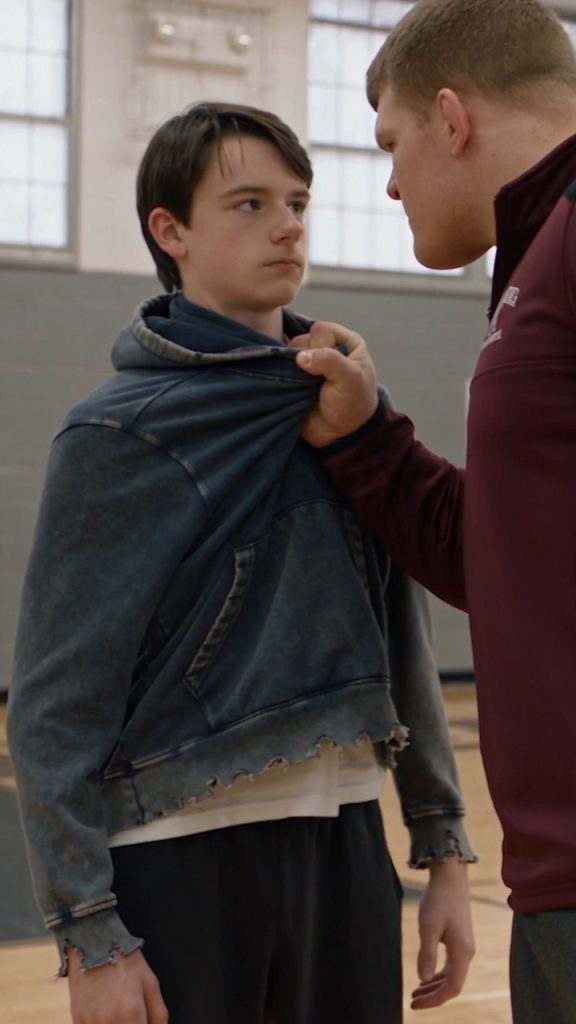
“No.” His answer was so fast it sounded painful. Then he steadied it. “I didn’t know. I don’t think some of the other guys knew, either. But he told us to make sure you stayed there until he was finished talking.”
That was more than he had managed in the gym, and I wanted badly to ask him to write it down. His fingers were tight around his sports-bag strap, though, and he kept looking toward the street.
“You should tell Ruiz that,” I said. “She can talk to you without Brody there.”
“I already talked to her a little.” His voice dropped. “Now they all know I said something. Brody isn’t supposed to contact me about it, but people talk for him.”
I didn’t ask him to name names. He wasn’t there to hand me a list of enemies. I wanted to tell him that doing the right thing would become easier once he’d done it once, but that would have been a lie. The second time could cost him more than the first.
“I won’t repeat this conversation to anyone at school,” I said, “except if someone asks me officially what I saw or heard. You get to tell your own part.”
Marcus nodded. His eyes still didn’t meet mine.
“What if I can’t say it again?” he asked. “What if I’m in a room and I freeze?”
I stood beside him for a moment, listening to a bus engine turn over. I thought about the way my body had wanted to shove Brody, and the way it had nearly forgotten how to breathe after the fight. I knew there were things you could practice and things you couldn’t guarantee.
“Tell Ruiz you need to be alone with her,” I said. “Or ask to write it down first.”
He looked at me, finally. “Do you think they’ll believe it?”
“I don’t know.”
His face fell a little, and I wished I had something more comforting to offer. But he had trusted me with an honest question, and I couldn’t repay him with a promise I had no power to keep.
That night the edited clip reached another group chat. Someone had added the words Noah attacked first above the picture, even though the picture showed nothing before Brody’s fall. I muted the thread and saved a record for the office. Brody’s allegation sat unread in my inbox for an hour before I opened it again.
The school had my timeline. Sarah had agreed to give her account. Owen might still be deciding about his phone. Marcus had already spoken in front of the whole gym, yet I had seen how afraid he was to do it again.
For a few seconds on Monday, the question had been whether I could keep myself standing. By Wednesday evening, the more frightening question was whether the one person who had named the trap would feel safe enough to repeat the truth when it mattered.
Owen gave the school his original recording on Thursday morning.
He told me before English class, though he didn’t look particularly pleased with himself. “I sent it directly to Ruiz from my phone while I was in her office,” he said. “She asked me not to delete anything and asked when I started filming. That’s it.”
“Thank you.”
“Please don’t make it a thing.”
“I won’t.”
He sat down and pulled out his book. I understood the request. In the group chat, the argument about the edited clip had become a competition: people who weren’t there claimed certainty, people who had been there said only what protected their friends, and every new comment sounded more confident than the last. Owen had spent two days imagining what it would mean if someone found out he had given the full recording to the office. He had decided to do it anyway. He didn’t need me turning him into a symbol.
At lunch, I noticed the back table had acquired a new shape. Two classmates who had once walked past it without looking were sitting there with their trays. They were talking about a chemistry quiz, not about Brody. Sarah came over for a few minutes and asked about an English assignment. I answered without wondering what Brody would think, though I caught myself glancing toward the door once.
My counselor had said earlier that morning that I was allowed to be relieved and watchful at the same time. She hadn’t tried to explain away the watching. We’d met in her office for twenty minutes, with the window shade partly raised and a clock I could see without turning my head. She asked what had changed since Monday. I said I could walk down a hallway without expecting Brody to appear, but only because adults were keeping us apart.
“And what would make it feel less temporary?” she asked.
“I guess knowing I’m not going to be punished for getting away.”
“You can ask Ruiz about the process. You don’t have to turn that worry into a prediction.”
I nodded. In truth, I had another worry I hadn’t said aloud: my scholarship. It wasn’t only tuition. It was being able to take advanced classes without my mother choosing between school and rent. It was transportation, books, the chance to compete for opportunities I’d believed existed only for families who could pay. I’d worked hard to earn the scholarship, and Brody had reduced all of that to a word meant to make me smaller.
Later I asked Ruiz whether an unresolved complaint could affect my scholarship. She said a disciplinary allegation was not itself a finding, and that financial aid was not being changed as a consequence of a pending review. She couldn’t promise how every possible future matter might be handled, but she could tell me the school had not initiated any change to my aid. I wrote that down. For once, getting an answer that stayed within its limits made me feel better than a sweeping reassurance would have.





