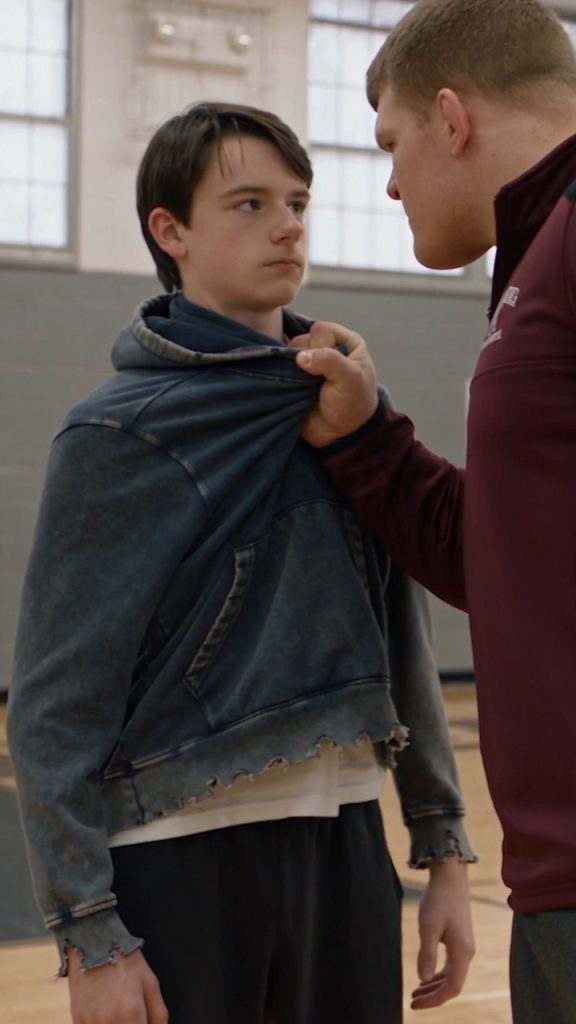
He nodded once. I went to class. It was not forgiveness, and it wasn’t a speech. It was the only request I had for him that could make the next student’s afternoon different from mine.
At lunch, the conversation at the back table turned to the edited video again. A student from chemistry, who had seen the original only through other people’s descriptions, suggested that Owen should release the full thing to everybody so Brody would be embarrassed for once.
“Then they’ll know,” he said. “You should want that.”
I considered the suggestion. Part of me did want the room from Monday to watch Brody stumble in front of the same people who had laughed at me. I wanted the chants to reverse direction. I wanted the people who’d held their phones up for entertainment to feel uncomfortable holding them again.
But I remembered Owen’s face when he told me he’d submitted the original. I remembered Sarah asking that her name stop being used as an excuse. I remembered Marcus saying he might leave wrestling. None of them had asked to become an exhibit in a schoolwide spectacle.
“The office has the full file,” I said. “I don’t want another clip going around, even if it makes me look better.”
“Easy for you to say,” someone answered. “You’re the one who put Brody down.”
“That isn’t the part I want people to remember.”
The student shrugged, unconvinced. I could live with that. I didn’t want to win the argument by showing everyone the worst second of another person’s day. I wanted the school to stop treating intimidation as something an audience could vote on.
After lunch I walked with Sarah toward our next class. She said the athletic wing had been unusually quiet. She had heard that some of the JV boys were upset with Marcus, though she couldn’t tell which stories came directly from anyone involved and which were being repeated by people looking for drama. I appreciated that she made the distinction.
“I told Ruiz that people are trying to make this about whether I like Brody,” Sarah said. “It’s not.”
“I didn’t think it was.”
“I know. I just need to keep saying it.”
We walked past a display case of sports trophies. The names etched into the plaques looked permanent, though the people who’d earned them had probably forgotten half the games by now. I wondered whether Brody had ever looked at his captain title as something that could be taken away. In the gym he had seemed to treat it as permission to decide what everybody else should do.
Sarah stopped at the stairwell. “You shouldn’t have to be the example everybody uses to talk about courage,” she said.
“Neither should Marcus.”
“No,” she agreed. “Especially not him.”
I found Marcus near the bus shelter at the end of the day. He was alone, turning his phone over and over in one hand. When he saw me, he didn’t smile. He asked if we could walk a little way along the school path, where there were people around but no teammates close enough to hear us.
We walked beside the low fence that separated the courtyard from the parking lot. The rain had stopped, leaving dark patches on the pavement.
“They talked to some of the guys again,” he said. “I can’t tell what they’re saying.”
“You probably shouldn’t try to,” I answered.
“I know.” He kicked a loose leaf with the side of his shoe. “One said I made it sound like Brody told us to hurt you. I didn’t say that.”
“That’s not what I heard you say.”
“I said he told us to get in front of the doors before Coach came over. I said he wanted us to surround you. That’s what he said. He didn’t tell me he was going to punch you.”
“Then that’s what you should say again.”
He stopped walking. “They think I betrayed the team.”
I turned to face him. “You told an adult what happened. That’s not the same thing.”
“To you.”
I couldn’t argue with the loneliness in those two words. He’d spent afternoons in a locker room where belonging had its own rules, and he’d broken one of them. I had spent years being treated as if I didn’t deserve a place at the table. We weren’t the same, but we understood something about what people would demand in exchange for letting you stay.
“You don’t have to prove anything to me,” I said.
“Maybe that’s why I can talk to you.”
He looked down at the phone in his hand. “Ruiz said I could give a written account and then answer questions without the rest of them there. I started writing it. I keep deleting the sentences because I hear Brody telling me to shut up.”
I thought about my timeline, the part I’d crossed out because I’d mistaken the phone’s angle for its recording status. “Write only what you heard. You can say what you don’t know.”
“I know you keep saying that.”
“It’s the only advice I’ve got.”
He gave a short, unhappy laugh. Then he put the phone in his pocket. “I used to think there’d be a moment where somebody asked me to choose between my friends and doing the right thing, and I’d just know what to do.”
“That’s how it works in assemblies,” I said.
“Yeah. In assemblies nobody has to sit next to the guy afterward.”
When we reached the bus shelter, he told me he’d meet Ruiz the next morning. He didn’t know whether he’d be able to finish. I told him I hoped he would, and we separated without making any promise about the outcome.
On the walk home, I took out my phone and opened the message thread where the shortened clip had first appeared. The most recent comments were less certain now. One person had written that the full version showed Brody holding my collar. Another demanded to know why I wouldn’t just post it myself if I had nothing to hide. A third said all eight JV wrestlers should be thrown off the team, no questions asked.





