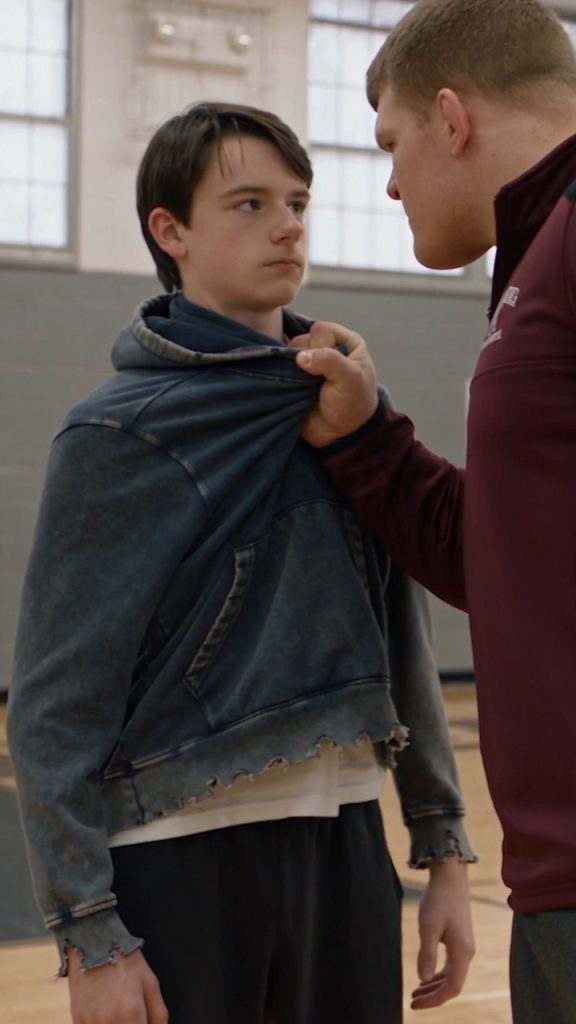
Ruiz set a blank form and a pen on the desk. “Be as precise as you can. If you’re unsure about something, say you’re unsure. We can work with that.”
I looked down at the first line, which asked where the incident began. The obvious answer was the gym, next to the east bleachers, at about 3:40 on Monday. But I thought of the nickname from middle school, the table in the cafeteria, the way Brody could arrange eight boys in front of a door and expect them not to question why.
I wrote the time and the place first. Then I paused before writing the name of the person who had touched me.
The hard part wasn’t remembering what he’d done. It was understanding how easily the version he’d told could become the version that went into a school file. And somewhere down the hall, eight boys were deciding whether the one who had spoken for them would be allowed to keep speaking.
By the time my mother arrived, the school had already made two phone calls to her. The first said there had been an altercation involving me. The second said I was physically all right. She told me later that the ten minutes between those calls were the longest ten minutes of her week.
I was waiting beside a window in the counseling office when I saw her cross the courtyard, hurrying against the November wind with her work jacket unbuttoned. My mother, Elena Ellis, never hurried without a reason. She worked at a medical supply office where people depended on her to keep track of things they hadn’t realized were important until they went missing. She was good at noticing what other people forgot.
When she opened the office door, she looked at my face, then my hands, and finally the stretched collar of my hoodie. “Are you hurt?”
“Not really.”
She held my gaze. “That’s not an answer I can use.”
I tried again. “My neck is sore where he held me. The nurse checked. I’m not dizzy, and nothing else hurts.”
She sat down beside me. For several seconds she said nothing. Then she reached for my hand, and I let her take it, even though at sixteen I usually pretended not to need that kind of thing. Her fingers were cold from outside.
“Tell me what happened,” she said.
The first time I told her, I left out the part about the chanting. I didn’t describe the phones, either. I said Brody grabbed me, that I got away, that he rushed at me twice, and that I’d used what I knew from the community center to stop him without striking him. Then I said the school was investigating because Brody claimed I’d attacked him.
Mom asked whether I’d called for an adult. I told her Coach Miller had been looking at his phone. Her eyes moved toward the open door of the office, where the counselor sat within earshot, and she lowered her voice rather than making a scene.
“So you had to decide what to do while a bigger boy was holding you?”
I nodded.
“Then I want the school to know that part before it decides anything about the end.”
Ruiz came back to explain the immediate arrangements. Brody would leave separately with his family, no student was to contact or approach another involved student about changing an account, and extra supervision would cover arrival, lunch, and the after-school gym while interviews were conducted. She asked whether I wanted a counselor appointment the next morning. I said maybe. Mom said yes, please arrange a time I could decline later if I truly didn’t need it.
“Are you suspending him?” she asked Ruiz.
“I’m not announcing a consequence before we have the facts,” Ruiz replied. “But we’re taking steps to keep the students apart today, and I’m documenting the safety concerns.”
Mom took a moment before responding. “All right. Please put those steps in writing.”
That evening we sat at our small kitchen table and looked at the incident form I’d started at school. The apartment was warm, and the kitchen window had fogged along its bottom edge. On the counter were two grocery bags I’d forgotten to bring in from her car. Normal tasks were waiting all around us, offended to have been ignored.
I began a new timeline on notebook paper. Mom didn’t tell me what to write. She read each paragraph and asked questions: Had the locker-room doors actually been locked? No, students stood across them. Had I heard Brody tell them to block the way? No, Marcus said he’d heard that instruction. Did I know who filmed the collar grab? Owen had his phone raised from the lowest row, but I hadn’t seen his entire screen. Could I say what Coach Miller had observed? Only that he’d looked up after Brody accused me.
Those questions irritated me at first. I wanted one account in which every detail was certain and everyone else simply agreed. But she was making me mark the edges of what I knew. By the time I reached the second charge, the paper had become a steadier version of my memory.
I wrote: I did not hit Brody. I did hold his wrist and elbow when he charged a second time, direct him to the floor, and release him immediately.
“You don’t have to make yourself sound harmless,” Mom said, reading over my shoulder. “You have to make yourself sound accurate.”
I showed her the places where my hands still trembled if I held them out too long. She didn’t ask why I hadn’t been brave enough to shout. She asked if I wanted dinner. I said yes, and we ate soup while she reminded me that fear could make a body tired after the danger had ended.
At 9:18 that night, the first edited video appeared on my phone.





