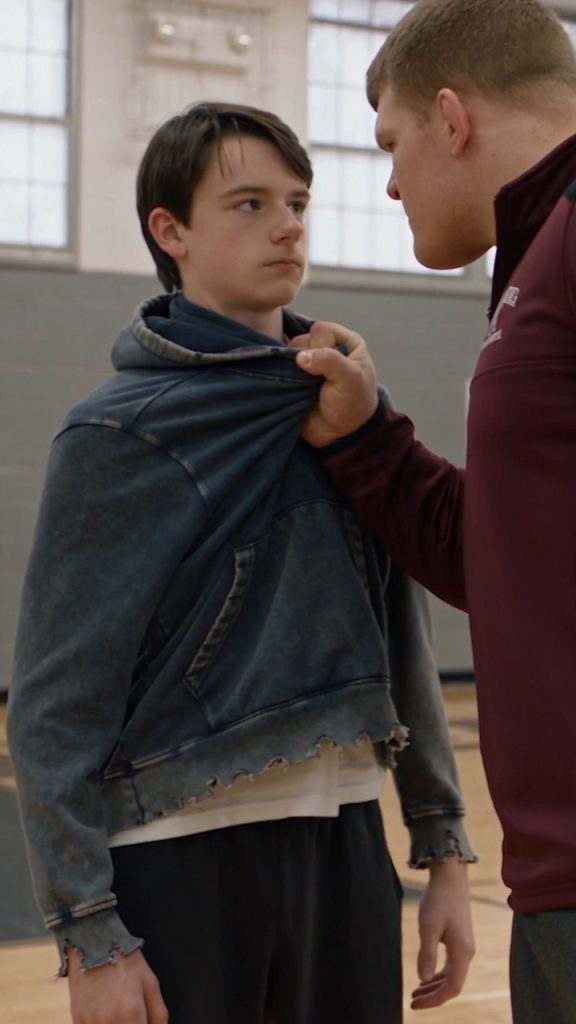
I started a reply and erased it. I understood the hunger for a clean punishment. In the first days I had wanted every boy at the doors to feel exactly as trapped as I had. But it was possible to know that they had made a wrong choice and still want adults to examine their choices individually. If I argued that the school should ignore distinctions when those distinctions didn’t favor me, what would I say if someone used the same shortcut to condemn me for holding Brody’s wrist?
I saved the thread as part of the continuing harassment record and sent Ruiz a note that the video was still being debated. I asked the school to remind students to stop circulating it; I didn’t ask anyone to seize Owen’s phone or search through classmates’ private messages. Mom had taught me to ask for what I actually needed. Today I needed the noise to stop, and I needed the review to be fair even when fairness required patience.
When I reached our apartment, the kitchen light was on. I could see my mother’s silhouette through the blinds as she put away dishes. The image was so ordinary that I stood outside for a second before unlocking the door. I wanted to bring a normal question home with me, something about dinner or the weather, and leave the gym behind on the other side. Instead I came inside and told her I’d asked the school how it would protect the exits. She said she was proud I’d asked a practical question. I didn’t know whether she meant it as praise, but it was easier to accept than being called brave.
That evening I was so tired I fell asleep over my homework. Mom woke me gently and asked me to move to the couch. I had been trying to solve the same math problem for half an hour. I complained that I couldn’t concentrate on anything that didn’t involve the gym.
“You don’t have to make the incident the most important thing that ever happened to you,” she said.
“It feels like it already is.”
“Feeling isn’t the same as deciding.”
She sat with me while I finished the problem. It took three tries. When I finally found the answer, I felt more relief than the work deserved. There were still things in my life that responded to effort in a way I could predict.
On Tuesday, the protected follow-up interviews began. Ruiz didn’t tell me when Marcus entered her office. I knew only that the adults had arranged them separately and that the school had asked students not to discuss testimony with one another. The rules were there for good reasons. They also made the day a study in waiting.
In biology, I watched rain move down the window and tried not to imagine what people were saying behind closed doors. I had given the school everything I could give it: my account, the name of a recorder whose device I didn’t own, a correction when I was wrong about one detail, and the request that students be allowed to speak without facing Brody. I could not sit in every interview and make courage happen.
After class, I saw one of the JV wrestlers leaving the administrative wing with his shoulders hunched. He glanced at me and kept going. I had no idea whether he’d told the truth, minimized his part, or simply disliked being questioned. I resisted turning his expression into evidence.
At the end of the day, Ruiz sent a brief update to my mother and me. The review was nearing completion. More statements were being compared against the existing recording and Coach Miller’s account. There would be a determination meeting later in the week, with families informed separately.
I read the message at the back table after most students had gone home. Someone had left a pencil beside an empty chair. Beyond the cafeteria windows, the sky was clearing. My phone buzzed with a message from Marcus. It was only four words: I don’t know anymore.
I stared at them until the screen dimmed.
I didn’t ask what he’d told Ruiz. I didn’t ask him to repeat his story to me or send me a copy. I wrote back: If you’re scared, tell her that. You deserve to speak without him there.
The reply never came that evening.
For the first time since Brody charged, I understood that the decisive choice might belong to somebody who had never wanted to be involved at all. I could defend myself when the danger came toward me. I could refuse to pass along a humiliating video. I could insist on accuracy. But I couldn’t step into Marcus’s interview and speak the words for him.
Whatever happened at the meeting, the school would have the full recording of the part Owen saw. It would have Sarah’s account and Coach’s limits. What it might not have was the courage, renewed under pressure, of the boy who’d admitted the trap while everybody was still watching.
On Wednesday morning, Marcus stood outside the assistant principal’s office with a single sheet of paper in his hand.
I hadn’t expected to see him. My own meeting was later, and I’d come early to talk to the counselor. There was a staff member at the end of the hall, and the office door stood open, but Marcus looked as though he were alone on a stage.
He saw me before I could turn away. For a moment neither of us spoke. Then he lifted the paper slightly.
“I wrote it down,” he said.
“Okay.”
“I didn’t write all of it the way I wanted.”
“You can explain what’s missing.”
He looked toward Ruiz’s door. “I thought I had to choose between saying what happened and saying what people expected of me. But I keep thinking about the way we stood there. I knew you couldn’t get through the doors.”





